At this point, I’m guessing you’ve mapped at least one state, and perhaps a few or more. If you still haven’t done so, make sure to dig into Volume 1: Fieldwork Mapping section, and if it helps, use the Try It! page(s) to complete mapping for at least one.
Now, before beginning to actually walk a specific feeling state through the moving process, we’ll need to set things up in a way that helps the move go smoothly. Here’s what’s most important for the setup.
Choosing a State to Move
Now, one thing to keep in mind as we go forward here is that every part of you is strongly interconnected with other parts. We’ll go deeper into the topology of that in the upcoming Science section, and that will give us the understanding we need to navigate the complexity better. For now, we’re going to keep things relatively simple.
If you’ve mapped only one state so far, just go for it and take that one through the moving process. Often, the first time through goes very smoothly, in part because you’ve never experienced it and don’t know what to expect. So any parts that are connected with this one will most likely go along for the ride.
Later, after you’ve gained some experience with moving, other parts related to the one you’re moving may have higher priorities and require being moved first. For now, if you’ve mapped more than one state, let me give you two rules of thumb for choosing which one to move.
Option One: Go for the Easy One
As you enter into practice with moving states, I recommend starting with a mapped state that is easy for you to access. Choose one that you feel very tangibly, the map for which feels clear and accurate to how you actually experience the state. Avoid states that seem ambiguous or vague.
Option Two: Go for the Most Uncomfortable One
If you have two or more states mapped, often one will feel more uncomfortable than the others. This one is likely to offer a more satisfying moving experience, so it’s a good place to start.
Option Three: Go for the Pivot
Two or more states that are related to one another often have dependency relationships. In other words, one state is a reaction to something you experience as outside of your control, while another state is a reaction to the first. If the first is not reacting, neither is the second.
Here’s an example. Let’s say I’ve mapped Anger and Shame. If I feel aShamed about having lost my temper, for example, the Shame is likely to be a secondary state reacting to the Anger, rather than a primary one. In contrast, if the Anger shows up in situations in which I have lost connection with someone important to me because of something I did about which I feel Shame, and the Shame gives rise to the Anger, then it is the Shame at the center.
I call these reactivity hubs pivots. Start with a pivot, and you’ll have much greater leverage in moving the group of states. The moving process will proceed with greater ease than if you try working from the outside in.
Entering the Felt Experience of the State
As you approach the moving process with the state you’ve chosen, it will be very important to start from a place where you are clearly and tangibly feeling the state, in the moment. If you’re having any trouble with that, take some time to read through your mapping description. Carefully place your field of awareness over the space occupied by the virtual material properties of the state, taking in the full size and shape of the feeling object.
Then, review each of the properties, revisiting your experience in the moment with an openness to noticing how your current experience may be a little bit different from what you mapped. If needed, use the slider test (see Volume 1: FM-11: Pro Tips) from time to time in order to confirm that yes, this state you are experiencing right now is the same part you originally mapped.
Choosing to Intensify Slightly Before Setting the Container
If you’re able to access it easily, and you feel it strongly and clearly, you’re good to go. If it feels a little “meh,” not so tangible, then I recommend going for a little intensification before you start. To do this, use the slider test again, but this time, deliberately shift one or two key properties that seem to have a strong effect on your experience of the feeling. Shift them in the direction that intensifies the feeling state in your experience. You always have the option of reversing the intensification, and you might just practice that if you have any concerns.
At this point in the process, you will want to intensify only to the point where you can feel the state very clearly. This will help make sure the next step in the process works well and the container can be strongly set. We’ll do that in the next chapter. Feeling the state clearly and distinctly makes it much easier to communicate with it about what is about to happen, and to set its expectations and intentions to best support the process.
Going for More Intensity to “Set the Hook” Before Actually Moving the State
Looking ahead to slightly later in the process, after setting the container, for some states it can be very helpful to use the property sliders to further intensify just a bit before starting to work through the properties. I call this “setting the hook,” as if we’re catching a fish and we want to make sure we really have it on the line.
By setting the hook and intensifying the felt experience of the state we’re moving, we activate it strongly enough to influence the physiological systems of the body. The heart pounds a bit, the stomach tightens, the breath gets more shallow — that sort of thing. This lays the groundwork for a full-body experience of the shift when we work through the properties and transform the reactivity into resourcefulness. It’s a powerful tactic, and it sets things up so your entire being experiences a profound shift that can’t be mentally explained away.
When the full body is more involved in this way, other states related to the one you’re moving will often experience a bit of a shift as well, so you’re getting a broader effect for your work.
Again, though, make sure as you begin that your intensification is fully within your capacity for agency, and that you have the ability to ratchet it both up and down, completely by your own choice. This strengthens your position as occupying a strong witness outside of the state itself, and solidifies your position as the facilitator of your own inner experience.
More…
After you have more experience with both mapping and moving, and after you’ve had a chance to begin to understand the underlying topology of how these parts connect to one another, you’ll be in a position to bring much more skill and agency to your fieldwork. Later in the book, you learn about the topology of a set in the first Science section. Then, I’ll go more deeply into some of the more advanced skills and strategies of this practice. There’s a lot to this work, and it’s quite an adventure to gain the agency and capacity to observe that enables us to more fully explore this inner terrain.
Another Example of What You Have to Look Forward To
To support your anticipation for what is to come in this adventure, I am offering before/after examples of feeling states my client Ruby gave me permission to share.
Fear
Goes hand in hand with Self-Doubt(to be shared in the next chapter).
Especially arises before starting a new class, becomes a barrier I have to get through to even start the planning process for that class. It also comes a little more subtly before any class I teach.
I’m planning two new classes coming up, in a new space, new set of people, starting in August. With that a lot of fear has been coming up, to the point I haven’t even started planning it and it’s coming up in just two weeks.
Whenever I feel any of these emotions, I get a sensation around my heart.
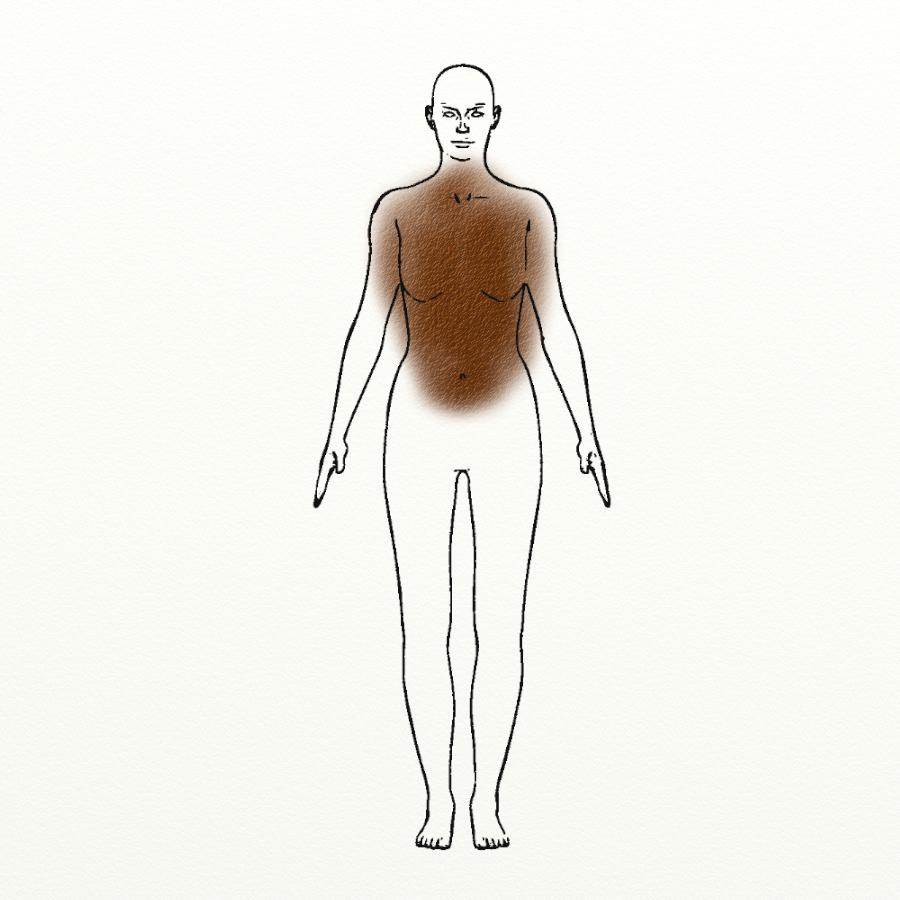
Fear is in heart center area, starts to go up into the throat. Gas, thick, heavy; seems mutable. Pretty hot. It’s almost a metallic color, but dark like when silver gets really old, silver-grayish, translucent. Both circulation and a very slow outward growing, then back in a little. It’ll go out a little, then come back in a little, increasing fear with outward movement. Kind of like a creaking sound that you’d hear in a scary movie when they go to a scene in a forest. Shape is in the throat and chest, but when it expands out, it goes out the back of the chest and I feel it throughout my rib cage and stomach area, goes a little outside my skin, just a little.
Very negative. It tells me that I’m not going to be able to succeed in these things. Something’s going to go wrong. Therefore, why even try if it’s not going to work? And... “You don’t know what you’re doing,” etc.
Support
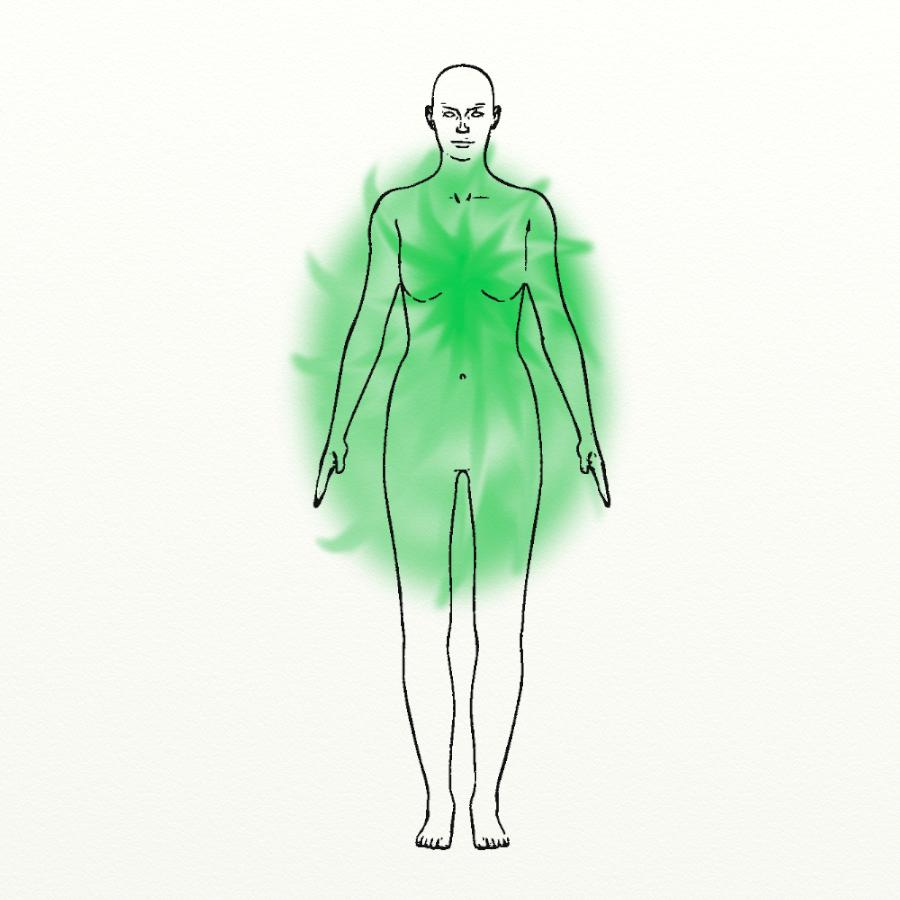
⟹ Cooler, a comfortable warm temp; lighter... it would be light; an emerald green, shimmering, translucent; still in throat and heart, but more free to expand, and when it expands it can go out of my skin a little bit. It can expand all the way down to my hips. Radiating out, particularly from the heart, and it goes all the way to a foot outside of my body; I’m picturing these rays of light radiating, but within the rays is a shimmering, wavelike movement. Sound of singing, an “aahhh” sound, a male choir.
It still wants to warn me, because that’s its job, but in a nice way.
[If nothing to be warned about?] ⟹ It would want to support me.
I keep hearing, “We are here for you.” It’s like they are my spirit guides.
New name ideas: support, guidance
New name: Support.
[What’s different?] It’s amazing; it’s like, I can truly go out in the world as myself, free of that fear of loss or failure. And I can just... there’s no restrictions as I go about my life.
I have had a hard time planning new classes because of that Fear, but if Support is there instead, not only is it easier to do it, but it’s so much more enjoyable.
I’m feeling the Support really wants to see me touch other people’s lives.
Next post/chapter in this series on fieldwork moving: