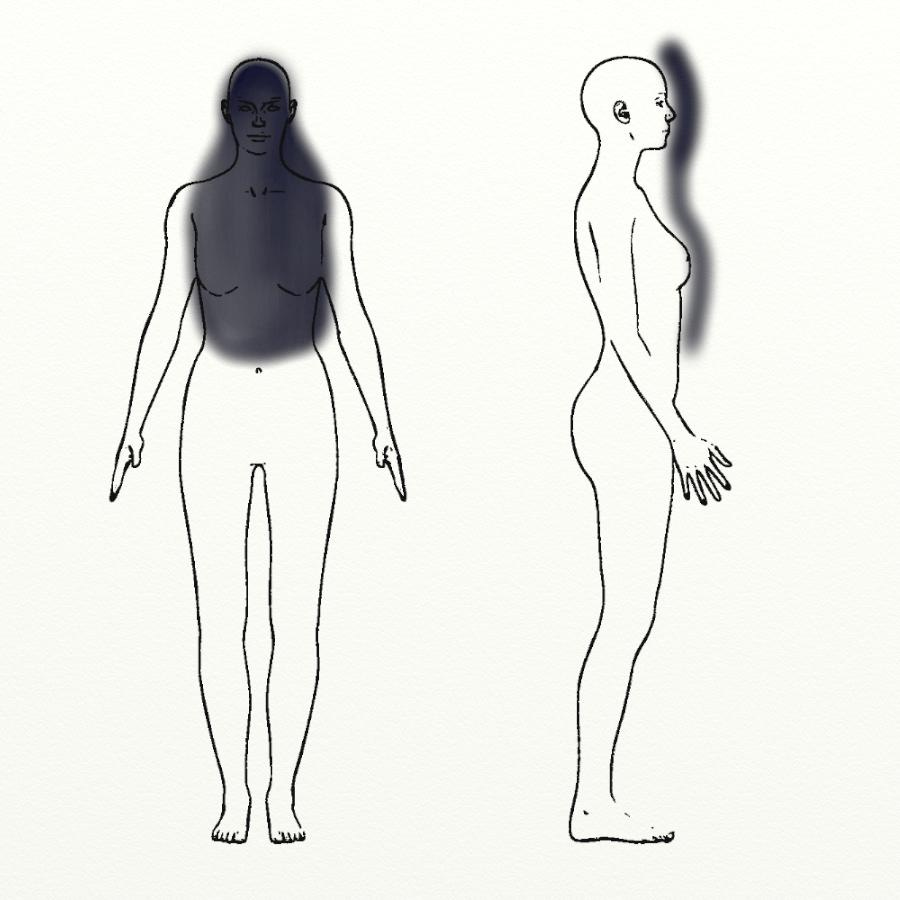
Now, from the framework of our traveling through a new territory, we are ready to pull out our compass. From the framework of initiating a new science, we are ready to interact with what is under investigation, to learn more about how it behaves. For both these purposes, we will rely on a surprising property of the specific maps we have created for each distinct feeling state.
When we worked our way through the sequence of mapping questions in Volume 1, for each parameter trying on this value or that one until we found the right fit, it felt as though we were merely applying an instrument of perception. Mapping seems like using a fancy telescope to view something far away, or passing x-rays through a body part and capturing the image on film in order to reveal the contours of the broken bone.
In mere perception, you can’t interact with your perceptual representation to directly alter what it is you are perceiving. For example, you can’t take a white pen to the x-ray film and color in the gap between the broken ends of the bone, and expect the bone to heal itself as a result.
The Bizarre Power of Direct Interaction
However, here’s where things get weird. With the type of perception we have created in our mapping, we can do exactly that. Namely, we are able to directly manipulate the virtual material properties of the mapping image we have created, simply imagining them to be different, “trying on” different values for specific properties, running the “slider” one way or the other, and the feeling state itself will transform as a result. If you take an anger that mapped as a hot, erupting liquid, for example, and simply imagine it cooling down, you will experience the anger itself “cooling down” as a result, most likely transforming from anger into something less volatile.
I can understand if this causes you to take a step back in skepticism. Nothing in our conventional understanding of feeling, mood, and emotion suggests that such a thing is possible. In my very first experiment with this method, my map was very crude, consisting only of the observation that a feeling of depression in my chest seemed to have a strong, gravitational pull downward. I reversed the direction of the gravity, imagining a strong push upward instead, and the feeling transformed instantly into a pervasive cheerfulness that shifted my mood for the rest of the day.
I was so stunned that I backed off, and did not attempt another such experiment for a couple of weeks. In the background, my mind was freaking out about what it might mean if my experience was actually what it seemed to be. At that time I was strongly invested in the methods I had been using to attempt to get control of my moods, namely self-hypnosis, journaling, reframing my thoughts and beliefs, and other approaches oriented around rewiring traumatic memories and the beliefs formed around them. I had invested hundreds if not thousands of hours in training and practice along these lines.
In contrast, in this experience I had made no effort to connect to the past, to memories, to ideas or beliefs, to any kind of thought structures or memories whatsoever. I had brought my attention, focused on the pure present moment of my experience, exclusively to this absurdly trivial and nebulous quality of the downward pull. A “downward pull” seemed irrelevant to the meaning and feeling of my depression, yet the impact of shifting it was impossible to deny.
The bizarreness had to do with a disruption of the fundamental, unconscious and unexamined assumptions I held, and we all hold, regarding our own experience of feeling. The baseline for these assumptions could be summarized like this:
Feeling is a product of a) our somatic physiology and b) our cognition including thoughts, beliefs, and interpretations of our perceptions. If we want to change how we feel, we must manipulate the underlying causes of the feeling by changing our physiology or our cognition.
This is something so close to home, so much a part of the air we breathe, the water we swim in, the ground we walk on, that we don’t ever consider questioning it. All of the science of emotion is built on these assumptions, as are most if not all of current psychotherapeutic, spiritual, and other practices.
When we encounter something that behaves in a way that goes completely against our most fundamental assumptions, the experience can be disorienting. It was for me, and it is for many people. Here is what my client Louise wrote about her experience of shifting her first feeling state:
“The experience of shifting the feeling left me stunned. It moved quickly and the feeling of relief and lightness was sweeping and overwhelming.”
Be prepared for your own experiences of “Huh?” as you begin to move your own states, and give yourself enough open time and space to integrate, especially with your first few times through.
A Brief Overview of the Process
In this Fieldwork Moving section of the book, I want to lead you step by step through your own experience of shifting a feeling state. The process I describe is the result of over three decades of incremental refinement. My intention here is simply to lead you through the experience as best I can.
Direct experience will be key to your understanding. Afterwards, we can begin to dig more deeply into how to skillfully apply the method. And we’ll be in a better position to apply our skills to more rigorously investigating what it is we are working with here, and continuing to assemble what our work reveals into our new science of subjective experience.
The fieldwork moving phase has six steps. Make sure to continue taking thorough notes as you go through the process. What comes up along the way may play a role in completing your move with this part, and it may also turn out to be helpful in working with other adjacent parts.
1. Choose a State
Every feeling state you will ever map exists in relationship with multiple other states. Each state is a unique expression of a module of your whole self, a part of you with its own function, purpose and intention. These interrelationships mean it can matter quite a lot which state goes first in the moving process.
2. Prepare the Container
Because of the tightly interwoven relationships between the state you choose to move and the others in its family, it is very important to set the space in such a way as to give the part you’re moving a maximum sense of freedom and support to follow its own inner compass.
3. Invite a Shift
In moving the state, we prioritize and support the part’s own autonomy in choosing what it prefers. One by one, we work our way through the virtual material properties, inviting the part itself to choose what feels best to it. Eventually, we reach a point of optimization, where it seems that no further property tweaks will make it feel any better.
4. Notice New Thoughts
From the new state that arises in the course of adjusting the virtual material properties, we gain access to a new perspective. In the course of moving the actual felt experience, we discover that our perceptions, thoughts and beliefs have spontaneously shifted in ways congruent with what we feel.
5. Name & Draw
After arriving and settling into the new state, it’s time to sit with its presence and find a new name for the feeling of it. At the same time, drawing the state with its new configuration of virtual material properties can further feed into the adjustment and refinement process as the visual representation brings the state even more tangibly into your felt experience.
6. Integrate What’s New
After a part has regained access to its ideal state, a phase of integration opens up. This part has recovered a more complete range of expression, and through that, a deeper sense of its identity and purpose. The emerging sense of new possibility invites you to establish new relationships with the other parts with which it is connected, and with your life as a whole.
Looking Forward
Over the coming chapters/posts, I’ll walk you through each step to help you get the best results. If you’re eager to begin, in Volume 1, the chapter FO-1, Fieldwork Quick Start takes you through a very concise presentation of both mapping and moving. Here on Substack, you can visit the Try It! page for links to that and several other posts that will lead you through the process using audio, body outline templates for drawing, and other support.
To support your anticipation for what is to come in this adventure, I will be offering before/after examples of feeling states my client Ruby gave me permission to share.
Should
A looming feeling; a shield the shape of my body in front of me, especially my face & forehead; heavy; dark. I can feel it in front of my face, and weighing down on my chest. It’s not completely solid, more like a gas, but it’s heavy and dense, and more dense in certain areas; black, kind of translucent; moving like a shadow with me as I go around, moving as one whole unit; kind of warm (uncomfortable).
“You have to practice yoga every morning and you can’t eat until you practice, because you’re not going to be a good teacher unless you practice yourself.”
Encourager
This becomes lighter in density; a little cooler, so it’s a comfortable warm; an energetic light; whitish/yellowish, translucent, iridescent, sparkling; all around me, touching me, and I can feel it in my heart too; radiating/glowing, moving out from me in all directions out from my skin, and there’s a little ball of it in my heart, radiating out a little bit too; a high, singing sound, like an angel’s voice, kind of hard to hear.
Wants to be something that is supporting or guiding me in a positive way, “I’m OK how I am, and everything’s going to be OK.”
Next post/chapter in this series on fieldwork moving: