You’ve likely encountered the preamble of the fieldwork moving process either as a very concise version in Volume 1, FO-1: Fieldwork Quick Start or as the longer script version offered in FO-2: Try It! (also in the Try It #3: Fieldwork Moving post). In preparing to deliver this again for Volume 2, I took the opportunity to step back and look at it with fresh eyes. The preamble has been so embedded in the process for so long that it has become almost automatic for me when I facilitate, just part of the water I swim in. But in looking at it more carefully, I can see that this brief little onramp to the moving process is quite significant, and it deserves a more thorough introduction.
Over the course of many years as I was developing this work in the early days, the preamble took on a three-part structure, and it has kept that structure for at least 15 years, probably more. It took shape as a way to soften the entry into the moving phase of the work, and to set things up so that the parts we’re working with have an easier time with it. Those three sections of the preamble were centered on three places that can often generate a kind of resistance or doubt around inviting any kind of change to a feeling state.
Inherent goodness: The first section took on the typical belief that a dark or negative state needed to be controlled because it was inherently bad in some way. We conceptually merge the reactivity of the state into our beliefs about the underlying motives. This first section separated that conflaction by acknowledging that the part took on this state to serve in the original context, and thanking the part for doing so.
Opportunity for positive exploration: The second section reassured the part that even though we are going to move the state, it can always be returned to its original reactive state if that’s what’s needed. Therefore, it’s safe to move it, and because it’s safe to move, it’s a good idea to really go for it, and to discover what the part could become in an ideal situation.
Recognition of related parts: The third section acknowledges the presence and invested relationships of other parts/states coexisting with the one being moved, and invites them to “participate passively, as witnesses only,” to support the moving part and absorb the learning from the shift.
But as I’ve listened to myself delivering the preamble more recently, and also in the course of simply facilitating the process of both mapping and moving, I’ve noticed those three sections of the preamble seem to be branching out and getting a little more complex. There is more that I am trying to communicate to these parts we’re getting ready to move, and I’ve decided to unpack that “more” to make my understanding, baked into my intuitive ways of working, more explicit and easier for you to learn.
As I have unpacked that complexity in writing this chapter, I have begun to realize that this preamble grew out of an intuitive reckoning with the significant gap between the deeper currents of our inner world and the surface norms by which we typically communicate with ourselves and one another. We are constantly using surface constructions of language based on our shared agreements about what is “real” in this inner world as we go about our days and share our experiences with one another. In the everyday, it’s easy enough to ignore the gap, at least when we’re with our closer friends and family.
But when we are digging into what is actually there with this kind of deep inner work, we experience this gap much more tangibly. This is the case with all kinds of inner work, not just fieldwork. And some methods do better than others in supporting the navigation of that gap by prioritizing direct experience over interpretions and concepts.
In the course of this chapter, I’ve broken this gap down and spelled it out as best I could. This serves a double purpose. First, of course, it explains why we do the preamble, and why it takes on its very specific structure. But this understanding goes beyond the preamble.
These elements unpacked here need to follow you throughout the work. They need to show up in the interactions between the explicit moving questions, in the attitude you hold toward new parts as they show up, in the overall grace and respect you offer to every part as you encounter it.
As you gain experience with fieldwork, both in working solo and in facilitating others, I suspect you will find, as I have, that these deeper structural parameters will begin to inform all of your experience far beyond fieldwork itself. This is the DNA of conscious experience, and as such, it lives with us in every moment. I hope you have good opportunities to notice this resonance and to benefit from it in your everyday life.
And. No worries, we’ll be digging far more deeply into all of this later in this book and the next. Take in what you can for now, use the preamble in its complete form when you do the work, and trust that all of this will make more and more sense over time.
Digging in…
Optimally at this point, as you get ready to move the feeling state, you (or your explorer if you’re in the facilitator role) have chosen a specific, already-mapped feeling state to work with, and you are ready and able to center this feeling state in your awareness, to bring it alive in your inner experience so that you are able to work with it. But we’re not quite ready to start the actual moving process.
Every feeling state you will ever work with has complex relationships with other coexisting states, with your life history, with the people around you, with the web of beliefs and knowledge you hold, and with the cultures (and sub-cultures) you inhabit. These relationships often impose constraints on the freedom of this state. These constraints can be thought of as rules governing what the state is free to do or be.
We want to respect these constraints. At the same time, we want to provide a free and open space within which the part underlying this state you’ve selected can explore what is possible.
The fieldwork method, along with the topology it reveals (which you will read about in the Science section), combined with my lived experience of many thousands of hours of actually doing this work, have all coalesced into a new understanding of human experience. This new understanding sits upon a very different foundation than the one we’re used to occupying.
Now, it is completely possible to do the steps of fieldwork without noticing or examining how the experience of mapping and moving feeling states contrasts with professional and societal norms to which we’re all accustomed. The practice will still get results, and you’ll still experience benefit. But at some point along the way, if you continue doing the work, you are likely to experience a mind warp, where it becomes clear that your expectations do not line up with your experience. This is the zone we’ll be unpacking here as we enter into a more thorough treatment of the moving phase of the work.
In short, what we are about to do in engaging the fieldwork moving process represents a rupture in the reality we commonly believe we inhabit. The “laws” we assume to govern our “psychology” are about to be warped rather significantly. We will address a few of these governing expectations as we begin.
To do so, we will of course rely on language, doing our best to describe the differences between what we expect and what we are actually going to experience as we go through the process. At the same time, though, we are not confined to engaging this intellectually. Not at all. We are working here with a deeper reality of being.
As we step into this new paradigm, expanding our conceptual boxes to welcome more of our direct, inner experience, the typical experience is one of reunion, of recovery, of restoration. We get to reconnect with something we have always known and felt beneath the surface of everyday awareness, but never had words to express. In its inability to speak up for itself, it was exiled from our many shared realities. In this work, especially in the moving phase of the practice, this deeper reality gets to return home to the center of your lived experience.
To support this homecoming, we want to build a gentle bridge from the old reality to the new one. In service to this bridge-making, I have designed an elegant preamble to the moving process. This preamble sets several frames — perhaps I should call them reframes — that expand what we allow to be possible. These reframes enable each state to enter a different way of being that activates its full freedom to transform itself and restore its most natural functioning. Let’s take a look at these essential reframes.
To Be Continued…
This chapter got way too long to fit into a single Substack post, so I’ve split it up. But I’m still going to offer another example of a state shift from Ruby to keep that going for you. And next week, we’ll start into the nine reframes embedded in the updated preamble.
Another Example of What You Have to Look Forward To
To support your anticipation for what is to come in this adventure, I am offering before/after examples of feeling states my client Ruby gave me permission to share.
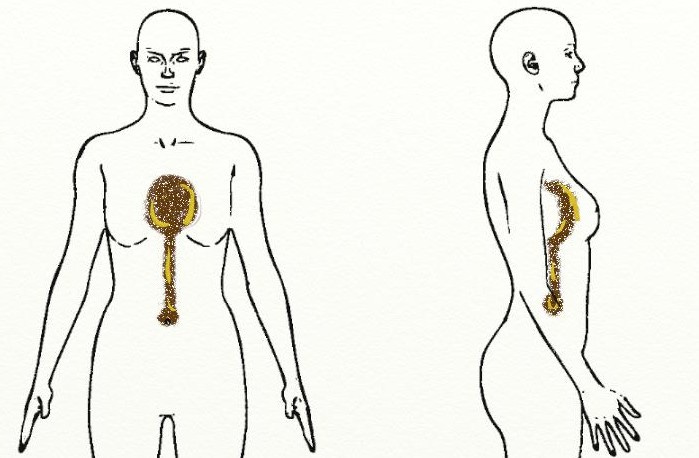
Self-Doubt
First encounter: This is about myself as a teacher - “Am I good enough?”
Six weeks later: In my heart, more like encapsulating the front of the heart, the size of the front two-thirds of a softball; feels more solid, the bottom part of it has a thick rope that goes down and connects to a smaller ball in the pit of my stomach, a thick, solid ball the size of a golf ball. Both made out of the same stuff and the rope too. The rope is a little softer, thickness is a half-inch thick. Pretty hot. The balls are pretty hard. Yellowish dark brown, opaque.
They kind of move up and down a little, away from each other and back together, pretty slowly, like the Fear (see last week’s post) is slow. Voice is like the Overwhelm (another state mapped the same day), saying all that stuff, “You’re not going to be able to do this, you’re not qualified, etc.” Also, a laughing sound, how someone would laugh if they think you’re full of crap and know you’re going to mess up, male, like one of those scary movie kind of guys.
At the core of it is very hurtful, saying, “I don’t believe in you.” It makes me want to cry when I hear that part of it.
It’s hard to believe there’s something inside of me that could be that mean or discouraging. I didn’t realize it was that bad. This is Sadness[see next week’s post]. It’s very painful.
A few days later: This is the core of the Fear. When the balls move closer together, the feeling gets more intense. This happens in coordination with the pulsing of the Fear. When the Fear intensifies by expanding, the Self-Doubt intensifies by contracting.
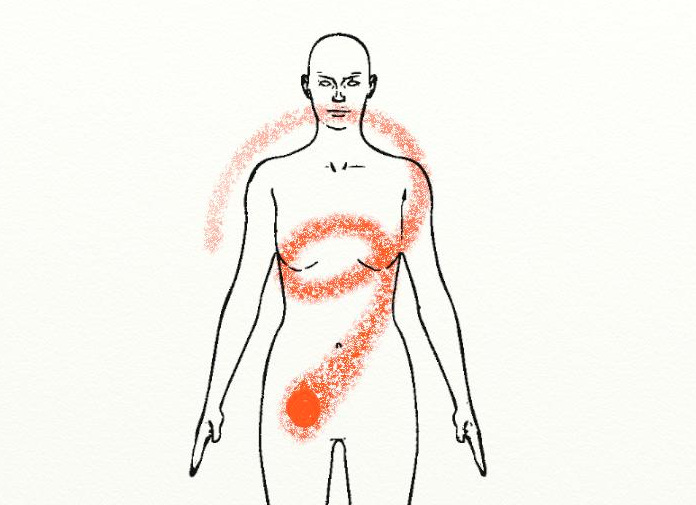
The Vibrancy Comet
⟹ Slightly cool. Softer, an energy, it would be expansive. Red-orange, translucent, luminous. It moves, circulates, but it starts in the shape of a ball, but behind it is all this luminous, glowing energy that sort of follows it, pretty much like you would think of a comet; it’s quite long. Ball is a little smaller than what’s coming from it. Ball is a higher-density energy. Ball is the size of my fist, primarily moves within my body, in a somewhat circular motion, can go out a foot from my body (because the tail is so long, it has to). The tail can grow, varies between one and five feet long. Tail is more translucent and sparkly. Sound of a really beautiful instrument, maybe a harp sound but even prettier, (an angel’s harp). Sound is in accordance with the movement.
It wants me to know it believes in me. “I want to help you. I want you to shine and be energized.” And that’s why it has that shape, so it can fly through me and give me energy.
Name ideas: The Energizer, Vibrancy, ...Comet...
New name: The Vibrancy Comet
What’s different: I’m really happy. I feel this source from within me, a source of joy. I’m very present, and live my life as though this is the only moment that matters.
Next post/chapter in this series on fieldwork moving: