In the last post, I offered a preview of what’s coming this next few weeks. The preamble has been a fixture of the fieldwork moving process for decades. Think of it as an onramp to a very different way of interacting with what’s inside. We’re accustomed to thinking about and interacting with our interior in certain ways. Deliberately shifting a feeling from one state to another through its virtual material properties kind of messes with the assumptions that support those longstanding habits.
The preamble leads you step by step through a series of reframes that open things up so the part you’re moving has greater freedom and agency as it goes through the process. And at the same time, taking a careful look at these reframes shines some light on the persistent, omnipresent gap between what we believe and say about our inner lives and what we actually experience on the inside if we pay closer attention. This gap is where the disruptive power of psychotopology points, and it is very helpful to open our eyes to it as we begin using the moving process.
Nine Reframes
The preamble contains the following nine elements, each of which sets a crucial reframe for the moving process. At the end of this chapter, I will offer a baseline script you can use, whether facilitating your own practice or that of someone else.
1. Confirm access to the feeling state and set expectations for the moving process.
The fieldwork moving process absolutely depends on directly and tangibly feeling the state as you begin working with it. You shouldn’t be moving into the moving process until you’ve revisited the mapping details for the state you’ve chosen to work with and revived the presence of this state as the focus of your awareness. This section of the framing script acknowledges that this has been done.
Of course, the main reason to establish contact with the feeling state is to be able to undergo the moving process. Just as important, though, at this stage before we begin, you need to have direct access to the state in order to set the reframe in a way that supports an easeful process. To get the setup underway, we need to verbally affirm that we are entering the moving process, and that the feeling state will change and become something different.
2. Acknowledge “this part of you” as the host for the feeling state.
The second section of the framing script is anchored in the topology revealed by fieldwork (as will be described in the Science section). This topology is modular in nature, with each module anchored by one specific feeling state in any given moment, but having access to a wide spectrum of feeling states as it serves its core function in the context of the whole self.
How we attribute “thing-ness” in our maps of reality strongly influences how we navigate. Typically in the modern way of thinking about emotion, we attribute thing-ness to either the emotion itself or to what we attribute as the cause of the emotion. We treat depression or anxiety, for example, by assuming that the nervous system pattern, or history of trauma, or whatever, is the defining “thing” that needs to be corrected or managed in some way.
Psychotopology fundamentally brings a new approach. The module is identified as the “thing” underlying all emotional expression, and the specific feeling state is one among many possible expressions of the module. The feeling state in no way defines the module.
We affirm this modularity as the underlying reality or identity and choose to use the wording “this part of you” to refer to the module that has expressed itself as the originally-mapped feeling state. As soon as we start the moving process, this module will no longer be expressing as that specific feeling state, but will be engaged in a wide-ranging exploration of a full spectrum of possible expressions. If you start by mapping “sadness,” as soon as you shift the substance toward being lighter or softer, for example, it will no longer make sense to refer to it as “sadness,” and the farther the moving process goes, the more true that becomes.
One thing I should note here is to make a distinction between parts as they are referred to in psychotopology and “parts” as they show up in various other modalities of inner work. Typically, “parts work” involves something more like sub-personalities or personas, each with a kind of job to do, a personality with which it does that job, an age at which it shows up, etc. This work tends to meet the “parts” where they are and to work with them as they show up, on their own terms, through dialogue of some kind.
The parts we work with in fieldwork are more fine-grained and fundamental. In fieldwork, it is likely that a “part” worked with in one of these other modalities would turn out to be made of multiple modules of consciousness. Taking these modules through the mapping and moving process would typically result in the original “part” being completely dissolved and replaced by something more organically integrated into the whole person. This is not to say that standard “parts work” as it exists today is not useful. But psychotopology is working at a very different level in its approach to inner experience.
Getting back to the flow of our framing script, by affirming that we are working with “this part of you,” we free the part from its attachment to either the state it has been holding or the interpretations of itself or its context that led to its choosing that state. It gets to reconnect to its original agency and wisdom as an integral, functioning, semi-autonomous participant in generating your full experience of being a thriving self in the world.
3. Affirm the part’s positive intention and persistent service.
Ultimately, every feeling state is an experiential signal about how well we’re doing in a complex, interconnected system of inner parts, outer people, physical well-being, material resources, environmental factors and more. Every part of us has a particular role to play in meeting specific needs and delivering specific capacities within that encompassing system.
Unfortunately, our modern culture often ignores or dismisses the fundamental functionality of feeling experience. Instead, it interprets feeling as peripheral to rational thought, and it handles expressions or indications of feeling as something to be managed carefully and curated appropriately. In addition, our culture also has a poor understanding of our essential needs and often ignores or suppresses these needs as a standard practice. “Big boys don’t cry” is a good (albeit simplistic) example of this.
The impact of the collision between our inherent nature and our cultural maladaptation is that most of us carry parts of ourselves that have been locked away from the normal healing and restorative power of our awareness for a very long time. In this separation, these states have become rigidified, locked into reactions from long ago.
These exiles carry the beliefs laid on them long ago. Often, the feeling expression was locked away because it was labeled as shameful, hurtful, sinful, or otherwise a marker for compromised value of some kind. We needed to hide it because of how it was interpreted by others around us, and eventually we took on these judgments ourselves as we attempted to navigate the world we shared with others.
These judgments are universally false. All of them. What psychotopology reveals unequivocally is that every single feeling state is attempting to serve the thriving of the whole. The whole includes the precise part expressing through that feeling state as well as a number of other parts in intimate relationship with it. The whole also includes many more parts of ourselves (we’ll get into this later in the Science section) that make up our entire, complex being. This whole extends further, out into our world, including those close to us, the world around us, and all of life. All of it. Every feeling state is attempting to serve the whole of life as it manifests within our individual selves and echoes throughout the universe.
We need to remind the part we’re going to work with of this truth. We need to affirm that no matter how dark or distressing the feeling state it holds, it originally took on that feeling state in order to serve you, and for no other reason. We want to acknowledge that service, to explicitly thank it for taking on this most likely very difficult job, and to let it know that we absolutely trust this essential purpose it holds. It has always been here for us, it is here for us now, and it will continue to be here for us far into the future, for as long as we exist. This we can trust, wholly and without hesitation.
4. Reassure the part that it can always return to serving in this way again, even after it transforms.
Next, we need to let this part know what’s coming. Often, it has been locked into a particular feeling state, perhaps for decades, maintaining a strong commitment to the service it originally took on before being abandoned by our generative awareness. But as we start to interact with it in the moving process, its state is going to change — swiftly, and often dramatically. We don’t want it to freak out about abandoning its post.
All we need to do here is to let this part know that, while it is true that we are going to interact with it in ways that invite it to change, it has full agency about whether and how much to engage with that process. Not only that, but it also maintains its full freedom to return to the exact state we started with, at any time after we finish doing the work.
The fact is, in moving a feeling state, the part gets to explore a far greater range of possible expression. After this exploration, the part is able to choose to express as the ideal state it discovers, or the original state we mapped, or anything in between. Stating this reassures the part that moving the state is safe. There is no risk, only gain in the form of freedom and agency.
5. Encourage the part to reach for a “perfect world” scenario.
After establishing that it is safe to move the part by transforming its feeling state, we want to invite the part to reach as far as it can to find an ideal. To do this, we introduce the idea of “a perfect world,” and we center the definition of “perfect” on the needs of this specific part and of yourself as a whole. A perfect world is one in which” “all your needs are met, fully and completely, exactly the way you want them, and you know how to keep them that way.”
The purpose of every part, expressed as a feeling state, is to meet specific needs. If those needs are well met, the part signals this satiation with pleasurable feeling states. Taking on this reframe encourages the part to reconnect with the feeling state associated with this fulfillment.
It is important to affirm that this exploration is of an ideal, a hypothetical reality that may never actually exist, but is nevertheless very useful to identify, to feel, and to establish as a touchstone for what is most important. We are taking on the “perfect world” reframe in order to give this part permission to find its own North Star, its most essential truth, its clearest resonance with its identity and purpose.
In this process, we are focused on this moment only. We are exploring the full extent of the terrain available to this part of you, not committing to any particular state in that terrain. In this moment, we are reaching for the ideal, but we are doing so only within the safe container of our perfect world hypothesis. What could this part be, what could it feel in such a world?
To Be Continued…
We’ve gotten half-way through the reframes, and it’s time to take a break. Pause for a moment (or a week), and reflect on what you’ve read so far. Some aspects of these reframes do show up, at least partially, in other places. Maybe you’ve encountered them, or even taken them on for yourself, to some extent. What do you notice when you hold all five together?
We’ll be back to finish the series next week. In the meantime, here is another sample map-and-move for your delight.
Another Example of What You Have to Look Forward To
To support your anticipation for what is to come in this adventure, I am offering before/after examples of feeling states my client Ruby gave me permission to share.
Sadness
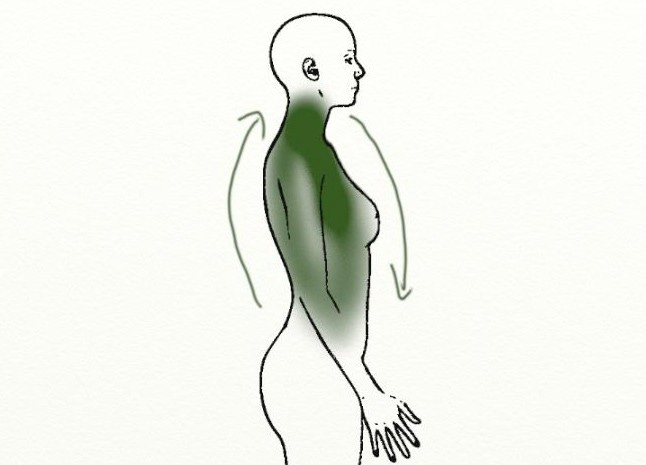
Painful realization of the Self Doubt part of me that is so mean and discouraging.
It feels like it’s within my whole torso, from the throat down into the lower abdomen. A heavy gas. Warm. Greenish black, translucent. It’s going in a slow circle, down the front and up the back. It sounds like sad music, instrumental. The whole gaseous part of it is strongest and thickest in the throat. It makes it hard to talk.
It’s asking a question: “How can there be such a self-defeating part of me?” It just doesn’t feel right.
Noticing another thing, now again it feels strong in the heart. In addition to the circulation, there is a pulsing, but it changes places where it pulses, sometimes in the heart, sometimes in the throat.
Self Trust
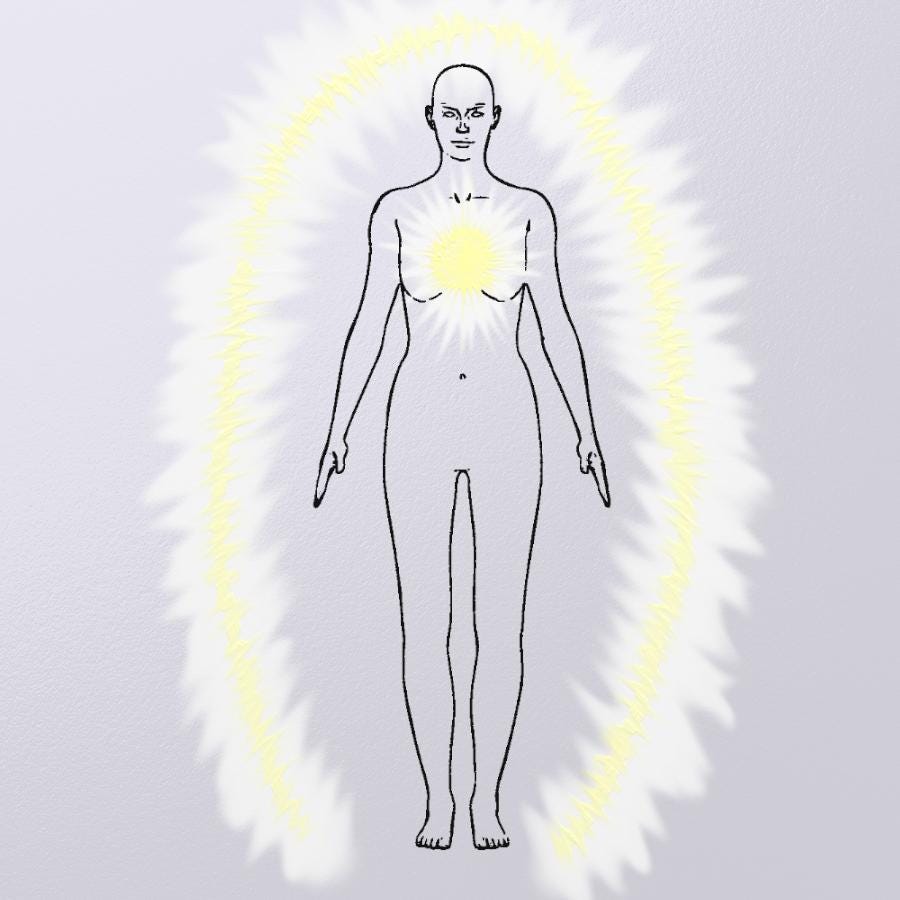
⟹ Lighter, thinner, a light; a refreshing coolness; white light, glowing; a ball at my heart radiating out, and about a foot and half away from my body it would outline my body all the way around. The outer band becomes thicker at times in response to my sadness on one hand, but on the other hand as an expression of my happiness. Would sound like a woman’s choir, singing “aahhhhh.” A floating upward, uplifting.
You are complete and whole as you are, and on the right track. Trust yourself. I love you.
Name: Self Trust.
What’s different: I’m excited about what I have to do instead of dreading it. Because I trust myself, there’s a real connection to within myself rather than a dependency on what’s outside of me. It’s huge because it actually makes everything possible. So rather than looking for solutions to health problems and all these other things outside, where they may or may not exist, I can solve those things just by connecting within myself. That’s what this gives me, the confidence that if I start within, everything else will fall into place.
Next post/chapter in this series on fieldwork moving: