We’re in the thick of it now, and I’ll avoid slowing things down with a cumbersome intro. Go ahead and dive into number 6:
6. Make a commitment to responsiveness, not arrival.
Striving to access an ideal state that would accompany existence in a perfect world touches on the next important reframe. We want to affirm very clearly that our goal is not to reach some sublime state and stay there. In fact, psychotopology makes it very clear that such state-chasing is not actually the functionality of true thriving. To thrive, we must be present with what is, whatever that is. And we must be present with our whole selves, with all the relevant parts active and responding with wisdom and vitality in the here and now. Locking our awareness onto a single part of ourselves and locking that part into a single aspirational state locks us out of a true aliveness within ourselves and in the world around us.
What this means is that you are even more free to reach toward that perfect world in seeking the ideal state for this part. You’re not going to set this ideal state as being in any way dominant in your life. Instead, you are choosing to touch into it in order to restore your access to its insight, wisdom, and capacity for thriving.
Every part of you functions best when it has access to its own ideal. You can think of it as a North Star. If you know how to locate the North Star, then if you find yourself lost, you can orient yourself to that north-ward direction, and use that orientation to help yourself navigate toward wherever it is you want to go. We triangulate to navigate. We use the felt sense of where we are in the moment, compare that to the felt sense of our North Star, and choose the third point of where it is we wish to travel, how we want to respond in ways that honor our inner truth.
Nobody who uses the stars to navigate the surface of our planet expects to arrive at an actual star. Instead, the stars provide context by which we are able to sense into what is the right direction for us in any given moment, taking into consideration other factors including the topography of our current location, weather conditions, and more. We regain this responsiveness in locating the ideal state, not an arrival at the state itself. It is important to set this reframe as we begin the moving process so you can be clear about your relationship to the powerful states you will access.
One valuable thing we gain in restoring the responsiveness that comes with regaining access to the ideal state is a much more vibrant sensitivity. When parts of us have been locked outside the boundaries of awareness, the job they are doing becomes much more difficult. They are trying to signal that some essential need is not being met, that something should change within yourself or in your world in order to restore a state of thriving. And because that signal is not being heard, it tends to intensify over time.
Unfortunately, this sets up a vicious feedback loop. The stronger the feeling state becomes, the less we are able to accommodate it, and the more intensely we commit to our strategies to keep it outside of our awareness. Which, of course, results in it intensifying further, which strengthens our defenses, round and round.
When you restore access to the state in its full spectrum of expression from reactive to ideal, and when you have experienced a confident trust that this part of you is working to serve you, no matter what state it is inhabiting as its expression, things get much, much easier. You actually notice when you start feeling some discomfort. Your attention goes to that state, and you have a reference point for what its purpose, its truth, its ideal wants to be.
And so, with little fanfare, you make a small choice. You communicate something to someone. You step away from a situation. You turn inward to connect to your own resources. You do whatever it takes to re-ground yourself, to re-nourish yourself, to respond to the situation in a way that honors your needs and moves you in a direction that serves your life. And it’s no big deal.
7. Invite the background support of related parts.
Every part of you inhabits an ecosystem of other parts. You’ll learn much more about this in the upcoming Science section. But even at this point, after mapping one or more feeling states, you may have a good sense of the fact that the part you have chosen to work with has strong relationships with other parts. You may have mapped one or more, you may have named a few others, while still others may remain in the background, unidentified at this point. Some of those relationships may take the form of enmeshment, others of conflict or separation, while others may collaborate in their pursuit of a particular task or function, perhaps that of protection or alarm, for example.
Always, parts coordinate their activity overall, even when that coordination involves direct conflict between parts. And in their coordination, many parts have a kind of investment in a particular part staying exactly the way it is. To take a simple example, a part that feels a boastful arrogance might might feel that its role is being undermined if the shame it is protecting suddenly goes away. At the same time, the shame part might feel uncomfortably exposed if the protective arrogance is shifted. It is as if the two parts are bonded in a contract, with each performing its role in order to maintain equilibrium.
Add a third part, and suddenly you have three contracts instead of one. With a fourth, the contracts double to six in number. Work your way up to the nine parts generating every full experience of being a self, and you can see that it becomes impossible to re-negotiate these contracts one by one.
All of this is rooted in the past, and this state you’re about to move is anchored in that past. But in the fieldwork moving phase, this part becomes very definitely grounded in the present moment, and it is able to reach forward into the possibilities of the future. This capacity also exists for all the other parts in relationship with this one. We want to invite this shift in focus into the present moment in order to support this part of you in exploring its full range of expression.
To support this, we directly speak to the other, related parts. We invite them to participate in this process first as passive witnesses, learning from the process what is possible for every one of them as well. Second, we invite them to be present in full support of the focal part having freedom to explore and discover its core ideal, affirming that in doing so, it will gain access to wider resourcefulness in serving the whole self, including these related parts. And we want to remind all of the related parts that this part will be free to return to its original state if that turns out at any time to be what best serves the whole.
8. Express openness to other parts’ needs.
At the same time that we want to invite other related parts to be in full support of this part’s shift, we also want to leave open the possibility that one of the other parts may indeed have more important needs that want to be addressed first. In this case, we speak more to the explorer as the one engaging this process, and let them know that if they notice another feeling state coming strongly into the foreground, they should pause and decide whether to turn attention to that part.
Rather than power through and push the intruding state aside, it can be very helpful to pause in order to investigate just what this other part needs. From there, a respectful and supportive decision can be made about how best to continue the work. Sometimes, that might look like a simple affirmation before continuing with the original part. At other times, though, it might make more sense to shift attention to the signalling part, to map it if it hasn’t been mapped yet, and to move it first before returning to this one.
9. Finally, trust this part’s inherent compass to find its own way home.
Moving a feeling state is honestly a big deal. Having access to a virtual slider by which you can shift a state in pretty much any direction, on purpose, defies expectations of all kinds. Because of this, it is common for other, related parts who experience themselves as being more or less “in charge” to step in and try to direct things.
One way this shows up is through thoughts about what a part “should” become. “Oh, that anxiety needs to just chill out and become confident instead.” Another way is through expectations. “Obviously this sad part will become full of joy.” Sometimes the thought or expectation is for a very uncomfortable state to just “disappear” or “go away.”
It is important to invite impulses such as these to step back and to serve instead as support for the part itself in its exploration. We do that by explicitly naming the fact that every part has its own inner compass, and that all we need to do in order to follow that compass is to trust the part itself. By making our virtual material property adjustments solely in directions that result in the feeling state moving toward what feels best to itself, we honor that inner compass.
In this way, we are affirming a deep trust in the wisdom of feeling. We are not acting from a conceptual or belief framework, but instead we are fully trusting that by following what feels good, we will be led to the place of the ideal. Feeling itself is the guide.
One of the best indicators that we are following this inherent wisdom faithfully is that of surprise. Very often, the part arrives at a state we could never have predicted when we started. And yet, when we arrive, it feels absolutely spot on. The right state reveals itself when we show up in full support.
As you get the hang of the fieldwork moving process, you will come very naturally to a place of pervasive trust. You will come to see every part of yourself (and others) as having something profoundly valuable to contribute, and you will trust that contribution to be revealed in its own way. Occasionally, the state the part arrives at turns out to be familiar, something you remember having access to at an earlier stage of life. But more often, you lost your access to this state long enough ago that you do not carry any active memory of it, and it seems both completely new while at the same time providing a felt sense of coming home.
One thing is clear, though. We can’t ever actually know what we truly want unless and until we are free to experience the ideal state of having everything we need. If this has never been true in the course of our life in the context of this part you’re working with, or if this state was lost a long time ago, we can be sure that whatever the perspective of the distressed, reactive feeling state we’re working with, its idea of what we need or want is bound to be mistaken. For that reason, we need to surrender fully and completely to the wisdom of feeling.
To Be Continued…
We’ve gotten through the nine reframes, and it’s time to take a break. Pause for a moment (or a week), and reflect on what you’ve read so far. Some aspects of these reframes do show up, at least partially, in other places. Maybe you’ve encountered them, or even taken them on for yourself, to some extent. What do you notice when you hold all five together?
We’ll be back with some reflections on the reframes next week. In the meantime, here is another sample map-and-move for your delight.
Another Example of What You Have to Look Forward To
To support your anticipation for what is to come in this adventure, I am offering before/after examples of feeling states my client Ruby gave me permission to share.
Dread
Feels connected to the Fear.
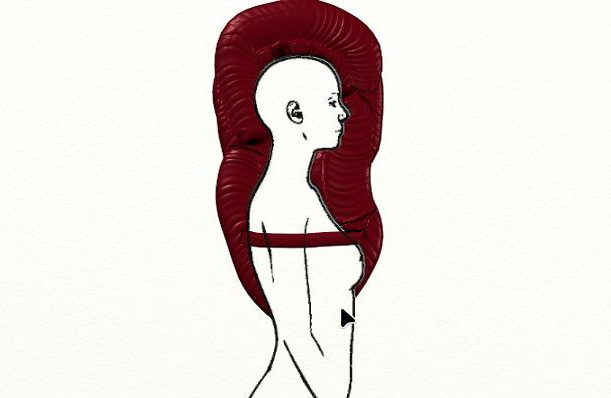
Surface of my upper back, around my shoulders, head and face, and the top part of my chest. On outside. Six inches thick. It goes all the way down to the sternum and connects through me to the back part, almost like the rope thing of Self Doubt. Like this huge helmet kind of thing. Seems to be solid, (but that seems too solid), a heavy, very thick gas. A soft solid, like paint that kind of dries up. Black, kind of shiny almost, opaque. On the hotter side. It’s a feeling of weight coming down on me, like there’s something heavy on top of me. It’s like a voice making a sound effect in a low tone, a tonal “uugggghhhhh.”
With the pressure going down, because the bar is going through me, I feel it especially in the heart area.
I’m noticing that the reason I’m dreading doing these preparations (or whatever), is that I’m afraid it’s going to be fruitless work. This part knows these things must be done, but it’s so hard. I’m not sure how to do it. The Self Doubt: Is it going to be good enough?
If this were to come to pass, disappointment (Fear), and a told-you-so tone (Self- Doubt).
Divine Flowing Breath
⟹ Cooler and lighter, softer; an energy - if you put your hand into it you could feel it tingling; warm; white, translucent, glowing; ... (feeling of a little self- doubt, “am I doing this right?” heavy, pretty lethargic, so it’s hard to get into a real positive place. This feels like the Sadness.)
(At this point, we turned attention to Sadness and moved it to Self Trust.)
⟹ Comfortable coolness; lighter and softer, a vibrating energy, tingly to the touch, like a tangible energy; light blue, translucent, iridescent.
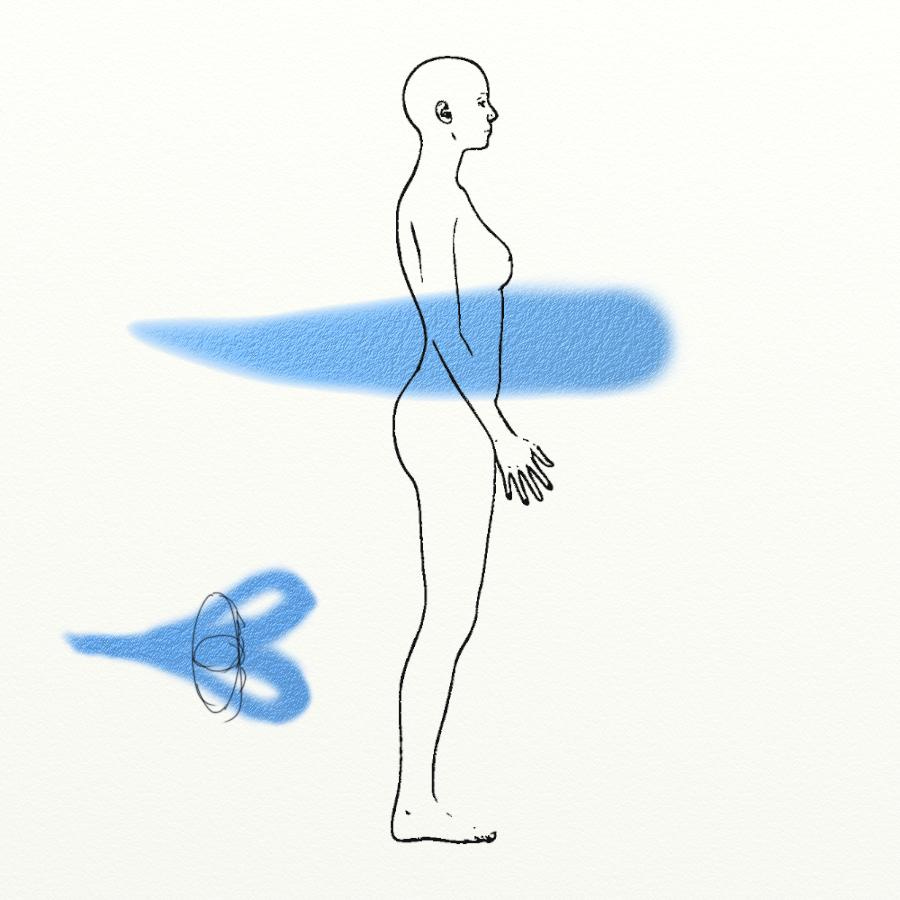
In the lower back, where the kidneys are, I feel it come out through my stomach, out in front of me, and then it goes way back behind me, starts way back behind, goes all the way forward and through; two strands: one through the right, one through the left, of the lower back, each curved into loops, and they circulate back; start close to the spine, go out in front two feet, curves out to the side, back in through my side to the starting place. The origin is three feet behind. Flowing. Sound of flowing water.
I have nothing to dread. I have everything to look forward to. I’m going to be fine. This part wants me to breathe.
Name: Flowing Breath.
What’s different: I’m filled with life, and light. It’s like I have a respect for what’s going on inside me, my feelings. But I realize that I’m the creator here. I have the power to form my life as I wish.
There’s usually a fight within me about teaching my classes how I’m “supposed” to, or really teaching them from my heart and that might mean that I’m teaching them differently than I’m supposed to. There’s still a concern there because I care about my students so much and I want my class to fulfill their needs, but with this Flowing Breath, I trust that I’m guided to teach in a way that will automatically nourish them. Those things I’ve been taught about what I’m supposed to teach are good, but it’s OK to present something different to show a different experience of yoga.
A few months later, after moving a few other states: ⟹ Warm, a little brighter and shinier, likes moving from behind and in the loops, and also circulating through the rest of my body, swells up and down to fill my body, like a mist from water.
Feels like lightness, like when you take a deep breath, “Aaahhh.” And peace. Sound of breath.
It comes from divine source, the same source that we’re all connected to. It’s not just coming from inside me, it’s coming from something greater than me.
It’s a really unlimited source of power and energy. And I feel like if I connect to it, I can bring lightness and maybe even healing to other people. It’s very much like presence as well. Connecting to Flowing Breath gives me presence, thus taking me out of my ego.
New name: Divine Flowing Breath.
The part that swells up into my body goes out more than just to my skin; it shines, turns into light and shines out. The yellow light is Encourager (see a few weeks ago).
Next post/chapter in this series on fieldwork moving: (coming)