I mentioned at the beginning how this preamble had taken a three-part structure over the years and then continued to develop in nuance in order to address the gap between our ideas about inner experience and the thing itself when we’re brought into more direct contact with it. In the next post, I’ll deliver a full, nine-part script for you, along with a repeat of the simplified form.
For now, though, let’s just take a moment to reflect on what I’ve laid out in the reframes we’ve reviewed.
The Raw Power of Awareness
This preamble carries a lot. It invites a radical shift in attitude toward our inner realities. This shift rides on the central catalyst for all human power: that of self-directed awareness that is aware of its own self-direction.
I’ve written about this before, and I will return to it again later in this book and the next. Awareness as we experience it, not only as something we inhabit but as something we have the capacity to fold in on itself in order to become aware of our own awareness, sits at the center of what has enabled the human species to step into this strange dominance we have imposed on this planet. Our misunderstanding of this power, combined with the accompanying ways we misuse it, also sits at the center of what cripples our efforts and makes us vulnerable to self-destruction.
Psychotopology fieldwork offers us a giant step forward in the agency we have available to apply — and choose how to apply — this super-power. We experience a hyper-focused form of this agency in the fieldwork moving process.
All of our cultural norms are, at their core, systems which shape the patterns of our awareness to serve the system’s goals. Here, we get to take charge of our awareness, and in doing so, we get to step out of these culturally-imposed systems and to re-align with the underlying power of life itself.
Let me acknowledge here that what I am saying about culture is hardly even scratching the surface of what there is to learn about cultural dynamics from what psychotopology reveals about the inner lives of the people out of whom culture is made. Once you really see it, you cannot un-see it. And inhabiting this altered perspective means that it becomes well-nigh impossible to earnestly participate in so much of what passes for collective activity, community, and belonging in today’s society.
I’m going to say something radical here, and I will not have a chance to back it up right away. That will take the rest of this book, and probably most of the next. Nevertheless, I feel compelled to say it here, to let you know more about where I am coming from and where you are likely to end up if you follow where fieldwork eventually leads. Continuing down this path into the fieldwork moving process definitely moves you down the path, so I want to be clear about where you are heading. This is what I see from my position of having been on this path for over three decades…
The universe experiments, constantly. Some experiments fail, and life has a way of clearing the failures away to make room for fresh starts. Our current western culture is an experiment based on a certain pattern of shaping our habits of awareness using a hyper-focus on “objectivity,” “truth,” “God’s word,” and other such conceptual principles as the basis around which to build our societal systems. The choice to pursue this form arose in response to opportunities to stabilize our relationship with the material world, and it seemed to move us toward greater thriving in its earlier days when it maintained a balance with other forms of pattern-shaping including shared myth, ritual, and other embodied access to mystery.
Today, though, our culture has hyper-focused on the objectivity side of things. In doing that, the experiment is failing by cutting us off from our own direct experience of life.
Consciousness is the ground of all being, all existence. Our capacity for self-directed awareness of that consciousness, and through that awareness the capacity to catalyze dynamic emergence toward greater thriving, represents a new threshold. This threshold opens the way to an opportunity for life to bring forward a higher-order form of itself. By locking our awareness into representational thought and downgrading our direct perception of the field dimension of consciousness, we are directing this new capacity in ways that are sabotaging its potential.
This form we have chosen is a dead-end, and we can see that the dynamics of the culture based on this form are clearly self-destructive. In this, evolution is taking care of things. We are set up for catastrophic failure and potential elimination if we stay locked into our current form. At the very least, life is working to make sure, from many directions, that there will be a collapse of some kind, and in that collapse the conditions will (possibly) be present for a re-structuring of how we are conducting this experiment.
It is up to us when we choose to engage with this. We can start now, and possibly detour around the collapse. Or we can wait until we are swept into it by forces much greater than ourselves, and hope for the best. I am choosing to approach the challenge now, and I invite you to join me.
Back to discussing the preamble as it relates to our human (potential) superpower. In the course of doing fieldwork, mapping and moving multiple feeling states, we begin to access the natural functioning I’m referring to and we become re-acquainted with the field dimension of consciousness that serves as the core medium for all existence. Through mapping and moving, we enact this natural functioning by bringing intentional awareness to the affect fields at the heart of our life patterns. In doing so, we reactivate our natural responsiveness, reconnect with our personal inner truth, and become more creative and alive in all facets of our lives. It’s a big shift, and it helps to have a bit of a preview before going there. That’s the main job of the preamble.
We’ll dig into plenty ofc examples in the course of this book and the next. For example, throughout these chapters on the moving process, I am also sharing small glimpses of one person’s work, showing the shift from the reactive to the ideal state. As you take these in, imagine for yourself what it would be like to experience these shifts. Your own shifts will be unique, but in having a glimpse into others’ experiences, you’ll be able to take on a larger context, beginning to see our shared humanity in a way that is much more hopeful than other perspectives, and much more grounded in the actual reality of conscious experience.
At the same time, I also need to acknowledge that the culture we inhabit is everywhere, and it is not easy to find ways to cultivate this new awareness in isolation. Believe me, I know this from long experience. If you are to continue down the path of doing extensive fieldwork, I strongly encourage you to invite others to join you.
More on Why This Is a Big Deal
OK. I can’t help myself here. I’ve got one more thing to share. I want to make sure you’re really getting what it is I’m talking about before we actually get into the weeds of the method. At the heart of this preamble, really, is a radical trust in the goodness of what lies within ourselves. I call it “radical” because it goes against so much of what we’re immersed in every single day.
Think about this for a second. What does it mean that every single part of us can be trusted to serve our greatest good, no matter what form it seems to have taken in the past and no matter how that form is typically interpreted according to the societal (and personal) norms we inhabit. We’re talking states like rage, hate, shame, terror, judgment, bully, manipulator, mask, sadism — all the things we love to disparage and cast aside. What does it mean that when we give the part expressing with that state the full support and freedom to choose what it wants, instead of imposing our rules and constraints upon it, it steps without hesitation into a state of utmost resourcefulness?
In our society, we have defined what is most human to be what is least trustworthy. We impose that definition through various concepts including (original) sin, nervous system dysregulation, trauma, evolutionary competition, weakness, confusion, unconscious impulses, and lots more. And we have defined what is most good by creating specific rules, laws and principles to which we are supposed to surrender our actions and words. We have placed these rules, laws and principles upon a pedestal and built our societal systems around them. And we reward those who demonstrate clearly their worshipful stance. Say the right words. Enact the right behaviors. Show the right signals. Wealth, status and power are conferred on the basis of these paradigms. And what is most human within ourselves is left to rot.
So think about it. What does it mean to take on a reframe that says you can actually trust this part of yourself to know what’s best for itself, and you can trust that what’s best for it is what’s best for your whole self, and you can trust what’s best for your whole self to be what’s best for your entire human ecosystem? What does that mean that you do not have to turn to logic? No rationality. No external rules. No imposed principles. No “universal” values. No agreements or contracts. No supreme desired states. No leader, no text, no savior, no external force of good and right. None of these things. The greatest force for beauty, belonging, and thriving lies inherently within every single part of you, and within every single part of every single person.
And yes, I can see that you might perceive that I am creating another principle to impose with this statement of trust. This one is a little different, though. It’s a principle that says, check your ideas at the door, get the heck out of the way, and trust the inherent force of life within you. What shows up will take on different shapes in different people, different relationships, different contexts. It will probably surprise you. The job of your rationality, then, is to make sense of what shows up, for you, in the context of your life, in a way different from how someone else might make sense of something similar in their life. And the “something similar” is important, because what shows up in you will be absolutely unique and irreproducible within anyone else.
This is a principle that says, essentially, that our rationality-and-rules impulses need to be placed in service to the pure experience of life instead of imposed upon and controlling it. It is a principle about the optimal position for all principles in the context of human life: the position of support for emergence, for creativity, for connection, for aliveness, for thriving.
Enough said. I’m pretty sure we’ll be getting further into this later in the book, and even more so in Volume 3.
What’s Next…
This wraps up my presentation of the nine reframes, and some thoughts arising from taking a step back from these reframes to consider where they come from and what they mean. As I mentioned at the beginning of this section, I was not anticipating that what I had to share would grow so wildly into something so extensive. In that, I suspect that this section may turn out to fit best in its own section rather than shoehorning it into these chapters on how to do fieldwork moving.
I’m curious to hear your thoughts and feedback. And that goes all the way from nit-picking critique of the writing flow and clarity to more broad assessments of whether this is just too confusing and might need to wait until after I’ve developed more of the science and topology of things. In this moment, I chose to act on what was showing up as I approached presenting the preamble and to trust that it will find a home even if here is not the place. I welcome whatever you can offer.
And now, to wrap up this sub-chapter before ending next week with the preamble script itself, here is your weekly example…
Another Example of What You Have to Look Forward To
To support your anticipation for what is to come in this adventure, I am offering before/after examples of feeling states my client Ruby gave me permission to share.
Untrusted Self
The bands of Guilt/Shame are containing me, and who I really am, my capabilities.
This is the part of me that is basically so bad that I can’t trust it. It feels similar to other things, like the Little Self, and the Heart and Sadness.
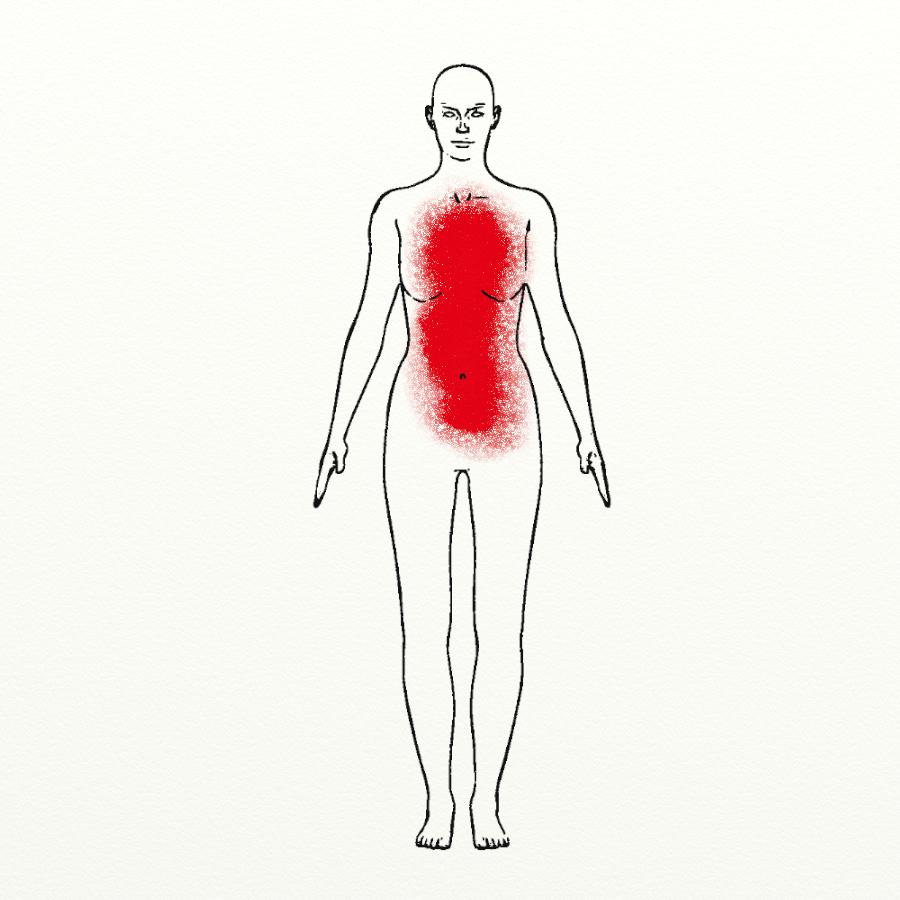
In my heart, and in my stomach, pretty big; a light but thick energy; warm; red, translucent; moving, trying to press against the bands and get out, shrinks and expands too, as the bands get tighter or looser. Kind of yelling, like there’s danger, no words, just “aaaahhh!” My voice.
Feels like it’s a part of me that wants so bad to fulfill its potential, it’s a part that has felt restricted for a long time. “Give me a chance. Trust me, I won’t let you down.”
Feels like it has qualities of when I was a child. When that part of me that is slow or makes mistakes got called out on its incapabilities. It’s the part that learned from watching my parents, and thought that’s how you’re supposed to be.
Name: Wanting to be trusted; Untrusted; Untrusted Self.
Red: Upset that it’s not being trusted.
Inner Source
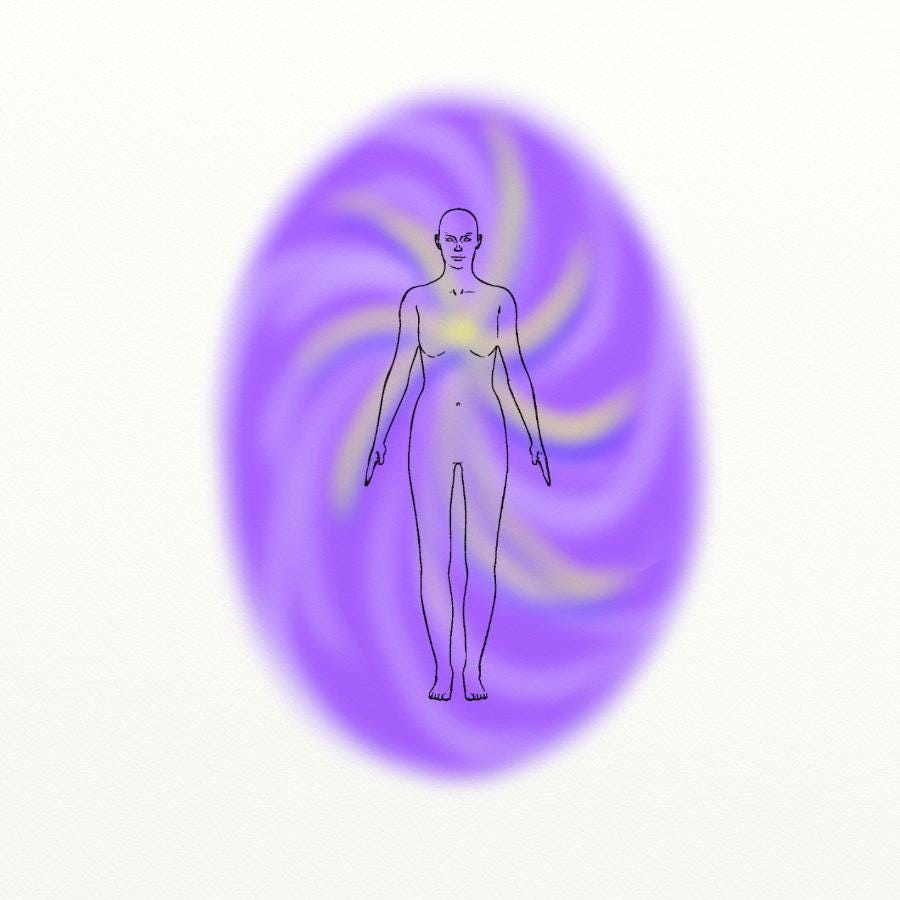
⟹ It would relax; a little thinner, an energetic light; warm; violet, a blue-purple, translucent, luminous; in my heart, shining out around, a few feet outside of my body. Doesn’t have any sound, more like a smiling.
It’s happy that it’s free now. It gets to express joy. It gets to guide me. “I know it’s hard for you to trust me. But it’s OK. Things will actually turn out much better this way. Turn to me before you turn to anyone else.”
Name: something about a source of light... solutions, or a place where I make my choices. Inner Source.
Interesting: seems like there’s a container around the source, and I have to go to it. It wants to shine out, but maybe I’m already not trusting it again.
My question to Ruby: “What is keeping you from trusting yourself?” This led to identifying and mapping a state called Critical Self and moving it to Accepting Self. (See the next chapter for these.)
Having Accepting Self available, would be a little brighter, a little more luminous. With beautiful music coming from a smiling cello.
Everything you need is right here. By starting here, within you, all else will be provided for and fall into place.
Next post/chapter in this series on fieldwork moving: (coming)