Before we wrap things up in this section on the basic method for moving states, I’d like to offer a few strategies to support a more powerful experience. None of them are essential in every case, but in lots of situations they can add strength to the entire process.
As You Begin: Setting the Hook
As I hope you are beginning to understand, we are working with something very different from somatic sensation. These virtual material properties we are observing and changing in order to transform the feeling experience of a distinct part of ourselves occupy a dimension that is distinctly not physical. At the same time, though, we very definitely do inhabit a physical body, complete with its own very powerful sensations that do accompany emotional activation of all kinds. It serves us well to get these two domains talking to one another.
Our strongest feeling states do activate our somatic emotional systems. The feeling system we are mapping serves as the primary medium of conscious engagement with ourselves and our world, optimally providing clear, fine-tuned readings on our reality that enable us to respond in ways that support our thriving. Some realities require the body to be primed for action, and out of that priming comes effective fight / flight / freeze / fawn (or other naming systems) responses.
The strongest experience of moving a feeling state from its original reactivity to a new ideal resourcesfulness will be accompanied by a strong somatic shift happening in parallel. Having such a somatic shift provides a strong sense of validation and confirmation that what we have done is “real” and significant all the way up and down our levels of existence from pure physicality to pure consciousness. With such validation, we believe in the shift and our perceptions, thoughts and orientation shift to support its persistence.
To establish this strong entrainment and feeling/emotion synergy, I have found the best technique to be a kind of “setting the hook.” Before entering into the actual moving questions, I will first run a quick survey of virtual material parameters with the explorer to identify which ones have the biggest effect on the actual felt experience. I’ll start with the obvious ones, whichever ones are most extreme in their qualities, and I’ll ask the explorer to experiment with making small changes in both directions for that parameter. For example, if the temperature is hot, I’ll ask about the effect of making the image hotter or cooler. If a small adjustment results in a strong shift in the felt experience, providing great relief or higher intensity depending on the direction of movement, I’ll note that, and move on to test another parameter.
In this way, I’ll identify at least one, and possibly two or three parameters which are “drivers” for the feeling experience. Then I’ll share with the explorer the importance of feeling the state strongly for the process to work best, for her to get the clearest feedback about the direction to move. And I’ll ask her to crank up the intensity, specifically asking her to make the changes in each of the parameters we’ve identified.
I’m looking for a real experience of discomfort here. When I’m doing this, I generally also hold a sense of lightness and humor about it. I’m maintaining a rapport with her higher or witness self, working with her to facilitate changes that she wants. And we never tarry in the discomfort; just crank up the volume and get on with it. Usually, the explorer will only have to experience the extra discomfort for a few seconds.
This is a great technique for a couple more reasons. First, it demonstrates to the explorer that she is actually in control of the intensity of her discomfort. If she can deliberately intensify the feeling, she knows implicitly that it’s also within her control to decrease the intensity. Second, it augments the explorer’s motivation to follow all the way through with the move. We are all naturally wired to move away from discomfort, and when you intensify the discomfort, you elevate the force driving the part from its distressed state to its ideal state.
Generally, I’ll only do this if it seems useful. Often the explorer is already experiencing the feeling state with a sufficient intensity, and I’ll just go with it. But with someone who is in general reporting a low intensity of feeling as they go through the experience, I’ll use this with almost every part we move. This can be very important for those currently taking medication for mental health reasons since the meds in many cases are blunting the somatic response to emotion.
Adapting the Question Sequence
In general, you’ll do well with the standard sequence of questions as I’ve offered them. Starting with temperature is useful because it’s such a linear property, easy to slide in one direction or the other. However, if you have reason to believe that one of the other properties is a strong driver for a feeling state, it’s ok to start with that one. For example, if you’ve used a particular property to “set the hook,” as I’ve described above, it’ll be best to start with that property in the question sequence.
Even if you haven’t used the setting-the-hook tactic, though, it’s OK to consider adjusting the sequence. If the substance is extremely heavy, for example, or the color oppressively dark, go ahead and start with that, beginning with incremental changes to the weight or darkness. Then you can either continue to complete the full movement of that property, or shift from that small adjustment of weight or darkness back to temperature and go through the standard sequence.
Overall, it doesn’t ultimately matter in what order you ask the questions. In fact, make sure that as you’re wrapping up, you go back to check in on the properties you shifted in the earlier questions to see if they want to make further adjustments. The goal is to give each property an opportunity fully optimize itself, and through doing that for all the various properties, for the part to arrive at a final, ideal state.
When a State Shifts Too Quickly
Most of the time, you will experience an unbroken continuity between the reactive and ideal states. But every once in a while, a feeling state will virtually leap into its new, ideal state, with very little in the way of transitional states in between. You’ll start with temperature, for example, and immediately all the other properties have transformed as well.
When this happens, it’s a good idea to reverse directions and shift the state back to its original reactive qualities. This might sound strange when you’ve just moved something like Excruciating Despair or Apocalyptic Terror. But especially when you have moved something highly intolerable, I recommend that you reverse directions, moving your ideal state back into the reactive state. Then take the state through the full sequence of virtual material properties and shift one at a time, making sure this part of you stays engaged throughout the entire process from beginning to end.
There are a couple of reasons for this. First, it is possible to simply jump tracks, shifting your field of awareness quickly from the first, challenging state to a more pleasant state belonging to a different part of you. If this happens, the first state you worked with hasn’t moved. You’ve just shifted your awareness away from it. It’s still there, and it will still continue to work its power in your life from behind the curtain. (This is the sort of thing that happens with various forms of spiritual bypassing and other strategies people use to deal with intolerable inner states.) So you want to make sure you are actually transforming the state, and that the part expressing itself through the reactive state does get to experience a reunion with its ideal.
The second reason for doing this is to serve your overall process. We tend to hold intolerable states at arm’s length or farther, and avoid them whenever possible. That makes sense when we don’t have effective ways to actually engage the part and restore its resourcefulness. We’re just doing the best we can.
Instead, when we deliberately shift a state back into its painful dark space, we are saying to this part of you, “I’m not afraid of you. I trust that you have something valuable to offer me. I want to welcome you and your gifts into my life.” So this can be a good habit to get into in general. Move the state to its ideal, then put it back. Let it sit there for a moment, knowing you have access, now, to the ideal state. And then shift it back to its ideal. You might even do this a couple of times.
This does two things. First, it reassures all the rest of the parts of you that it’s OK to feel this state. Being reassured that it’s OK to feel it means that you will be open to its more subtle signals later on. You will lose the need to suppress your awareness of it, and so it will be able to do its job more easily. Not only that, you will be rehearsing for the future, when you might feel a lesser version of this state.
Doing this makes it easier to maintain an orientation and access to the ideal state. This part of you becomes familiar with its full spectrum of expression, so anywhere on the spectrum is familiar. That enables the ideal state to function as kind of a “north star” for this part of you, so no matter what state this part is expressing, you haven’t lost the important context of what is most important to you.
To Be Continued…
In the next post, we’ll take a look at some ways that states can seem to resist the moving process, what that means, and how to work with it.
Another Example of What You Have to Look Forward To
To support your anticipation for what is to come in this adventure, I am offering before/after examples of feeling states my client Ruby gave me permission to share.
The Little Self’s Heart
Those patterns require so much attention that it’s difficult to put attention into the Observer. What’s there instead is this Little Self.
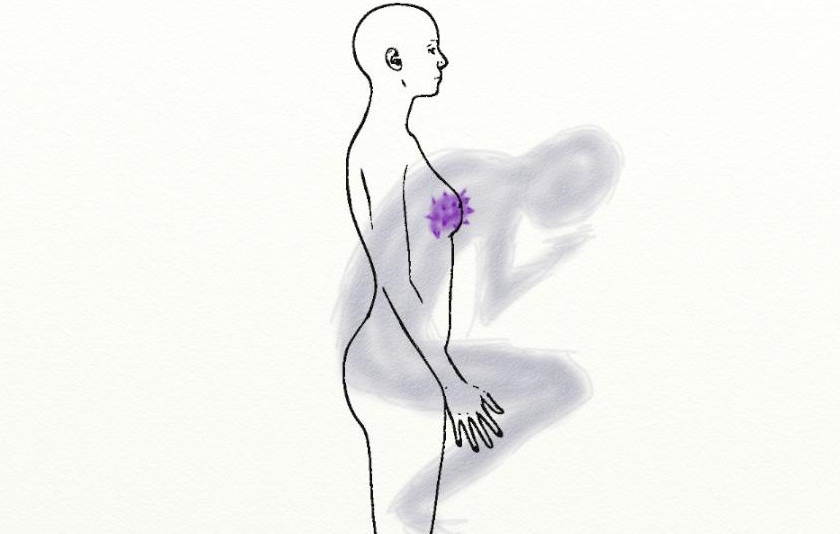
Something in my heart, a heaviness; between a gas and an energy, heavy, medium thickness; warm; kind of a dark purple; just a few inches, round; swirling around inside, in loops; a static-y sound.
I’m not being allowed to be at my full potential right now. But I’m still here!
... not allowed by what? The reactive states are too intense to let The Little Self be the Observer.
[World?] Unfriendly, full of critics and bad vibes. [Mapped Unfriendly World.]
[Mapped The Little Self.]
Seems like there are spikes around it, a little more solid, made of the same purple stuff, just more condensed.
Radiant Self’s Heart
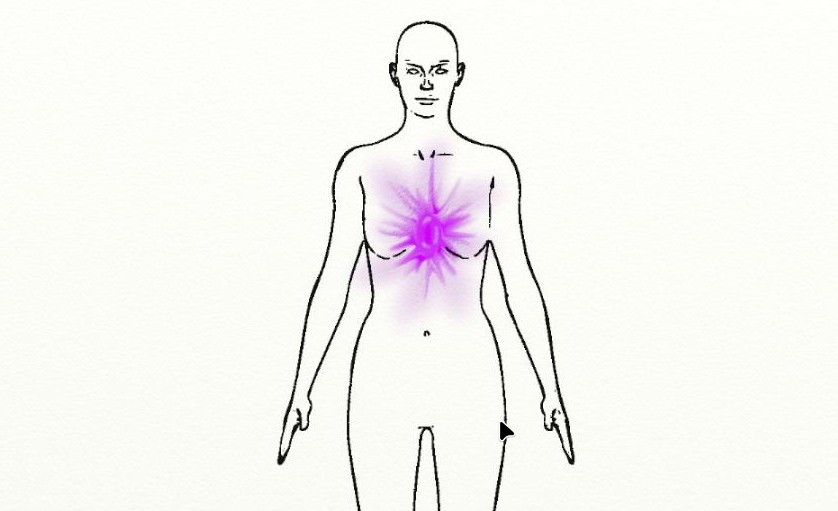
⟹ a little warmer, a soothing warm temp; lighter, a little denser; an energy, light, thin; fuchsia red, translucent, sparkling; in the center of my chest, a little bigger than my fist, an oblong, circle shape, so the outline of the shape could be seen, but the light coming out would be radiating almost to the outline of my body; a shimmery movement; focused in a circle around the heart area; sound of an ocean.
I am at my full potential right now. Therefore all is well.
Next post/chapter in this series on fieldwork moving:
This is great! I love the idea of actually shifting it back to the reactive state on purpose, to show that all states are welcomed in awareness. That feels really important to me in my own work.




This is great! I love the idea of actually shifting it back to the reactive state on purpose, to show that all states are welcomed in awareness. That feels really important to me in my own work.