Occasionally, you will come across a feeling state that seems like it doesn’t actually want to move. In fact, sometimes the feeling will seem to want to intensify in its discomfort even further. No worries. There’s usually a good reason for that, and it’s fairly straightforward to adjust your process to respond to the unexpected.
When a Part Seems to Resist Moving
It is usually the case in situations like this that another part is involved which has a stake in this feeling state remaining just the way it is. Usually this other part will be making itself known — you will be feeling the other feeling state as well. You can find this out by simply asking, “What else are you feeling?”
It will be important for you to identify this other part and address it respectfully. Give it a name if it doesn’t already have a place in your list of states. Ask if it would be willing to stand aside just for now, and observe the process. Reassure this part that the feeling you’re working with can always return to its current state if that’s what’s best. And make a commitment to bring your attention fully to this new state and work with it at a later time.
If you get a yes, proceed. If not, shift your attention to the resistant feeling state, map it first if you haven’t done that yet, and them move that one first.
Another counter-intuitive strategy you can use when you encounter a feeling state which actually seems to want to intensify is to go with it. Support the feeling state in ratcheting up the intensity as far as it wants to, and then encourage it to go even further. Many times, this traveling into the eye of the storm has the effect of turning the feeling state inside out. It goes into the intensity and all the way through it to a positive state. In a way, you’re giving it what it wants, and in getting that, it has an opportunity to discover its larger intention.
Once you’ve done that, you’ll find it most helpful to re-do the move. Go back to the original configuration of properties, connect strongly to the state, and go through the moving process in a more straightforward way, adjusting each property step by step. In this way, you will give this part a more complete familiarity with its full spectrum of expression and make it easier for the part to settle into having access to its ideal without risking getting swept into a strong reactivity again.
Occasionally, you’ll need a strategy for what to do if you get stuck in the more intense state. There are two things you can do. First is to simply invite the state to ratchet the intensity back down. This deliberate intensification and diminishment of a feeling state actually can give more of a sense of personal control over the feeling state. This is especially true when there is fear about feeling it. Going deliberately into the intensity demonstrates that the explorer is actually able to survive and even thrive through the journey. And it provides a sense of personal choice, power, and self-efficacy. If I can choose to deliberately intensify a feeling state, I can certainly choose the opposite.
One tactic that can make it easier to do this kind of intensification more securely is to make sure to establish a strong witness position before you work with this kind of state. I’ve discussed this in Volume 1, FM-10: Cultivating a Witness Awareness. We’ll talk about it more here in Volume 2 in the Science section.
Note that this tactic of deliberately ratcheting intensity up and down is only for the purpose of giving this part of you the opportunity to safely experience its full range of motion. You can use this tactic in a pinch when you need to calm an intense feeling in a social situation, for example, but you don’t want to rely on it habitually. Every part will serve you best when it is free to move on its own, to express the state most appropriate for the conditions of your life in the moment.
One more strategy that is useful for feeling states that seem to be resisting movement is what I call the North Star technique. I covered this in the Volume 1, FM12: The Being-With and North Star Practices chapter, and I will touch on it again in this volume’s section on more advanced skills.
To remind you, it’s very simple:
Ask the part, “What do you want?”
When you get a clear answer, continue with the question, “If you had that, what do you want that’s even more important?”
Use the second question recursively until you get a felt shift, then map the state which emerges.
Get familiar with this strategy and give yourself plenty of practice so you can do it easily. You’ll want to keep it in your back pocket, ready to apply when you need it. Believe me, it comes in handy.
When a Part Seems to Want to Just Disappear
Sometimes a feeling state seems to want to just “go away” or “disappear.” This usually happens with a distressing feeling state in the body, where some other part just wants to be free of it once and for all. It can take various forms including, “I just want this to go away,” or, “It just dissolves and disappears.”
In situations like this, support the explorer in making that transformation, and then invite her to follow the feeling substance, whatever that is. Use a statement like, “Great, now let’s just follow that and see where it wants to go,” or “…go away, to where?” Mention that every part ultimately has a positive intention and that parts exist for life – they don’t disappear but only go outside of awareness. Explain that you want to follow this feeling state and give it an opportunity to return to the area in or around the body to contribute its positive intention for the explorer’s highest good.
Once the explorer has connected with the feeling state in its banished location, wherever that is, acknowledge the part for wanting to relieve the distress, and gently, steadily say something like the following:
“Now that this feeling is away from your body, I want to invite this part of you to consider how it might come back into the space in or around your body in such a way as to offer its greatest gift and contribute to your well-being. In exploring what is possible in a perfect world, where all your needs are met, exactly the way you want them, if this part of you were free to become warmer or cooler, what would it prefer…”
Continue the standard moving sequence, paying special attention to the questions regarding location and movement. Most of the time, this takes care of things. If it doesn’t, there is likely to be another part playing a role. Ask,
“What else do you notice about your experience? What else are you feeling?”
Move on to another feeling state to map and move, and come back to this one at a later time. When you do return to it, begin with the original map of the feeling state as it started out. Go from there.
Wrapping Up: Working with Multiple Feeling States
As I hope is clear by now, no feeling stands alone. When you are mapping one feeling state you will often encounter different other states tightly linked to it. And when you move one or more feelings to their ideal states, sometimes these other feelings will practically clamor for attention.
There are two reasons for this. First, the reactive configuration is often long-standing, (sometimes decades), and rigidly fixed in place. It is usually constructed in such a way as to prevent awareness of a central, intolerable state of suffering. When you start peeling off these defenses, other defenses are likely to start working harder, and the pivot feeling at the center may begin to make an appearance.
The second reason is the obverse of intensified defenses. When various parts which have been locked in positions of compensation and avoidance discover that is no longer necessary, they seem to be eager to break into awareness and participate in the process. They want to be mapped and moved!
The best response to both of these is to welcome the new feelings to the party and assure them, either directly or indirectly, that these breakthroughs are possible for every part. When the facilitator maintains a tone of eager curiosity and a trust that every feeling has an ultimately positive, resourceful purpose, there arises an atmosphere of trust that can reassure and motivate the explorer.
It’s like you’re saying, “Feeling what you’re feeling is OK. It’s better than OK. Every uncomfortable feeling is an opportunity to go further into the authentic truth of who you are. Let’s go!”
Coming Back After Moving Other Parts
As you will experience over and over again in doing fieldwork, these parts of us are very, very intimately intertwined. Every one has a strong relationship with its neighbors. And so, even with a solid preamble invitation, and even with the best support for a part to find its way home, very often a part will head in the right direction but stop short.
There are good reasons for this.
Many parts are so uncomfortable when we first map them that almost any movement feels great. And heck, great can often be good enough, at least for now.
Other parts have investments in this part staying just the way it has been. So moving it brings up a bit of resistance from these others.
Any given part may never have experienced itself in its ideal state, and so finding its way “home” feels like entering an entirely new universe.
Because of the interconnected functionality of our parts, often times a part really needs its companion parts to be in their ideal states before it is able to find its way home to its own ideal.
Because of this, a really good habit when moving multiple parts is to revisit those moved early in your work. Invite them to make a few refinements and you just may find they have a lot farther to go. We’ll get more deeply into this after we have a chance to establish the full topology of how these parts interrelate.
Looking Ahead
In the next chapter, we’ll take a step back to look at some important perspectives to support our work before wrapping up this section on the moving methodology.
Another Example of What You Have to Look Forward To
To support your anticipation for what is to come in this adventure, I am offering before/after examples of feeling states my client Ruby gave me permission to share.
Unfriendly World
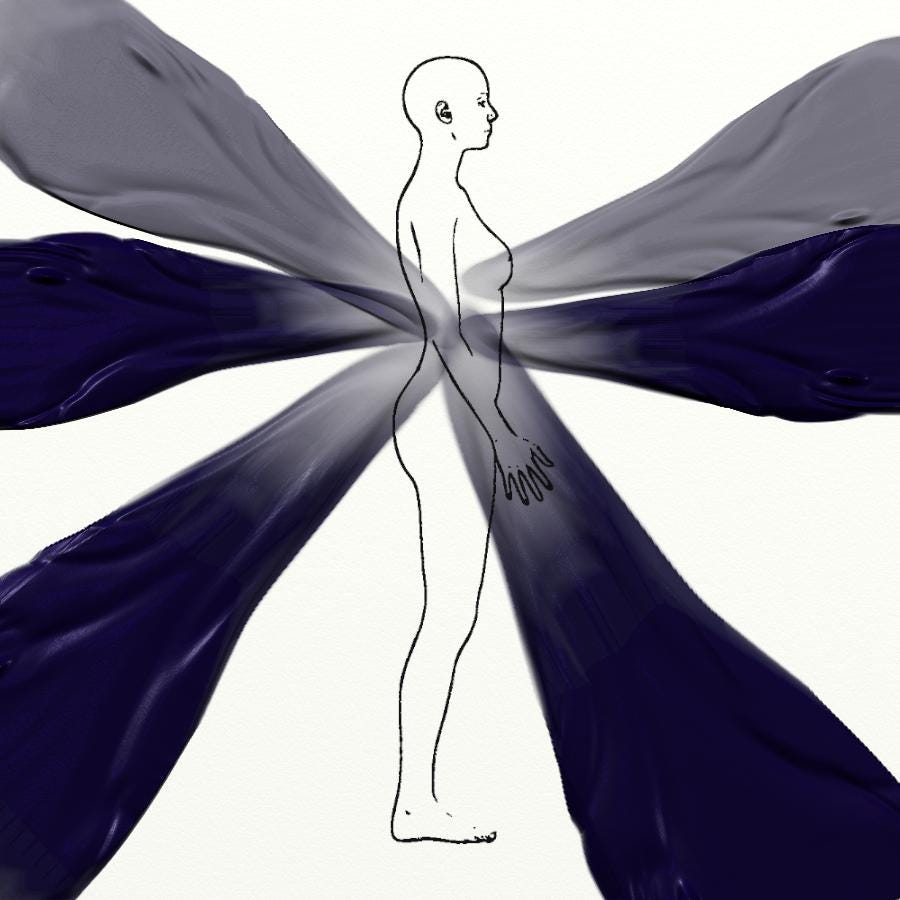
When I am in The Little Self, the world is unfriendly, full of critics and bad vibes. I just have to remember my time in Japan. That was my everyday experience because I felt just such a negative energy around me.
This could come up when I’m dealing with someone who doesn’t like me. Especially I can remember this from when I was a kid.
Seems like these rays of dark energy coming in towards me from all around me. Usually this feeling comes up because of a person or people. Whenever I feel put on the spot, or feel people are judging me, it could feel like the rays are coming from all the way around. From 6-10 feet away, cold, transparent black; they’re not really moving; sound of a very unpleasant screeching, you could make it with metal or a chalkboard. It’s very constricting.
The world is against me, but I’m not sure why; I’m letting it hurt me. The quote comes up, “nobody can make you feel inferior without your consent.” The world feels unfriendly, but I don’t have to let it be that.
[How live in the world?] Cowering down, very timid. [Mapped The Little Self.]
Infinite Encompassing Uplifting Support
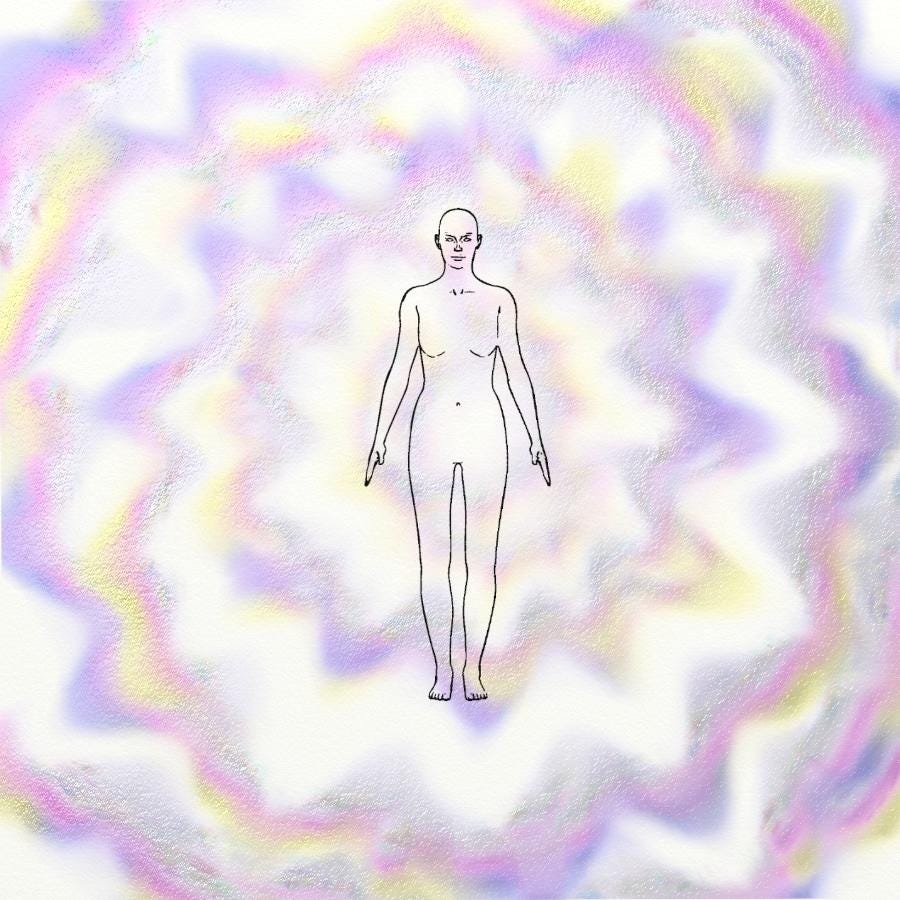
⟹ Warmer, a cozy warm temp; still coming toward me, lighter, brighter; silvery white, iridescent, luminous; an energy, but a positive one, uplifting; still coming in, but it wouldn’t be restricted to these sharp rays; it would be a force field radiating in towards me from all around, infinite; sound of the most eloquent chimes possible, those tiny ones people cling together at the end of meditation, that wonderful sound, so when it sounds it’s expressing something, you have to notice its presence because it’s so strong.
You are safe here. This uncomfortableness is passing away. In its place is confidence. Shine your light. You are doing great.
Next post/chapter in this series on fieldwork moving: