Well, you’ve shifted the virtual material properties of the feeling state you originally mapped, and now this part of you is experiencing itself in a new state. Nice job! What we need to do now is to give this new state more of a home by a) inviting new thought and belief connections to other parts of yourself, b) giving it a new name, and c) drawing what you have described as this new state. Another way to think about this is that we want to make this new state grow in familiarity to you and to build easy-to-open doorways by which you can access it from other places in your complex inner world.
Make sure the state you are working with is centered in your awareness before proceeding. If you need to, use the slider test to confirm your access by making small adjustments to the virtual material properties, and notice how these adjustments shift your feeling experience. Set things to their optimal positions before inquiring into the thoughts and beliefs that show up in connection to this ideal state.
Thoughts and Beliefs
And now, turn your attention to the thoughts and beliefs that naturally want to arise from this place. Leave plenty of spaciousness between the following three components of this inquiry.
If this part of you were free to express in words what seems most true, or real, or important, what would it say?
For example, how might this part of you complete the sentence “I am...” or “I have...” or “I can...”? What else do you notice?
What does this part of you most want you to know?
Take some time with this, and capture what comes through in your notes. If appropriate, consider inviting the explorer to substitute “you,” “they,” or “it” for “I.” And if it seems useful, encourage adding the word “because…” or “therefore…” to the end of a statement to see what connection might arise.
One of the most satisfying parts of fieldwork is the moment when you ask about your new beliefs and perceptions from the perspective of the new feeling state. You quickly realize, “We’re not in Kansas anymore, Toto.”
When you have one to three clear statements capturing the general thoughts arising from the feeling state, and it feels like you’ve captured the essence of this part’s reality, it’s time for drawing.
If at any time the explorer continues to draw a blank with these more specific prompts, don’t push it. Move on. Sometimes you are working with a feeling state that took shape before language and has been suppressed ever since, and it hasn’t yet developed a mature linguistic connection with other states in the form of articulable beliefs.
Belief statements and point of view
The explorer will have two choices of perspective available when eliciting belief statements. As one option, the explorer can speak as her whole self, having this feeling state. Something like, “When I’m feeling this, I can easily imagine having what I want most of all.”
But it can be even more powerful to speak in the first person from the perspective of the feeling state itself. For example, the state Radiant Self depicted at the end of this chapter states, “I am a part of the divine. Trust the guidance that’s coming from within, and keep feeling confident.” It speaks to the whole self, advising the self to “trust the guidance.” Sometimes, a part speaking as itself can go so far as use the second-person “you” when speaking to the self as a whole.
I find it is usually most powerful to go with the feeling state speaking from its own perspective. Especially as you map and move multiple feeling states, hearing distinctly from each part playing its role within the whole pattern can lead to terrific self insight.
For some explorers, though, this perspective is more difficult to sustain. Or it can seem strange to have these parts speaking as if they were sub-personalities. Reassure the explorer that this is natural, that all of us have these parts of ourselves interacting with each other to create our experience. At the same time, provide full support for the explorer to generate statements from either perspective. It’s all good.
Inviting a New Name
Once this part of you has been moved to its ideal state and you have had some time to reflect on what’s unique and new about the feeling, it’s time to give the new feeling state a unique name.
Finally, what name would you like to give this new feeling state? What name would it like to be called?
This can be quite fun, because you are naturally in an open, creative space. The names that arise spontaneously can sometimes tend toward poetic descriptions of the feeling qualities or derivations of the new beliefs and perspectives.
You might find some ideas for the new name in the notes that you’ve taken already. You might be drawn to either descriptive words that capture the state’s unique properties, or something from your new belief statements might apply. Sometimes these words can be used verbatim to name the feeling. Other times they will spark new insights and the name will emerge in your reflections about the possibilities. It will help to “try on” various combinations of word choices to sense into what feels right.
When I am facilitating, and the explorer is struggling to come up with a name, if some of their language suggests a name to me, I’ll make that suggestion, making sure to also invite them to reject it or respond with something more suitable. As with all of the questions, it can be helpful for us to have specific suggestions to reject as a way to move toward greater clarity. And sometimes, when offering their own words back to them, this can be a reminder along the lines of, “Oh, yeah, I said that, and it fits.”
Once you have settled on a name, try it on to make sure this is the name that works best. If so, capture the name prominently in your notes.
Drawing
And now, take some time with the drawing, in the same way as you did with the original feeling state map. Stay open to adjustments and surprises that may show up as you draw, including the following:
Shifts and clarifications in specific properties. For example, you might find yourself adjusting the color, extending the size and shape, or noticing that the substance wants to be a little more airy than it seemed to be when you first moved it. If this happens, make sure to go back and capture your insights in your notes.
Greater clarity about the essential nature of the part. As you settle into the drawing process, you’re letting go of intentional thought and allowing those connections to reach out and form in ways that you may not have expected. Notice the background rumination process and see if there are some new beliefs and perspectives to capture in your notes.
Other parts making themselves (more) known. As you draw this new state on the outline of a body, you may find yourself noticing the presence of other states that are spatially or otherwise related to this one. These may be previously hidden reactive states that need to be included in the mapping process. Or you may be gaining some clarity about the relationships among the ideal states. Either way, do what you need to incorporate these discoveries into your process.
How to Know When You Are Done
So how do you know when a particular part has actually achieved its ideal state? The fact is, it’s not important. As long as you are moving feeling states in the direction from more distressing to less, from less functional to more, from reactive toward the general direction of ideal, you’re doing great.
Because each feeling state is interconnected with eight others, there are many times when a first-pass move yields moderate results and it’s clear the state has not achieved its ideal. An example of this might be a state of fear moving to a state of protection. The protection state still presupposes a danger. As long as that danger is represented internally by a feeling state indicating the presence of some kind of threat, the original state of fear will be unable to fully transform.
But after moving through the entire set and transforming the danger as well as others which might play a role in the experience of threat, the fear will be ready to move fully to a state which transcends danger. The protection will be free to become something like strength or freedom. And ironically, in the absence of the internal representation of danger, full access to the inner experience of freedom will turn out to be objectively far more safe in the world than the original configuration was.
Overall, the complete answer to the question of how you know when you’ve found a part’s ideal state has to do with the information covered in the next section on the science. With some parts, you will know right away. For others, it will depend on completing the full set of parts, and seeing the relationships among the ideal states.
Summary
So that wraps up the moving process. You’ve brought a feeling state more into awareness using the mapping, feeling it more fully, creating a clear, tangible image, a kind of visual handle. And then, using that handle, you moved the feeling itself. You invited this part of you to reveal to you what it really wants to be feeling, in a world in which it has access to its ideal, its north star, and it has the full freedom to feel what is real and present in this moment, responding to your world in ways that support your thriving.
Can you see the connection between the first feeling and the second one? This is the same part of you. It is trying to do the exact same thing for you, but in the second case, it’s doing it in the context of possibility, of what could be if your life was truly as it wants to be. In the first case, the state you originally mapped was a response that signalled some kind of action or response that needed to happen in order to restore your access to that world of possibility.
For various reasons, you were likely prevented from taking that action, or even becoming aware of the feeling itself, and thus you became locked into patterns of replaying the original scenario, trying again and again to find a new way through. Now, having regained access to the ideal north star for this part, you will have opportunities to explore and discover new ways to respond to limitations in your world that better support your thriving overall.
The possibilities are wide, but it will require new experimentation, new learning. Fortunately, you now have access to greater resourcefulness, more options, better allies than what was available to you in the original experience of constraint. In this, you have the opportunity to learn how to bring new capacities into your life. Good luck!
Looking Ahead
We’ve wrapped up the essential steps for moving a part from its original reactive state to a more ideal state much closer to its purest truth of being. In the next chapter(s), I’ll offer a few tips for strengthening your move as well as suggestions for how to handle a couple of the ways that parts can seem to resist the moving process. The key to all of this is the fundamental multiplicity of parts — their coexistence as distinct, coexisting, interacting feeling states, and the need to work with the dynamics that show up in order to facilitate the most effective integration of the whole.
Another Example of What You Have to Look Forward To
To support your anticipation for what is to come in this adventure, I am offering before/after examples of feeling states my client Ruby gave me permission to share.
The Little Self
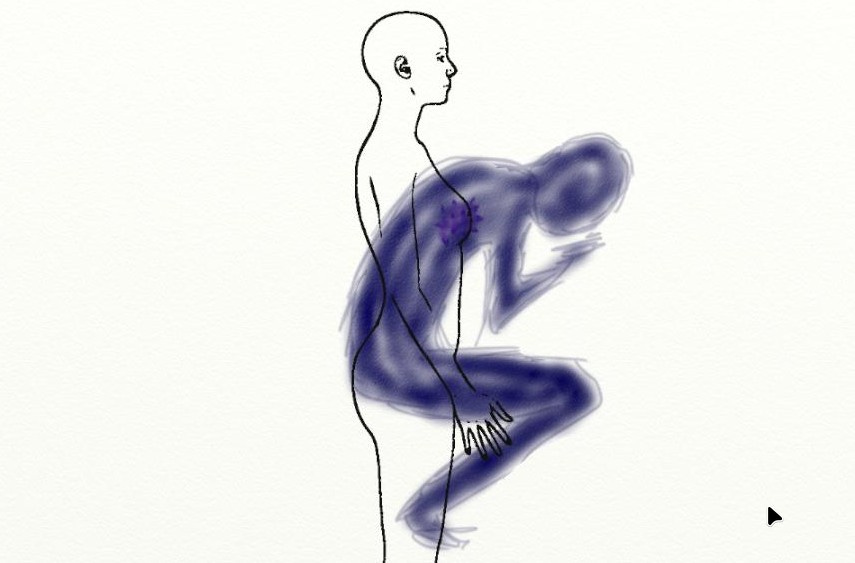
There have been so many times in my life that I’ve felt so small, there’s a shape like my body that is in my body and just shrinking.
What’s happening to me in the Unfriendly World. I’m shrinking. Gas. The shape of my body. My body encompasses it, but the feeling of it. In the experience of the unfriendly world my actual physical body may be standing up but my Little Self is hunched over like it’s covering its face. Like my body but in a protective posture. Seems like it’s a little bit smaller. Cold. Midnight blue, translucent. Gas moves a little bit, like gas would move. But the actual figure can move too. Sounds like a child crying, age 5, my voice.
Feels very sad. (The Little Self’s Heart). I don’t like being this way. I know this isn’t really me. Please help me.
Radiant Self
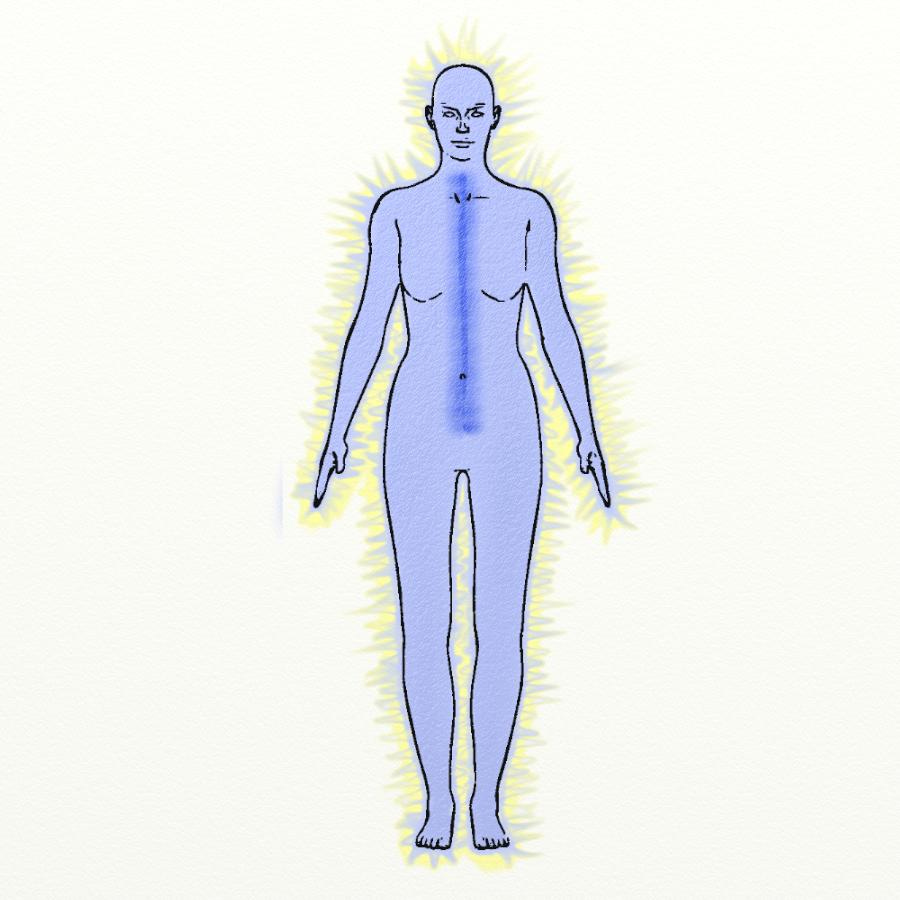
⟹ Warmer, comfortable warm; lighter, an energy... (this one’s hard for some reason)... image: sitting up really straight, how good that feels, like there’s some sort of weight supporting you from inside. When I’m feeling supported by that infinite energy I feel really confident and present. It feels tempting to have it be the shape of my body because the other one was... but I’m not sure.
I like the idea of there being this energetic me, the shape of my body, made out of energy, coming off my skin, shining out, just a little bit; comfortably warm; the energy within my body is a beautiful, bright blue, and the little shiny part coming out from my skin would be a yellowy sort of color, you could barely see bits of blue within that shiny part that comes out; the energy along the spine is a little darker blue to give me the support to stand or sit tall. Moves with my body and my breath. The sound would be from an orchestra that’s playing very upbeat music.
I am a part of the divine. Trust the guidance that’s coming from within, and keep feeling confident.
(While drawing…) Might have to change the color. Maybe add some luminosity to the blue.
Next post/chapter in this series on fieldwork moving: