Whew, finally we’re ready to dig into the actual moving questions. When you’re ready to fully engage the process, make sure you tap into the feeling state you’re planning to move, feeling it tangibly in the moment as you begin working your way through the following invitational moving questions.
The Questions
We’re going to go through the different properties of the image, starting with temperature. Keep notes as you go.
Place your attention on the feeling you mapped previously. You might have the image in front of you to help. I’m going to refer to this feeling as “this part of you,” because as soon as we start moving it, it will no longer be that original feeling. The first image is specific to the feeling you mapped, and as we shift the image, the feeling itself is going to become something different. The old name for it will no longer be relevant. Yet this will remain the same part of you, simply expressing itself through a different feeling state.
Transitioning from Preamble to the Moving Questions
After the preamble, it is helpful to use a clear transition into the moving process. Here is a good example.
Now, in this moment, in the spirit of exploration in a perfect world, where all your needs are met, what would this part of you get to become? Let’s explore the various properties one by one, starting with temperature.
Temperature
We’re going to start with temperature. As we begin, temperature is often the easiest image parameter to shift and feel an instant, tangible result, especially if the mapped temperature of the original reactive state is significantly warmer or cooler than neutral.
If this part of you were free to become warmer or cooler, what would feel better? What would this part of you prefer?
Wait for a clear indication of preference for one direction or the other before continuing.
And in becoming [ warmer or cooler ], if this part of you were free to take on any temperature at all, what temperature would it most want to be? What would be this part’s perfect temperature?
In place of “warmer or cooler” in brackets, substitute whatever shift showed up. Write down the new temperature in your notes, along with any interesting detours along the way, and notice (or encourage the explorer to notice) what it feels like for the virtual material substance to have taken on that shift.
I usually lead with temperature because it’s such a simple quality with a clearly linear scale. You can make small adjustments in one direction or the other to find out which leads to improvement, and then invite further exploration along that same direction to find the optimal value.
Also, I think temperature works well when you’re starting because it is so clearly kinesthetic. There’s no easy way to distract yourself, and it guides you to pay more direct attention to the actual virtual material properties and avoid getting caught up in more mental imagery.
Substance
Now, let’s turn our attention to qualities of substance.
So, [ in taking on that new temperature / in becoming {name the temperature} ], if this part of you were free to become harder or softer, heavier or lighter, thicker or thinner, more or less dense, what would feel better?
Wait for a clear signal in a particular direction.
And [ in moving in that direction / in becoming {name the direction, e.g. harder and more dense} ], if this part of you were free to take on qualities of any substance at all, would it prefer to be more like a solid… or a liquid… or a gas… or some kind of pure light or energy… or something else?
Pause briefly after naming each possible substance type to allow yourself/the explorer to test it out and notice any yes/no signal. Wait for a chosen type of substance before proceeding.
And going into the finer qualities of that, in becoming [ that substance ], would it prefer to be [ hard or soft, heavy or light, thick or thin ]? What other qualities do you want to notice about what substance qualities this part of you most wants to have?
As with all the questions, I usually start with a reinforcement of the progress we’ve already made. The language, “…in becoming…” presupposes the moment has happened or is happening. The presupposition is a powerful verbal technique to support unconscious processing.
First, we move directly into the fine adjustment explorations to identify positive direction. For substance, you’ll want to base your fine adjustments on the substance of the reactive state you’re starting with. For almost all substances, the question “more or less dense” will usually serve well. For solids, “harder or softer” is often useful. For solids and liquids, “heavier or lighter” works well, and for liquids and gasses, “thicker or thinner” can be useful.
Once you’ve gotten the substance moving a bit, transition directly into the open invitation. For substance, it is important to list the options as a way of inviting the explorer to actually “try on” each quality, making sure to consider the full spectrum of possibilities. Often times a substance will make a dramatic shift, for example from solid to pure light, and without considering the full spectrum you might stop the movement with a small shift to liquid because that does feel better. At every point in the process, work to maintain the full “perfect world” treatment.
Finally, after identifying the broad shift in substance category, it’s time to refine the qualities by asking about fine-tuning the sub-properties. It’s kind of like finishing where you began, by adjusting these sub-properties here and there to optimize the ideal substance as a whole.
Capture the new substance qualities in your notes.
Adding the “Laws of Physics” Anti-Frame
One thing I love to add in the process of shifting substance qualities is the following statement:
We don’t have to obey the laws of physics. It is perfectly possible to have a solid gas, for example, or a liquid light.
And this is true. We are working with “virtual” materials here. It is the case that we have spent our lives as material bodies embedded in a material world. This lived experience influences our virtual material fields to interact along general patterns similar to those of the actual material world. But our capacity to generate these fields goes far beyond the laws of physics, and the structure of our inner world is served best by letting go of those constraints.
Color
Next we’ll look at color and other qualities of appearance.
So in taking on these new qualities of substance and temperature, if this part of you were free to become darker or brighter, what would it prefer?
And in shifting in that direction, if this part of you could take on any color or colors of the rainbow, what color would it most want to be?
And would it want to be transparent, translucent or opaque?
And would it want to have any qualities of being luminous, iridescent, shimmering or sparkling?
What other visual qualities of appearance do you notice this part of you wants to take on?
The first question here is optional. Often by the time you’ve reached color in the sequence, the feeling state has already shifted considerably and may already have started taking on new color properties. Starting out with the open invitation question is often sufficient at this point, but if there’s a bit of a struggle, then I’ll readjust by asking an incremental question. Useful ones to consider are “darker or brighter,” “more or less vivid,” or “more or less transparent/opaque,” depending on which seems most relevant to the qualities of appearance you’re starting with.
Make sure to ask about opacity, etc, and invite an exploration of other qualities like iridescence. These can be fun additions to the image!
Write these new visual appearance qualities in your notes.
Location
The next property we’ll explore is location.
In taking on these new qualities of color, substance and temperature, if this part of you were free to locate itself anywhere in or around your body, or in and around your body, where would it want to be located? And what kind of size and shape would it most want to be?
Location can be one of the most powerful properties in shifting a feeling state to its ideal. Many times, a feeling state which starts outside the body will end up on the inside. The opposite also happens, where for example, a tiny crystal inside the body will expand to become a river flowing into and through the entire body.
One important dimension here is size. Many times, we might be used to a feeling state being rather small, and don’t immediately consider the possibility of expanding it to full-body size or beyond. You can guide this process by asking explicitly what it would be like to have the feeling occupy a larger size. “Try it on.” If it wants to spread through your chest, for example, would it feel good to go up into your head? Down into your belly? All the way down into your legs? If it extends outside your body, how far? (Some feeling states will expand infinitely in all directions.)
Sometimes a feeling state seems to you that it would be beneficial to occupy the whole body, but it just doesn’t want to go into the legs, for example. Sometimes this is because another feeling that hasn’t yet been moved is occupying that space and it doesn’t feel so great to have them overlap. In cases like these, it is often useful to come back around to make final adjustments to the feeling location (and other properties) after you’ve moved the rest of the feelings in the set you’re working.
Make note of the new location, size, and shape.
Movement
After exploring location, we bring our attention to movement.
In locating itself in this new location, how does this part of you want to be moving? Does it want to be flowing, or pulsing, or vibrating? Does there want to be any sense of waves or ripples? Does it want to be radiating, circulating or exchanging in some way? What directions or other qualities of movement does this part of you most want to have?
Most of the time, the movement will quickly suggest itself during the shift in location. By this far in the process, the feeling state has almost completely transformed and is probably already moving in a new way. All you need to do as the facilitator is identify that desired movement, reinforce it verbally, and invite it to go even further in positive qualities.
At this point there is usually no need to ask about “force or pressure” from the mapping phase, because those qualities are almost always a sign of opposition with another state. If they do show up, definitely inquire into what that opposition might be and respond appropriately.
Of course, as with all the properties, explore the details. As with mapping, consider direction, speed, intensity, and variability. Explore qualities of movement in time as well, noticing pattern, rhythm, and randomness.
Capture your new movement qualities in your notes.
Sound
Finally, we dig into the quality of sound.
In taking on all these new qualities, if this part of you were free to generate an inner sound, as a way of more fully expressing its true nature, what would that want to be?
Would it want to be some kind of music or a natural sound? Some kind of voice? One voice or many? Male or female? What age? What would be the optimal inner sound to express this part of you?
For some people, or for some particular states, sound is an especially powerful dimension of the experience. Give some time for yourself to inhabit the new feeling state and allow for an appropriate sound to show up. Once it does, ask clarifying questions to help make the auditory imagery crystal clear. Use the tips in the mapping section for exploring the details of sound or voice.
For some other people, or for some particular states, sound can be less prominent. In these cases, it can be useful to invite the explorer to make a distinction between whether this wants to be an actual silence that is present as a quality of the state, or simply more of an absence of sound altogether.
Capture these changes in your notes.
Anything Else to Notice?
And now, let’s review.
Going back through the different qualities, are there any other adjustments you want to make? Is there anything else you want to notice about what this part of you wants to be?
With this question, you are opening up for any further adjustment the explorer might want to make. Sometimes shifts in properties later in the process spontaneously change the earlier properties even further, or they open the possibility for further intentional change. For example, adding the sound of a choral chant might help shift the substance from a gas to more of a pure light, or shift its color in some way. Check these things out to make sure you’ve fully mapped the ideal state.
Make those changes in your notes.
Looking Ahead
We’ve completed shifting the virtual material properties of the feeling state, following the built-in compass toward what feels best to this part of you. In the next chapter, we will complete the moving process by asking about new beliefs and perspectives, giving the new state its own unique name, and drawing the new state.
Another Example of What You Have to Look Forward To
To support your anticipation for what is to come in this adventure, I am offering before/after examples of feeling states my client Ruby gave me permission to share.
Wall of Fear
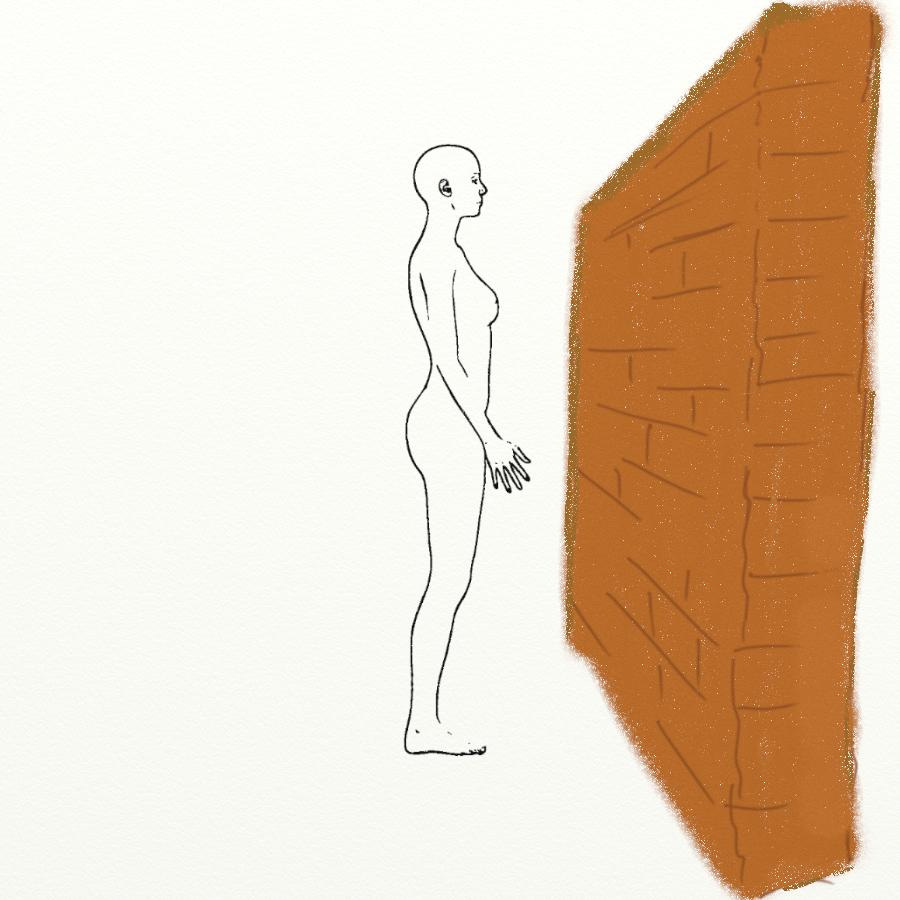
When the Fear is activated, it’s not just inside me, it really creates a wall or barrier in front of me. The Wall of Fear.
Three feet in front of me, 6 feet high x 12 feet wide. If I’m feeling encouraged I could walk around it. A foot thick. Solid, very hard, like a brick wall. Cold. Sandstone color, as if carved out of rock. No movement, just stagnant. Sound is like one of those very scary gong sounds.
The wall is a little different from Fear, a little more positive. It’s saying, “I’m here, but you have within you what it takes to get past me.” It almost feels like, just by seeing the wall, and knowing it’s only 12 feet wide and I can get past it, it’s moving the fear.
I Am Light
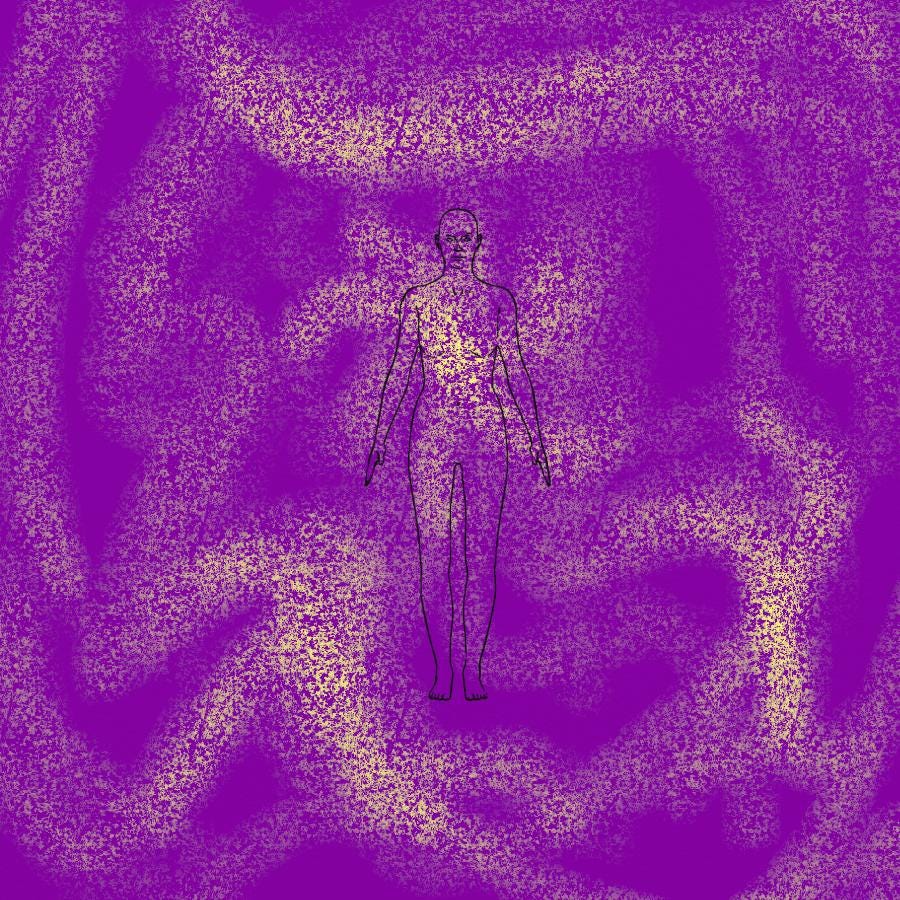
⟹ Warmer, 80 degrees. Softer, lighter, less dense; almost seems like it wants to be like the Infinite, Encompassing Support. Wants to be a positive presence outside of me. These little stars or whitish specks of light, and there’s a whole bunch of them, millions. Each is just a little bigger than a grain of sand, they almost look like little crystals, but there’s light coming out of them. Yellowish white. Three feet away from me, but forming this little circle around me. For about one foot they’re really solid, but after that it sort of fades out.
⟹ Inside and outside, extending pretty darned far. Pulsing and sometimes making patterns, like the Milky Way, becoming more shiny in different places, (maybe to get my attention). Sound of chimes, sounding really nice, higher and softer.
I am light. And that means I can do anything! A very playful sense to this, like Tinkerbell. It’s wanting to remind me of my path, and it shows me the way.
Next post/chapter in this series on fieldwork moving: