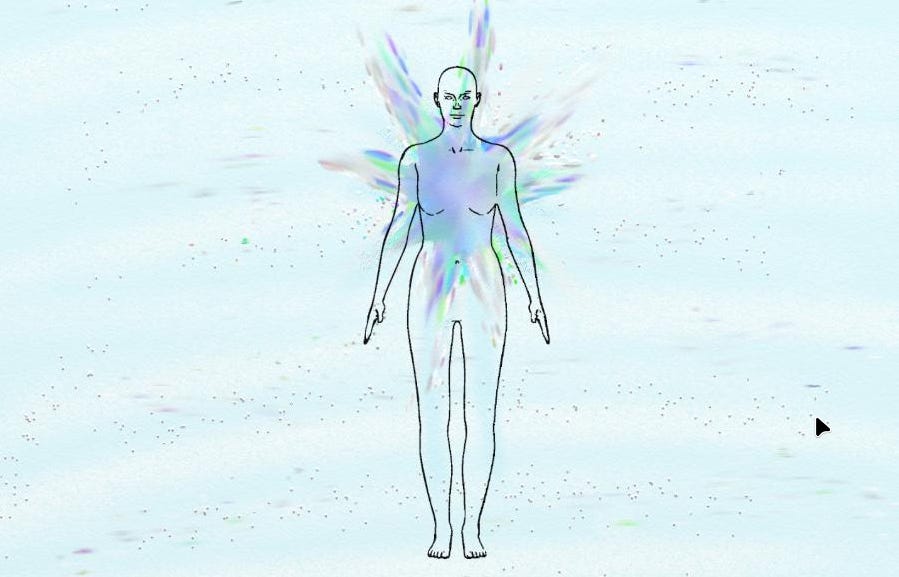
The preamble is handled. Now we’re ready to get into the actual swoosh of change. As we get ready to examine the sequence of questions used to invite the shifts in virtual material properties that reconnect a part of ourselves to its unique feeling-expression of wholeness, let’s take a step back once again. Let’s look at how, exactly, we facilitate these shifts.
One thing that shows up throughout psychotopology is the central role of feeling in our experience of being. And we have discovered how inserting the lens of virtual materiality over our instrument of awareness allows us to “see” our feeling with much higher and more tangible resolution. This enhanced perception turns out to also bestow the capacity for interaction, where we can deliberately shift the qualities of these virtual material properties in order to transform the feeling experience itself. That’s what we’re about to get into.
Specifically, we’re going to look at the role language plays in helping us make these shifts. In particular, we’re going to look in this chapter at the structure of the invitations we make to the parts we’re working with. How do we shape our language in such a way as to reduce the friction and support the part in making its most effective transition from one state to another?
We’ve already establshed in our discussion about the preamble structure how big is the gap between our expectations and our actual felt experience when we bring a high-quality awareness to that experience. Many times when encountering the preamble, we experience a softening and the beginning of a shift just from that. That framing holds such a stark difference from what we are accustomed to receiving from the world around us, and it so resonates with the truth of what we experience inside of ourselves, that simply hearing it sets things in motion. And actually, simply giving ourselves permission to bring our full awareness to the feeling, by itself, gets the process started.
As we do throughout our practice of fieldwork, we prioritize direct experience over our concepts and language about that experience. At the same time, language is incredibly powerful, and can be very effective when used in service to this core of experience. Throughout the moving process, we need our language to continue to hold a framework within which we can let go of these life-long societal expectations about the nature of feeling.
Let’s take a look at how we do this.
Asking the Moving and Beliefs Questions
As you did with the mapping sequence, read the questions in the following chapters verbatim, and as much as possible, thoroughly capture the important parts of your answers. If an answer isn’t clear at first, invite different possibilities until one feels like it fits.
As soon as we begin asking the first moving question, we enter a new world. In facilitating this process, we abandon all reference to the original feeling name from the very beginning. Instead, we refer to “this part of you.” That’s because a feeling name is very specific, and the name for the original feeling state referred only to the state represented by that specific mapped set of virtual material properties.
As soon as we change even a single parameter of that image, the feeling state is no longer the same, and thus the name no longer applies. Because the feeling state is in a constant state of transition throughout the entire moving process, we choose to refer to the underlying entity undergoing the change as “this part of you.” This part of you is the same from the beginning of the process to the end and beyond. Using this language helps point to the aspect of consciousness we’re focused on, and also helps us let go of any attachment to the original feeling state.
Each moving question has seven important components:
1. Acknowledge progress with each step.
Restate the changes already achieved and reinforce their felt expression in the moment. Key expressions are, “In becoming [ parameter, such as “this new temperature” ]…” or “In allowing this part of you to become [ parameter ]…” where we substitute one or more descriptions of the changes that have already taken place for the “parameter” in brackets. For example, “In becoming this cold, hard solid…” Or we can open the prompt with the generic, “In taking on these changes…”
The idea is to support the explorer in tangibly inhabiting the shifts that have emerged, feeling what it feels like to have the state take on the new values for the virtual material properties that have been shifted before proceeding to the next property.
2. Set the “as if” frame.
It is important throughout the process to undertake it as if it were a simple exercise of imagination. We want the ultimate latitude for movement, and that requires the maximum amount of permissiveness for this part to try anything at all. One way of reinforcing this frame is to use the language of possibility: “If this part of you could become… what would it want…”
This supports a letting go of any attachment to its existing form and an encouragement to experiment.
3. Set the “in this moment” frame.
Another way to support unconstrained exploration is to add the language, “In this moment…” at the beginning of the question. This doesn’t have to happen every time, but is helpful to add on occasion to remind the explorer about the frame of possibility that holds the moving process. Any shift that happens can easily be reversed, so it is safe to move.
This can be further enhanced by adding the phrase, “…in the spirit of exploration…” for the full intro phrase of “In this moment, in the spirit of exploration…” before any of the questions. I often use this in the transition between the preamble and the first questions.
4. Identify a specific direction to begin an initial shift for each property.
Invite trial changes in both directions to very specific sub-parameters to choose a positive direction. For example, ask if the feeling state would prefer to be warmer or cooler, heavier or lighter, darker or brighter, faster or slower, louder or more quiet. Make sure to apply equal or neutral emphasis to any choices suggested, and include the possibility for no movement at all, “…or neither.”
We usually begin the moving process with temperature because it has a generally linear spectrum of possible values, and it is relatively easy to “move the slider” in one direction, then the other, to test which direction feels best.
5. Invite complete transformation.
After getting things moving with a small shift along a specific sub-parameter, we want to invite further shifts toward what feels best. Specifically, ask what parameter value this part would “most want to be.” Occasionally restate the frame “in a perfect world, where all your needs are met…”
Another way to invite the more complete shift is by asking, “If this part of you could take on any (qualities of) [ property ] at all, what (kind of) [ property ] would it most want to be?” where “property” is temperature, substance, color/appearance, location, size and shape, or sound. You’re wanting to open the door wide here, but usually only after the direction for the positive shift has been established.
6. Offer specifics.
As in the mapping phase, the explorer may find it easier if the facilitator provides a selection of possibilities to choose from, including the option, “… or something else.” The property for which this structure is most often applied is substance, where the standard question asks, “…would this part of you prefer to be more like a solid, a liquid, a gas, some kind of pure light or energy, or something else?” But it can also be used for other properties.
This sets up the opportunity for the explorer to easily “try on” various values for the given property, and to feel a simple yes-or-no, toward-or-away-from response to help in the experimental testing of what this part wants to become. It can be a lot easier to say “no” to several options in order to settle on the best direction than to be working with a wide-open spectrum of possibilities.
7. Invite refinements.
After settling on the “best” parameter for the property being explored, it is often helpful to explicitly invite further refinements. Selectively scan various refining sub-parameters to invite the explorer to enhance and improve the feeling state. The easiest example is that of substance, where, for example, a solid can have qualities of weight, hardness, density and texture, among others. Often, these enhancements can lead to further significant shifts as new insights emerge from the qualities elicited.
8. Reinforce part autonomy.
Always in inviting transformation, use the language “this part of you” to refer to the agent in charge of making the shift. A couple common ways to hold that include, “which feels better to this part of you?” or “what would this part of you prefer?” This places the locus of evaluation directly within the part itself, where it belongs.
Gradually Flexing the Structure
When you first facilitate this process, whether for yourself or someone else, you’ll be best served by asking the questions verbatim, as I’ve provided them in the next chapters. Eventually, many of you will find yourself wanting to make changes to better suit your personal style. As you get comfortable with the process, you will also likely loosen up your delivery to better follow the flow of the moment with the explorer. If so, please keep these guidelines in mind, and you’ll remain effective in your facilitation.
As you and others go through this process again and again, over time you and/or the explorer will begin to take on these underlying guidelines as the ground you are walking on. Notice when that is beginning to happen, whether in working with yourself or someone else. That will be the time to ease toward simplifying the questions, gradually paring down the full version into a simple, “What substance/temperature/color/etc. does it want to be?”
Also, don’t expect that every state or situation you are working on will automatically be able to take on this framework. Even after doing the work to the point where it feels as natural as breathing, you are likely to come upon states that do need the explicit full support. When that shows up, it’s easy enough to go back to the full question structure and ease the part with more explicit support through the process.
Another factor to consider as you get more experience working with highly diverse parts involves the order in which you visit the various properties. I almost always begin with temperature, for example, but sometimes a state very clearly has another property that serves as definer of the state. It might be size, or the direction of movement or pressure, or some more or less extreme quality of substance, for example. Sometimes in those cases, it can be helpful to begin with that stand-out property to get things moving strongly right from the beginning. Later in the book, we’ll take a closer look at factors like this.
Working Solo
If you are working on your own, all of these principles apply just as much as if you are working with a partner. Whether you are reading the question, speaking it aloud or internally to yourself, or listening to an audio prompt, you will find it very helpful to include these elements to support the ease of shifting a state. Of course you will eventually find yourself holding this framework implicitly, but as I mentioned earlier, be prepared to access the full framework in explicit language at times when working with more challenging states.
Some Things You Can Expect
Although the experience of shifting a feeling state does often operate on what seems to be a simple slider mechanism, the moving process can actually be quite a bit more complex than that. I’d like to remind you of a few things to keep in mind as you get started with the moving process.
First, as we’ve talked about many times now, feeling states do not exist in isolation. For example, don’t be surprised if that seemingly trivial state you chose to map turns out, when you start moving it, to be linked to the big knot at the center of everything. Because every state is connected strongly to a full set of other distinct but interdependent states, I encourage you to make it a priority to stop from time to time as you go, and to ask yourself, “What else am I feeling?” If you detect something relatively strong that you haven’t yet identified and mapped, make a note of it, acknowledge it internally, and either turn your attention to it or come back to it later.
Overall, I want to encourage you to keep in mind that as you map and move feeling states, you are traveling through a rich, complex ecosystem of feeling. Be prepared for the unexpected, be open to surprise, and make sure you have enough time set aside to take a detour if that becomes necessary to complete what you begin. Sometimes as you move one feeling state, another will come barging into the foreground as if to demand to be taken through the process. Make it a priority to at least acknowledge it and commit to returning to it soon. Consider the possibility that it might be best to turn your attention fully to the new state to map and move it before returning to the state you were working on before it showed up.
Be especially open to surprise as you take your state through the moving process. It is very possible that the part of you that has been holding its form in the feeling state you mapped does not remember what it is like to experience its ideal state. In many cases, you will feel completely and delightfully surprised, arriving at a feeling and state of mind that you never would have anticipated. At the same time, it will probably feel more like your authentic, “true” self than the state you started with, no matter how familiar and pervasive the previous state has been in your life.
Looking Ahead
We’ve completed our preparation for the moving questions. In the next chapter, we’ll delve into the details for each one.
Another Example of What You Have to Look Forward To
To support your anticipation for what is to come in this adventure, I am offering before/after examples of feeling states my client Ruby gave me permission to share.
Critical Self
It’s pretty dark, but it’s hard to know exactly what it is.
The word shame, thinking I feel so ashamed of myself that I have to keep depending on one person, that I’m causing that person so much stress.
Ashamed of Myself
On my back, partly inside, the upper half; a really heavy energy; a little hot; reddish black, translucent; pushing down on me; no sound. It feels like it’s spreading out behind, becoming like the shape of a bat’s wings or something.
The Guilt/Shame was trying to keep the Untrusted Self from messing up. This is the part of me that would mess up.
It doesn’t feel good that it has to hold my negativity. It actually doesn’t like slowing me down. But it has felt like it needed to because it doesn’t trust itself. This is the part that slows me down (I think), the part where all of my negative ideas are.
You’re not good enough. You’re lazy, you’re fat, you’re slow, you’re going to mess up, you don’t know what you’re doing, you’re not as good as them, you can’t do that, you’re going to be able to do that.
(None of that stuff is true.)
Name: Critical Self.
This part has an element of sabotage, of deliberately messing up as a form of rebellion to others imposed standards.
Accepting Self
Lighter, sparkling light; a soothing warm temp; iridescent sparkly, many colors; starting in my heart and shining out so far that it ends up being in all of my body, across the room, across town... infinite. Connecting everything through its sparkles, the way that they’re moving. Singing voices, both genders, a kundalini mantra “wah hey guru.” It wants to sparkle goodness to other people too.
All those negativities I used to believe in were just an illusion. I’m made of goodness. And other people are too. It’s my role now to not only know this but to show others about it.
Name: Accepting Self.
I’m not just a yoga teacher. My job is to remind people of their goodness too.
Next post/chapter in this series on fieldwork moving: (coming)