

Previous post in Susan’s Session:

The audio:
J: So does it feel to you like it would be more of a relief to shift the Shame first or one of the others?
S: No. It’s definitely from the inside out in this case.
J: Mm hm. And the Shame, that could shift and the Love would be OK with that.
S: Well, it’s like the Love wants to expand...
J: Wants to expand, right...
S: ...yeah, it wants to... I mean, it’s kind of like, sort of vaporize or... I think vaporize would be the right word. It’s not like blow it up, but it’s just like dissipate it, disappear it.
J: Yeah, yeah. All right, well let’s see what happens with shifting the Shame.
My Comments
Here I’m confirming with Susan my instinct to move Shame before the others. Notice how she’s already anticipating what might want to happen. In her mind, the best thing would be for the Shame to “dissipate” or “disappear.” She hasn’t yet had the experience of moving a state, so this is a natural impulse.
In fieldwork, however, we learn that feeling states don’t ever “disappear.” They change, yes, but they maintain an exquisite continuity of presence. This is an important principle in fieldwork. A state that seems to “disappear” can always be found, and when guided through the moving process will enable access to a strong, positive resource that would otherwise remain dormant. Loss of a negative is not a positive. Transforming a negative into a positive is our goal.
Preparing to Move Shame
J: So before we shift this I want to just establish a couple of frames. One, I want to acknowledge this part of you, this Shame. It took this form at some point in your life when it seemed like this was the best way to serve you. So I want to thank it for doing that. And I want to reassure it that if it ever needs to serve you in this way again, it can do so. Yes, we are going to move this today, but it’s safe to move because you can always put it back. We’re adding to this part’s repertoire of feeling, not taking anything away.
And so because of that, because it’s safe to move, you might as well go for it. What could this part of you be in an absolutely perfect world, where all your needs are met, exactly the way you want them, fully and completely, and you know how to keep them that way?
Also, I want to acknowledge that, as you see, this Shame is connected to the No! and the Fearful Fear and the Love, and there are other parts it’s connected to that we haven’t identified. I want to invite all the other parts of you to participate in this process passively, as witnesses only, to experience for themselves what’s possible for every part of you. But if there is some other part of you that is needing to contribute something crucial to the process, you’ll notice another feeling coming to the foreground, and just let me know. All right?
S: Yes.
My Comments
This preamble to moving a state sets up three essential frames to make the moving process effective. Throughout all three of these, we begin referring to the feeling state as “this part of you.” This is an essential concept for understanding fieldwork. Every feeling state is a specific expression among a full repertoire of possible feeling expressions for a particular part of your being. That part is indelible, indivisible, unmergeable. In this moving process, it will transform its expression to a new feeling state.
First, feeling is naturally fully responsive to whatever is going on, and responds in ways that support your well-being. What has happened in most cases where you’re doing fieldwork is that this natural responsiveness has become compromised and the feeling has become locked into a specific state that no longer serves your highest good. How this happens is a (big) topic for later. What’s important here is that we acknowledge the inherent, positive motivation of this part of someone to serve the highest good of the whole person. We want to acknowledge that even though the state might seem to be a detriment from our current perspective, its response was originally entirely appropriate given the situation, the level of development, the lack of resources, etc.
Acknowledging this relieves a potential burden of guilt or shame for it having more recently been creating distress. It also affirms a fundamental trust in the part’s inherent nature, a trust which is essential for the success of the moving process. We want to support this part in finding its truest expression. Because of our culture’s incessant messages in conflict with that core trust, it will do that only if it feels welcome and appreciated for being what it naturally wants to be. When we explicitly acknowledge it in this way, we clear the path for it to find its essential expression.
The second frame invites a full transformation. This part of Susan which has become locked into the state of Shame actually has access to a wide repertoire of states. The fieldwork moving process reconnects the part to its full repertoire. The idea is not that the part will lock into a new, better feeling state. The idea is that by reminding it of its full repertoire, it will regain access to the full spectrum and regain its natural, fluid responsiveness to the ever-changing landscape of life. When we set the frame of “in a perfect world,” we explicitly invite this part to discover its ideal state. We identify the far boundary of its repertoire.
This perfect world frame, in combination with the acknowledgment of positive intent, creates a generous, supportive container for conducting the moving process. The relief and freedom most people feel simply in hearing these two frames is significant and important to the process.
The third frame acknowledges the interconnectedness of parts as experienced through their specific feeling state expressions. Inviting the other parts to “participate passively, as witnesses only,” creates the space for these other feeling states to be felt from time to time without disrupting the moving process for the part in focus. At the same time, it explicitly invites the explorer to give voice to any state that might be pushing into the foreground of their awareness and getting in the way of fully inhabiting the transformation underway.
Opening the door to receiving input from other parts makes it likely that any part that has an investment in this current part remaining in the originally mapped state will come to the foreground. For example, if we attempted to move Love before moving Shame, it is very likely that the Shame would come to the foreground as if to say, “That’s not OK. I don’t feel safe here.” When that happens, we organically shift attention to the state that’s asking for attention. It often happens that we will discover hidden states this way. We’ll be inviting a part to move, and it will dig its heels in, resisting the movement. Then we’ll ask what other feeling is present, and discover a new state which is dependent on the current state remaining in its place. We shift attention to that new one, map and move it, and return to shift the original state with no problem.
Let me add further perspective here. When we have the gift of this mapping process, a tool enabling such precision in our perception of actual feeling states, we discover all sorts of complexity we didn’t know existed. We humans are complex beyond our current understanding, and that complexity becomes beautifully evident in fieldwork. In other modalities, the interaction of parts often lies behind a veil of limited ability to surface the true complexity, and when people experience challenges in making desired changes in their lives it gets labeled pejoratively as “resistance.” In fieldwork, there is no such thing as resistance. Every state that arises is welcome and included in the process.
Moving Shame
J: So in this moment, in the spirit of exploration of what’s possible in a perfect world, if this part of you were free to become, oh let’s say harder or softer, bigger or smaller, warmer or cooler...?
S: Definitely softer, no more porcupine quills. And it would change color. It would be yellow, kind of like a glowing light, like a sun.
J: OK.
S: But really, very soft.
J: Yes. OK. And so in becoming softer, and changing color, if this part of you were free to take on qualities of any substance at all, would it prefer to be more like some other kind of solid, or a liquid, or a gas, or some kind of pure light, or energy, or something else?
S: Pure light or energy I think.
J: And in becoming this pure light or energy, if it were free to take on any temperature?
S: Comfortably warm. Like maybe a hundred and two degrees, like a little warmer than body temperature, but you know, you could still have your hand on it for a while without being burned.
J: Mm hm.
S: Maybe only a hundred degrees. You know, just a little bit warmer.
J: OK. And in taking on this new quality of being pure light or energy at 100 degrees or so, to confirm the color, if it could be any color of the rainbow...?
S: Sunshine yellow, or maybe lemon yellow, or egg yolk yellow. Like the heart was the reddest red? This is like the yellowest yellow.
J: OK. Great. And would it want to have qualities of being transparent, or translucent, or opaque?
S: Translucent, maybe. Like transparent, it really likes being yellow, and it wants to be noticed.
J: Ah hah. And obviously it’s luminous, this light? Any qualities of being sparkling or shimmering, iridescent, anything like that?
S: Shimmery or sparkly.
J: OK. And if this part were free now to located itself anywhere in or around, or in and around your body, and occupy any size and shape at all, where would it most want to be?
S: Well, the center of it would be right where the porcupine was, but then it would definitely go, like covering all the parts that were gray before. Almost like a circle except there’s not sharp, defined edges. So it would even go up to my chin, probably an equidistance down which might be the top of my thighs, and maybe out to my arms...
J: How about forward/back, also? Would it be a sphere or more of a circle?
S: It’s kind of a shape like this , so however far back the gray fog went before, it’s like that far back, and then however far the steel plate was, it’s like just past the edges of that. So sort of encapsulating.
J: Right. All right. And does this light want to be moving in any way? Is there any kind of a flow, a pulse, a radiation, vibration?
S: No. It’s just glowing. But it’s not... The fact that it’s light means that there’s activity.
J: OK.
S: Without any overt activity.
J: OK. And if you listen internally, does there want to be any kind of inner sound that arises with this feeling?
S: It’s kind of tinkly bells or wind chimes. I don’t know, celestial sounds, angelic sounds, music of the spheres sounds... I mean I can hear them in my mind because I have CDs that have music like that.
J: All right. So you know what that means.
S: Yes.
J: And is there anything else you want to notice about what this wants to be?
S: No. I think that’s it.
J: And so from this new place, this new feeling, what seems true, or real, or important now?
S: It seems very expansive.
J: And what’s important to you about that?
S: That I’m very open, so it’s like I am open to let the love in. It feels like it made that expansiveness.
J: Great. And what new name would you like to give this?
S: Receiving.
J: Mm. Great.
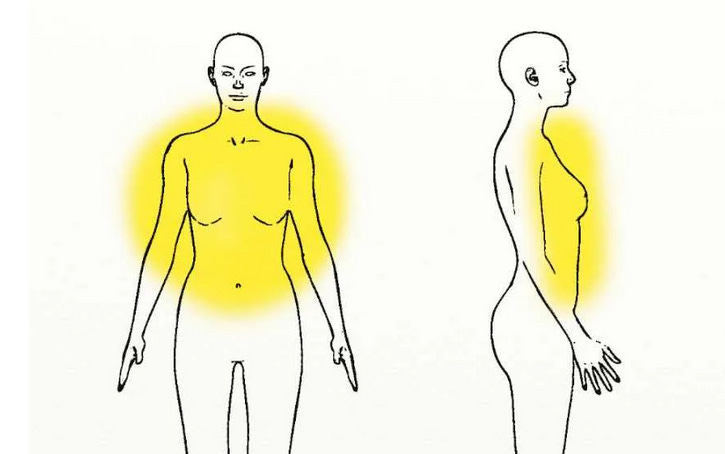
Note: This drawing of Receiving was made later in our process, after moving all four parts.
My Comments
Here I am providing a rich container within which Susan is invited to explore new qualities for the expression of this part of her. In the mapping phase, Susan created a tangible image expressing Shame. Every feeling state image has the unique quality of being a bidirectional pointer. As Susan experiments to deliberately alter the image, the actual feeling state changes to reflect the adjustment. At each step I invite her to test out adjusting the image in two opposite directions to discover which one leads to a state that feels “better.” Once we establish the best direction, I invite her to test out the full spectrum of that property to identify its optimum value. As we make our way through the full set of properties, the feeling state transforms from its original distressing state to one that is full and resourceful.
Some people like Susan will have an easy time simply inviting the shift and following where the part wants to go. Others will need more step by step guidance. I’ll help you learn the step by step approach in the section on methods. Learning the basics will help you adapt to different people’s strengths and challenges.
What’s Next
In the next post, we’ll have an opportunity to see what Susan’s Love wants to become. We might assume that, well, it’s already “love,” so what more could it want? Well, hang tight. You might be surprised.
Next post in this series:

Volume 1, Table of Contents:

Get your printed (or PDF/ebook) copy:
