

Previous post in this series:

Continuity: In last week’s post, I offered a bit of history leading to this watershed day, along with a little context of what I was going through at the time, before starting in with the transcript. The post breaks at the point where I have enough information about “my fear,” or “the fear space,” to draw it.
A Key Observation Skill
Before we dive back in, I would like to offer a bit more history related to what enabled to me to do this process with myself. Ten years earlier, in my efforts to learn more about my interior dynamics, I took a training in hypnosis. The most challenging thing about this training, to me, was the practice with other students.
At the time, I was extremely protective of my inner world, and I did not trust some novice to go mucking around in there. And yet, at the same time, I wanted to be a good partner to my fellow students. So in order to participate in our practice sessions, somehow I managed to split my consciousness in two. The bulk of me was able to go into the trance and respond genuinely to the guidance I was receiving from my fellow student. Completely autonomic body signals would arise along with everything else that provided my partner the opportunity to practice.
At the same time, though, I was able to be outside the process, watching it as an observer. I could monitor the facilitation of my fellow student and its impact on me, and if necessary, I could open my eyes and provide useful feedback to make sure I stayed safe and things went well.
Later, I took advantage of this new skill by developing a practice of self-hypnosis. I was able to guide myself into deep trance, with that observer part of me facilitating verbally from the outside while the bulk of my inner experience went fully under. In this way, I was able to do regressions, for example, using them in my efforts to heal myself by tracing strong, reactive emotions back to the original experiences that planted them in my psyche.
This skill served me very well as I began to develop fieldwork. That skill of being able to split supported me in diving into this mapping process entirely on my own, right from the beginning, before I really knew what the hell I was doing. On one side, I was able to serve as my own facilitator, while on the other, I was able to go fully into the mapping experience. This enabled me to use my own inner laboratory as my prime zone for designing and testing the process as it emerged.
In the long run, the capacity to witness feeling and other inner phenomena from a position outside the phenomena themselves is essential to this work. Fortunately, the mapping process, by itself, tends to lead to a spontaneous split that supports the work. I wrote a fair amount about this in Volume 1, FM-10: Cultivating a Witness Awareness. For some people this is more difficult than for others and it takes a little more explicit instruction to support their learning it.
But anyway. Let’s continue, picking up where we left off in exploring the “fear space.”
Transcript (continued):
MIND: If there were a sound associated with this, what might it be?
EMOTION: It seems very low and deep, like this electrical or machine-like hum, but very low pitch, like a throb more than a hum, very loud.
MIND: Does the sound seem to have a point of origin?
EMOTION: Yes, it’s coming from behind me, farther back than the fear space, height about mid-back, about four feet behind me.
MIND: Does the fear space have a weight?
EMOTION: It’s pretty heavy.
MIND: How about a temperature?
EMOTION: Seems cold. Like if I touched it, it would be cold. Making it colder makes the fear stronger.
Also, I didn’t mention, but making the sound deeper and louder has a similar effect. So does increasing both up and down forces/motions simultaneously.
Now here is an interesting thing I want to bring your attention to. Notice that I ask about the “point of origin” for the sound. And notice that this point of origin is located somewhere different from the fear object that was just described in great detail.
What do you make of that? I mean, immediately, the facilitator role goes right back into the “fear space,” inquiring into more detail about its virtual material properties of weight and temperature to wrap things up. But then at the end, the explorer side of me brings the sound back into focus.
But how is it that the sound is coming from a place different from the fear space? What does that mean, exactly? Let me just give you a short, direct answer that will receive a little more elaboration as we go.
Sound typically occupies a location different from the affect field of the state we’re mapping. Typically it arises within what I call the auditory imagery field of the module to which the affect field is connected. Imagery fields are where the contents of what we typically refer to as “thoughts” arise. For most modules, we have one visual, one auditory, and one kinesthetic/somatic imagery field that, together with the affect field, comprise the structure of that module.
In the next section, you’ll get to see more of this as I unpack the visual imagery field for this state, after which I will tell you a bit more about this dimension of our interior before we move on in the transcript.
In the mapping process as it exists today, I typically save asking about sound until last. Because it is not as explicitly sensory imagery as the visual imagery field, it tends to be experienced as an inextricable companion to the affect field. And because it does occupy one of the imagery fields, it makes a nice transition to the following questions that tap directly into beliefs and thoughts. These elicit some of the typical contents of these imagery fields as they tend to arise with the state. And they help us understand the relationship of this state to others around it, contributing to our efforts to map the full network of related states in whatever life pattern we are exploring.
Let’s push pause on description and just get back into it. This next portion takes us fully out of the affect field to explore what I call here the “image-space.”
Transcript (continued):
MIND: Are you aware of an image-space associated with this fear?
EMOTION: Yes, very close to my face, very large, very black/dark, extending to both sides, and up and down, (although limited in downward extent to the floor as a maximum). It is curved toward, sort of around, me, so I can’t see anything else around or beside it.
MIND: Is this a three-dimensional image space, or is it essentially flat?
EMOTION: It seems the space is flat, more like a surface separating me from the other side of it. Images on it are huge and dark. If I put a face on it, the face is huge, menacing, close, but it doesn’t seem 3-D.
The “Image Space”
I fell into this work through a deep dive into NLP (Neuro-Linguistic Programming). One of the focuses of NLP is the fine structure of mental imagery, which it refers to as “submodalities.” For example, with visual images, NLP inquires into structural details such as the following:
What is the size of the image in the actual space in and around the person’s body, and where is the image positioned relative to the body?
Is the image…
Flat like a photograph or three-dimensional?
Black-and-white or color?
Still like a photo or moving like a film?
Showing the self in the image or seen through the eyes of the self-in-the-body?
These qualities are much more strongly associated with specific emotions than the contents of the image. In NLP, if you take the subject of an image that comes to mind with an emotion of aversion (like a chore you keep procrastinating) and change its submodalities to match those of an image that comes to mind with an emotion of eagerness, you’ll find yourself feeling eager to begin the chore. There’s more to it than that, but that’s enough to give you the gist.
At an advanced training in 1992 with Richard Bandler, one of the founders of NLP, I asked him about the relationships between images, and his reply led me to think of these spaces hosting imagery as a kind of field phenomenon. I began to experiment with these fields in my exploration of acting, intentionally expanding their size and amplifying their intensity on stage, and finding that my connection with the audience intensified as well.
In the summer of 1994, it was my curiosity to investigate whether it was possible to identify the “submodalities” of feeling states directly that opened the door to my discovery of the virtual material properties of the feeling experience. But I was still fascinated by the link between the feeling state properties and the associated imagery spaces, and still spent quite a lot of effort in explicitly mapping those imagery spaces even when I worked more directly with feeling itself.
The two were clearly inextricable. Specific imagery arose in specific image spaces connected to specific feeling states, and changing the structural properties of any of these directly changed the properties of the others. For quite a number of years, I continued to map associated image spaces (what I call imagery fields today). But over time, I found it to be less and less important to actually getting the work of transformation completed.
For one thing, imagery fields are significantly less tangible than affect fields. It takes a lot more focus and skill to discern their properties. In general, people don’t have that skill, and there’s not all that much benefit to putting in the work to developing it unless you’re wanting to practice as a scientific observer.
Working with the states themselves (the affect fields) simplifies the process of change. They are easier to observe and interact with, and they are relatively much more stable, not nearly as prone to distraction through the imagery of thought. The more time is spent explicating the associated imagery and the spaces which host that imagery, the longer it takes to get through the full fieldwork process. These days, I don’t do it at all except out of occasional curiosity.
Nevertheless, this imagery field dimension is central to our full experience of being. And it is critical to understand how it works in order to get the bigger picture of how thought works and how our connections with others are woven. I am leaving my early work with these image spaces in place here in this transcript as a record of the beginning of the work and as a reminder that we will be coming back to this, most likely in Volume 3.
Now, let’s continue.
Transcript (continued):
MIND: Is there some kind of communication or connection between the image space and the fear space?
EMOTION: This is wierd, but it seems it is generated or projected by the sound from behind.
MIND: And is there some kind of communication or connection between the sound source and the fear space?
EMOTION: Yes, it’s like that downward force I mentioned is actually (I’m feeling the fear very intensely now) a force from the origin of the sound pulling on the fear object, most strongly at the top.
MIND: So do you have a sense that there is another space to find out about at the source of the sound?
EMOTION: Yes…
A “Force” Makes Itself Known
Well, what do you make of this? A “force from the origin of the sound pulling on the fear object”? But the sound is coming from outside the body, about “four feet behind me,” right? And it’s a “force,” which seems to place it solidly in the feeling side of things.
Here is an illustration I made here now of the combination of the fear space (the affect field) along with the auditory and visual imagery fields, as well as the experience of this “force” that shows up.
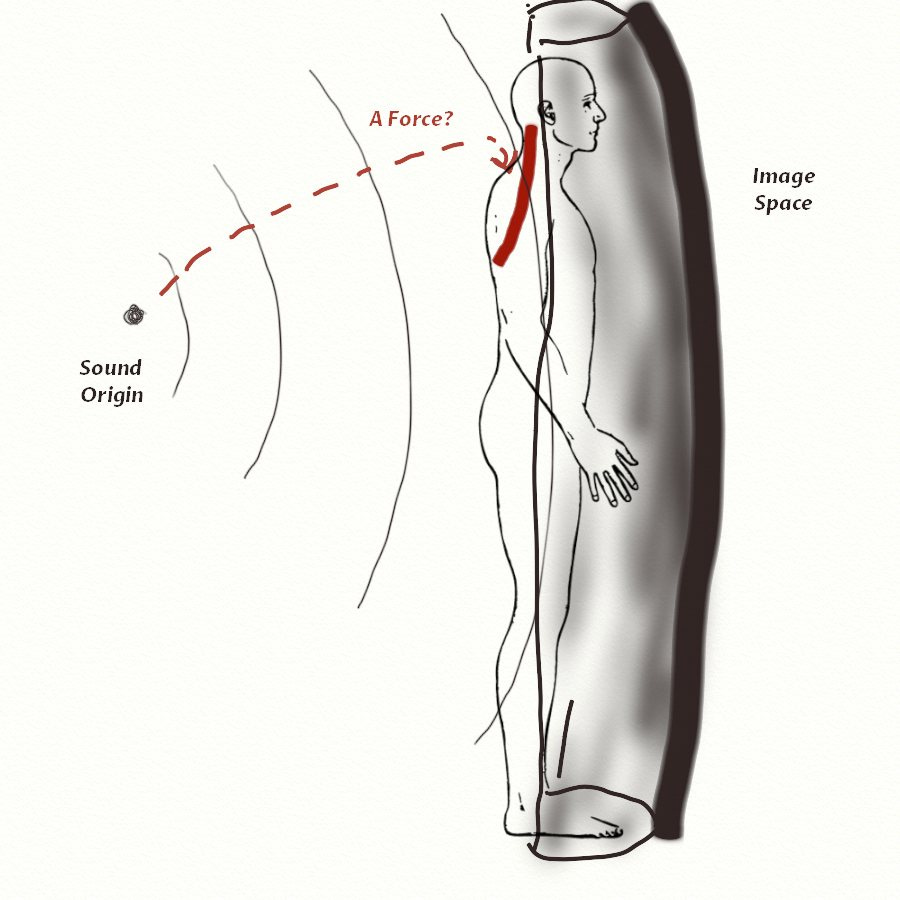
Let’s see where this leads. To be continued…
love to find this on my feed during a manic episode