

Previous chapter:

Many of us are familiar with being trapped between a seemingly intractable pressure from expectations on the outside and our desires and truths on the inside. This common dynamic shows up in many forms in the individuals impacted by it.
Here are a few examples of unpacking the fear and anxiety that often acts as the paralyzing force, showing what can happen when we release it.
“A Refreshing Transformation”
Mike worked with me for just one hour over the phone, focusing on a fear of public speaking which was affecting his professional success. Here are his words, including a description of how he experienced our work together:
“We talked about some physical distress I exhibited each time I presented a seminar or hosted an event. Through a series of guided imagery questions Joe had me actually visually place the feelings that came up during presentations in a specific place in my body. He prompted me to describe, locate, and get very acquainted with those feelings. He asked me to allow those feelings to transform into a different shape, space, and place.
“I immediately received a sense of lightening up, a refreshing transformation that freed me up and left me very, very energized. He left me with specific instructions as to how I can re-create that transformation and recall the image I created prior to my presentations. I now cue myself before every presentation, client meeting, and networking opportunity to fortify myself with that powerful image of who I am and what I offer those I connect with.
“I found the experience of my session with Joe invaluable. I easily connected with the model of creating visual images and descriptions for the questions he used to guide my learning experience. I am a very visual and creative person. Though we did talk of some very intimate things that lead me to a fairly vulnerable place, I always felt safe with his guidance and support. One of the best things is that he took notes and had a way of recording our session so whenever I want to go back through a reminder or refresher on my discovery, I can. I was completely free to do the work necessary.
“Being freed from the focus on how I’m being perceived, or how am I doing, or what am I going to say next is invaluable. It has allowed me to truly listen and be present while presenting, whether to a group or just one person.”
Mike’s experience was brief and focused. We did not work a full set or go deep into the structure that held his fear of public speaking in place. He is describing our session in the conversational terms in which he understands it. We focused on a simple strategy of shifting the fear itself, and anchoring that new state in a tangible, easily-accessible form.
From there, Mike simply activated that state whenever he needed it. Psychotopology fieldwork makes this strategy practical and straightforward.
“I felt good. I felt victory!”
One more client, Peter, had this to say two weeks after working over two long days with me, maybe 12 hours total, where he transformed a fear of public speaking that was so bad it had put him in the emergency room a few times before he sought my help. He’s describing a recent sales presentation he did:
“If I would have walked in there before I met you, I know I would have been sweating, stuttering, and probably left the room five, ten times, because I just would not be able to stay in there because of fear.
“Yesterday I sat in the middle, spoke to everybody, looked everybody in the eye, and talked to them like I had something to offer. I felt like I wanted to feel, the whole time, without feeling fear. Just like I’m talking to you here.
“It didn’t matter if it was one person or ten people, I was me, all the way through, and not out of whack, not too scared, not nervous. And I felt good. I felt victory!”
A couple years after I worked with Peter, he sent me this note:
“Your work has truly changed my life. I now look at my life as before meeting with you and after. I am now more of the person I have always wanted to be because of our sessions. Thank you so much.”
The Difference Between Moving a State and Moving a Set
The example of Mike’s leaping forward out of a single hour of working specifically on the fear shows us that yes, it is straightforward to narrow our focus to releasing a single state. When we do, we gain wonderful agency for being able to cultivate that specific new state and deliberately return ourselves to that state when it serves us.
But that can take significant effort. In contrast, Peter’s example shows what is possible when we take the time to also work the interconnected parts of the entire set in which the anxiety is situated. When we do that, the shift is more comprehensive, and requires far less effort to maintain.
Let’s see how this works with Sam, who worked on a set that had to do with feeling thwarted and overwhelmed trying to go to school full time while supporting her two children. We worked together weekly over a period of about three months.
To give you a glimpse of Sam’s experience of this set, here is a composite drawing of all nine of its states. At the center of the belly is Vulnerable, a cold, churning liquid surrounded by Anxiety, like a tense anemone. On the outside of the body we have Overwhelm, “like radial explosions all over my borders.”
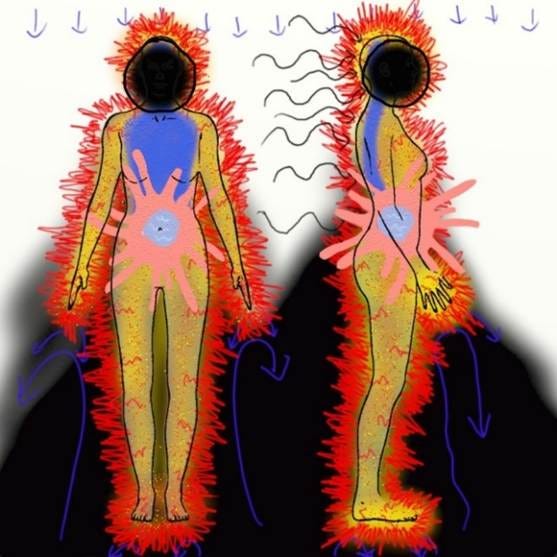
Really, really doesn’t look fun, does it? And finally, here is the composite drawing of the set after it was moved to its ideal state of natural wholeness:
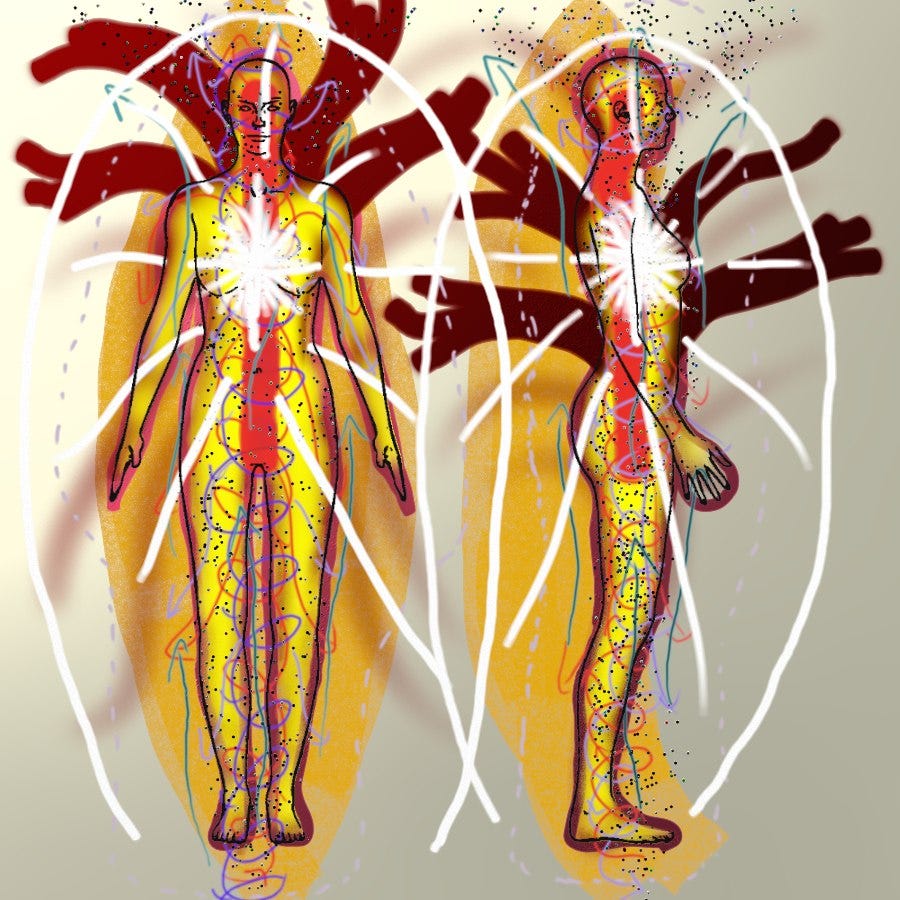
This is how Sam described the shift she experienced after completing that first set:
“So the first set of feelings that I moved with Joe had to do with feeling really unsupported in my work. Feeling overwhelmed and exhausted, and just alone with it all. And within weeks, I felt a spaciousness in my life. I did not feel stressed out any more. I wasn’t getting overwhelmed. All of that just kind of stopped happening. Without any conscious effort, I was just living differently, naturally, without even having to think about it.”
So, this is what I’m talking about. This is what it feels like to thoroughly excavate the complete set of parts that governs a pattern of distress in your life, and to fully restore its natural functioning.
Some Context
Before we take a look at another example, let me share a further thought. We are large, we contain multitudes (to use the Whitman phrase). This set that Sam worked was one of many that participated in her experience of being. But this one was at the center of her drive to raise her children while pursuing her vocation, and when it was released, it stayed at the center for a time.
Within a few weeks, though, another part of her, another self with all its complexity, stepped forward and captured her attention. So we worked on that one next. I wrote about that one in chapter SO-6: Multiple Coexisting Feeling States.
Most of us have this external container to our lives — the responsibilities, relationships, and physical environments — that somewhat constrains our freedom to foreground the various selves that constitute our full being. And so working those key selves by using fieldwork to restore the natural functioning of the full set of parts can go a long way toward greater ease and effectiveness in pursuing our goals. Peter is a great example of this.
Some people, though, have either more spaciousness in that life container, or at least give themselves more freedom to wander internally. For those people, restoring the functionality of one self/set is likely to open the door for another to surface. This process of working one set after another can go on indefinitely, at least from a practical perspective. There is a limit to how many selves we contain, but it’s large enough to keep us busy for a very long time.
Next chapter:

Volume 1, Table of Contents:

Get your printed (or PDF/ebook) copy:
