

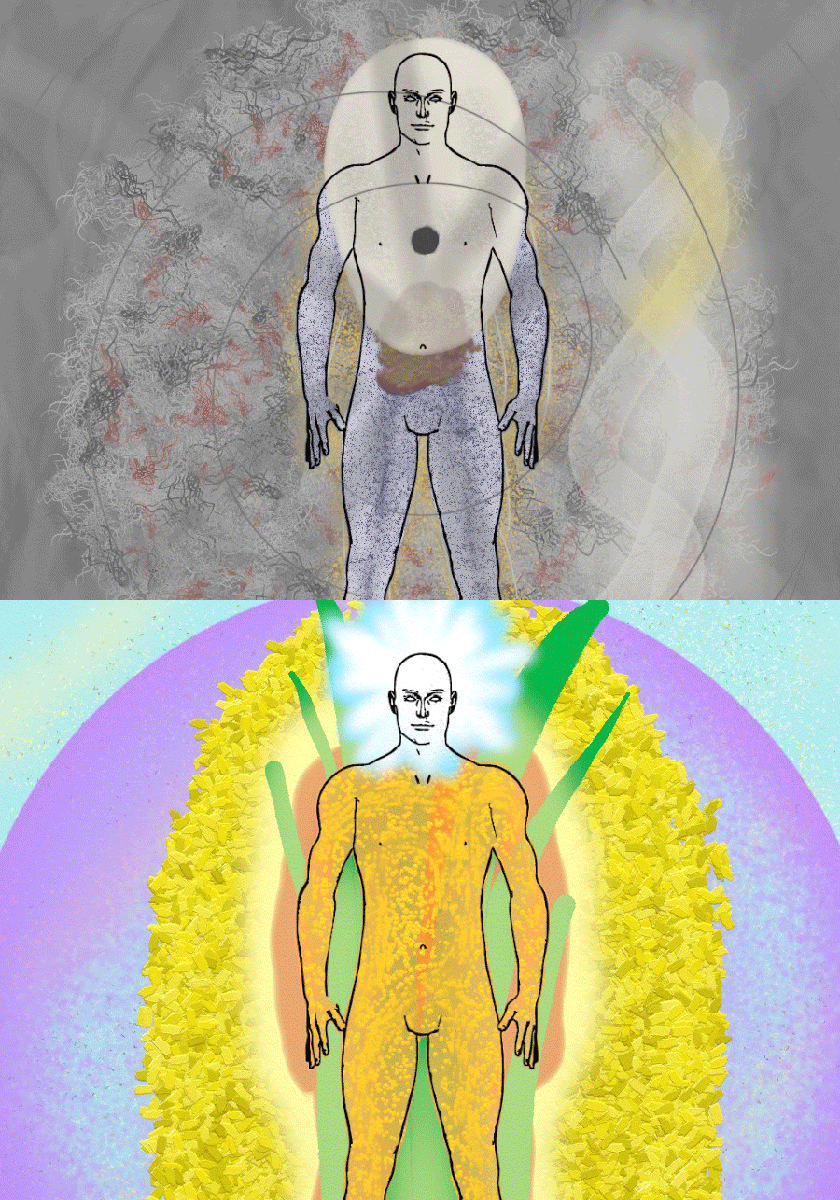
I’ve been sitting on this post for a really long time. It’s a summary glimpse of the direction all this is leading. I’m still working on it, and there’s quite a distance still to go. It will take the entirety of the next two Volumes to flesh it out so that it has a chance of making sense to you. And it will take no small amount of direct immersion in the work itself before you’ll have the capacity to understand. It is not likely to make mental sense from any place you might be standing right now.
I’ve gone back and forth about whether to post this. It’s rough and incomplete, for one thing. But again, it won’t be complete without the entirety of what is yet to be written. My decision to post it is more of a “just in case” than anything else. Just in case it does land for someone. Just in case something gets in the way of my laying out all the rest. Yes, it’s a rough sketch, but it is definitely a sketch of a something.
My thinking is this. At this point, after having finished the section on the moving phase of fieldwork, I have given you enough that, if necessary, you could start at square one and create psychotopology all over again from the ground up. It would take some discipline, and a number of years of consistent effort, but the right team could probably do it. Consider this post a rough sketch of what you might find, to help you notice and make sense of patterns as they arise.
In the long run, perhaps this document might serve as a broad kind of reference glossary of terms and structures, and I will revise it over time to be as clear and concise as possible.
The Topology of Being
The most important thing to keep in mind as you scan or read through the following is this: we are looking at the structure of the experience of consciousness, not the contents. We humans have tended to prioritize the contents of consciousness as what defines it because we have not had good tools to examine the structure. Now we do. And what we find is far, far outside our habitual ways of understanding this core experience of being that grounds every moment of our lives.
Consciousness occupies space.
Consciousness is a field phenomenon. Which means, essentially, that it occupies three-dimensional space in and around us, with that occupied space possessing properties different from the space outside of it.
Consciousness is modular.
Multiple zones of consciousness coexist within the same person, enacting different functions, occupying different spaces, yet coordinating their efforts.
Each module is composed of one affect field and several imagery fields.
Each module of consciousness carries a universal structure. Its core function is held by an affect field, experienced as what is most often referred to as “feeling.” Supporting this core function are imagery fields which host sensory imagery of various kinds, with the experiential imagery qualities congruent with the feeling tone of the affect field.
The fields of a single module maintain high congruence with one another. Changes in any one field are instantly accompanied by congruent changes in the other fields in that module.
Consciousness fields carry experiential virtual material properties.
All consciousness fields carry properties best described as virtual materials, experientially resembling phenomena of the material world including substance, temperature, color and others. The virtual material properties of affect fields are experientially most tangible and ground all conscious experience in their virtual materiality. The virtual material properties of imagery fields tend to be more subtle, acting more to support the projection of imagery, but carrying their own presence in the space in and around the body.
Modules of consciousness join to form agentic selves.
Sets of nine modules of consciousness function as a whole to generate the experience of a self with agency in the world. The nine modules serve a three-by-three matrix of nine universal functions necessary for the agentic self experience, as follows.
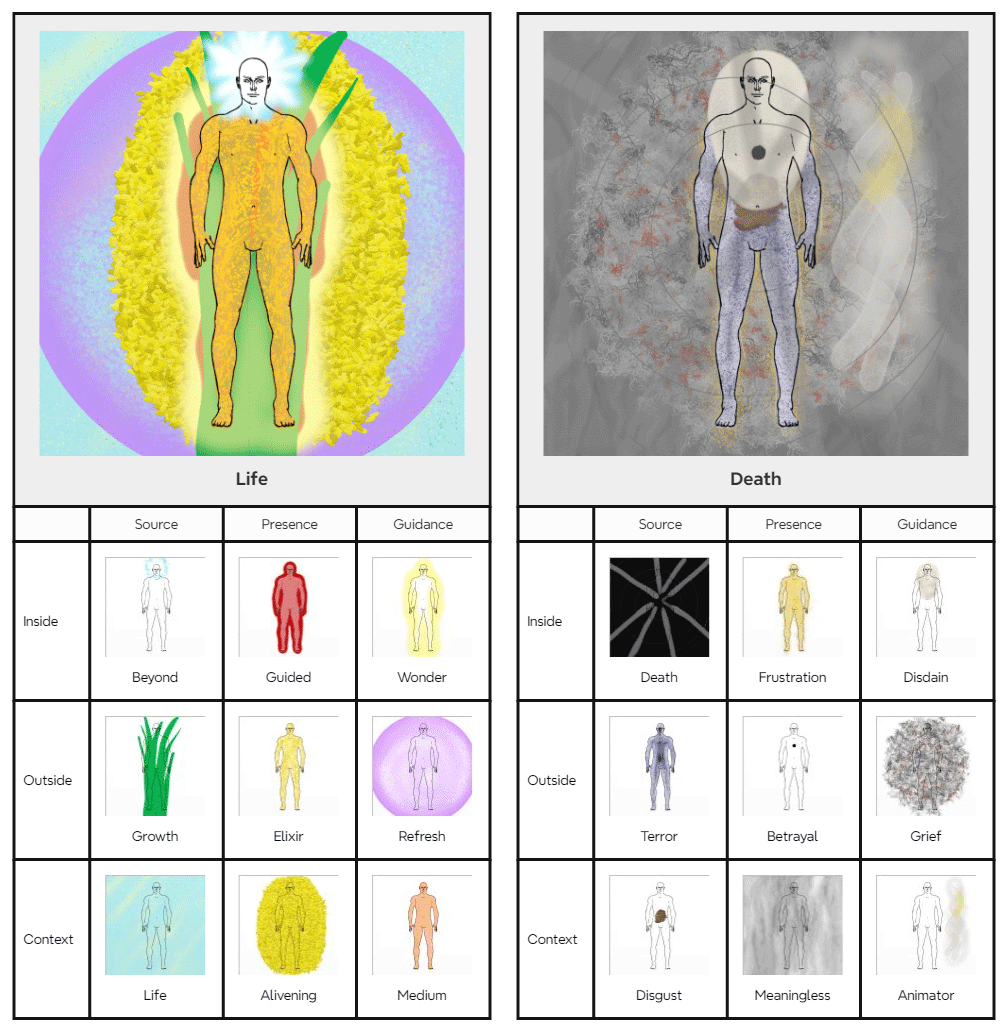
Along one axis of the matrix lie the inside, outside, and context functions to support differentiation of the self and its relationship to other in the context of its relevant environment. Along the other axis lie the possibility, intention and enaction functions to support the agency of that self. I typically refer to the functions in this second axis as source, presence and guidance to better reflect the typical structures of their ideal states.
All together, these nine functions are necessary and sufficient to generate the experience of a self with agency in the world.
An affect field operates across a spectrum of feeling states from ideal to reactive.
A module’s functional role is carried out through adjustments reflecting the state of the person’s experiential world including what is possible, what is intended, and what is enacted for the self, the represented other with which the self is in relationship, and the contextual environment in which that relationship is held. The affect field for a specific module expresses the summary feeling state which holds the essential assessment of how well things are going for the fulfillment of that module’s function.
The affect field holds as a reference point an ideal state, the feeling experience reflecting successful fulfillment of that module’s function. In any given moment, the feeling state expressed within the affect field reflects how well the fulfillment of its function is going relative to the ideal.
Images are hosted in imagery fields, and thought arises as links between images and across modules.
Links of simultaneity or sequence between sensory images within a module and/or across modules generate the experience of thought, often with the inclusion of language attached to the images and/or links. The basic structures of these links include:
Equivalence: This equals that.
Causation: This causes that.
Sequence: This precedes that.
Imagery fields and thoughts maintain congruence with affect fields.
As the affect field moves its expression along the spectrum from ideal to reactive, so too do the imagery fields, and thus, the thoughts which connect the images arising within them. Reactive feeling states shape reactive perceptions, images and thoughts. Ideal feeling states shape ideal perceptions, images and thoughts.
Every person hosts many selves.
The structure of the person is fractal in nature. Nine modules assemble into a self. Nine selves assemble into a functional level serving a fundamental life capacity. Nine levels serve the needs and capacities of the whole person.
Each distinct self serves a specific life capacity.
Each of the nine levels of being is committed to an archetypal life capacity, including, for example, that of inhabiting one’s physical body, engaging in a mutually nurturing relationship, or contributing to one’s community. Each of the nine selves operating at a particular level fulfills a specific role in the service of that level’s natural capacity. For example, a self might fulfill a role that holds the core assessment of the state of the relevant surrounding world, while another role might involve directing activity to pursue meeting essential needs to support the capacity’s functioning.
Our various selves and capacities activate over the course of a developmental life journey.
A person’s capacities emerge over the course of a lifetime in a sequence roughly corresponding to stages of development. Gaining agency in one capacity frees up inner and outer resources to develop the next. Fundamental capacities such as embodiment and play come first, while more advanced capacities such as fulfilling one’s life purpose or contributing to one’s community come much later.
Each life capacity requires specific needs to support its functioning.
Each capacity level requires specific needs to be met in order to function successfully. For example, the capacity for engaging in a mutually nurturing relationship requires another participant in the relationship who is able to engage in a mutually nurturing way. If that need is not met, the capacity is unable to function.
Shifts in affect fields indicate the status of such unmet needs. For example, the experiences of loneliness, longing, or frustration may arise in the modules of a self connected to the capacity for engaging in a mutually nurturing relationship. In doing so, these feeling states motivate actions directed toward meeting the need so that the capacity can be enacted.
The meeting of relevant needs is essential for any capacity to develop.
A newly emerging capacity needs to go through a developmental process of learning how to meet its needs and enact its gifts. When essential needs are met, the capacity learns how to function over time and through experience, using resources available through the whole person, key allies and aspects of their environment. When this process goes well, the capacity develops to the point of being available at any time and able to function automatically, without the need for conscious direction.
When needs go unmet, the capacity develops compensations.
When a capacity’s needs are decisively or chronically not met when that capacity first comes available to the whole self, that capacity’s self shifts from development to compensation. Unable to learn how to embody and employ that capacity for its purpose, the self commits to compensating for the unavailability of those needs, rendering the capacity non-functional.
The unmet needs are marked by persistent distressing feeling states which, over time, often intensify in order to attempt to motivate action that could achieve the meeting of those needs. When this fails and the overall stability of the whole self is threatened, other selves step in to establish a broader functionality within the need-deficient context.
This often takes on a general, three-stage structure. In the first stage, often in childhood, essential needs are not met and the self is distressed. In the second stage, often in teen years, some agency is regained through a kind of rebellion against the unavailability of the need. In the third stage, often in adulthood, a strong compensation emerges in which the need is redefined and pursuit of a substitute is undertaken.
These three functions are taken up by three complementary selves most usefully identified as core, reaction, and manager selves. Their essential modes often take on a form resembling, “Life sucks,” “Don’t want to participate,” “Unless…”
This particular structure may be reflective of western culture, and other cultures may have other common forms that show up.
The modular field topology functions as a whole system.
Each module and each nine-module self functions in the context of those around it. Every element is influenced by every other element. Through the developmental journey, for example, early compensation strategies for unmet needs will likely be applied to later emerging capacities, often even when those new needs are able to be met. Personal themes emerge that infuse the entire system.
In any given context, at any given moment, one or more selves will occupy the foreground, functioning as the interface for lived experience. But at the same time, other selves will be acting in the background to shape and influence what is experienced up front. We are never fully disconnected from any of our inner selves, even when many of those selves remain definitively outside of awareness.
Awareness overlays consciousness.
Most of consciousness remains outside of awareness, with many fields occupying the space in and around the body as various levels and selves are stimulated in response to capacities called forth by various contexts. Awareness operates as an activation field, also occupying space. When the field of awareness overlays one or more fields of consciousness, the contents of that field are brought into explicit awareness.
Consciousness generates lived reality. The field of awareness brings that reality to life.
The full range of what is possible for us to experience in the world we inhabit is generated and held by consciousness. We are constantly engaged in constructing this world and maintaining it. The field of awareness activates portions of this living world moment by moment.
Even our sensory perceptions are organized into fields of consciousness and activated by the field of awareness. We perceive the information that comes through our senses through the mediating interface of the fields of consciousness. Sensory data is assembled into dynamic representational models of the world, and it is those models with which we interact when they are brought into awareness.
The field of awareness chooses what to activate from consciousness.
One function of the field of awareness is to act as a filter, bringing to the foreground of awareness certain contents of certain fields of consciousness while releasing other contents of that and other fields into the background to remain outside of awareness.
Fieldwork enables awareness to access the virtual material field structure.
Fieldwork applies the activation power of the field of awareness to the underlying field structures of consciousness. The virtual materiality of both affect fields and imagery fields becomes accessible, and through that access, fieldwork enables direct engagement with a field’s structure. We gain the ability to alter virtual material properties in order to interact directly with our conscious experience.
The field of awareness is directed by one set of three modules functioning as an agentic witness.
What is activated by the field of awareness is controlled and experienced by one module functioning as a direct witness. This module is held in the context of a triad of three holding a sense of what is possible, with an intention and a path to action which guides the movement and selection of the field of awareness. This witness function can be situated within any self, although habits of attention tend to constrain the witness to only a few key selves for any given person.
The field of awareness has the power to activate change in the construction of our lived reality as it inhabits consciousness.
Fields of consciousness operating outside of the field of awareness tend to occupy themselves with simple maintenance of the worlds they have constructed. When the field of awareness overlays one or more fields of consciousness, these constructed worlds have the capacity to change in response to the intention of the witness.
This activation power is the source of creativity. Bring into the field of awareness two fields and/or specific contents that have not interacted before, and something new emerges. Fieldwork explicitly leverages this capacity. On the other hand, rigid habits of attention kill the life force of creativity.
This universal structure is inhabited by an infinite diversity of unique expressions within and across individual people.
The topology of modules and functions and selves described here is universal, perhaps beyond the human. The specific way these are enacted and expressed within a single person is infinitely unique. No person has ever lived an identical experience with any other person. While the topology of consciousness is universal, the topography of any given person’s lived experience is absolutely unique and irreproducible.
The field dimension infuses relationship, culture, and the natural world.
Above I’ve presented the universal topology of conscious experience for an individual person. Discovery of this topology and the field dimension of consciousness carries significant implications and insights for our understanding of collective experience.
These fields occupy three-dimensional space not only for the person from whom they are generated but also for other people who share that space. Whether through “reading” one another’s non-verbal expressions to pick up where in space their most active imagery lies as they speak, or through somehow “sensing” the fields as they intersect with our own in some way as yet not confirmed or understood, we are sensitive to the field spaces of consciousness inhabited by one another. This sensitivity plays a very important role in our relationships, communities, and shared spaces.
This is also the case in the context of all beings, whether with our pets or the creatures in nature. My hypothesis is that all of life is grounded in this field dimension, that we have direct access to an awareness of this dimension, and that other beings carry this same awareness of us.
Two key features of human inner topology are incompatible with dominant modern concepts.
Human inner topology as revealed by fieldwork radically revises current concepts about human nature as follows:
Feeling shapes all inner activity. It is fundamentally wise and interconnected, and offers the most reliable source of guidance for navigation through the experience of life.
The modern understanding of human nature places rational thought as the universe’s highest achievement. Human inner topology, however, is built upon the foundation of feeling. Thought is an expression of feeling, not the other way around.
When supported by awareness and thought, feeling functions as a broad interconnection among the many modules, sets and levels of the human topology. Feeling is able to “think” with the whole self and to sense beyond what is explicitly available through the senses and explicitly represented through thought. True wisdom arises from a healthy, natural relationship to feeling.
Every module of consciousness, every set of modules, every level, every whole person is inherently, at the core, an expression of life as goodness seeking thriving.
There is no evil in the world. Every single module of consciousness seeks wholeness, goodness, and thriving for the whole person and for the whole world in which the person resides. Any action of any person which disrupts these drives arises only in response to the imposition of a greater power which obstructs their achievement. Restoring access to the natural functioning of what is inherently alive and human in that person restores their capacity to manifest these highest goods.
Because of this discrepancy between our nature and our systems, the following is of utmost importance to the future well-being of our planet.
Our current modern worship of “objective” rationality above feeling, along with our attribution of evil to individuals who perpetrate harm and our efforts to police and control such behaviors and shame such perceived tendencies, has ruptured the natural connection of every human to the inherent wise goodness of feeling. This must be restored.
First, we must place feeling at the center of all human activity from the beginning of life through to the end. The purpose of thought is to serve feeling, not to dominate it.
Second, we must trust the goodness and wisdom inherent in every person at every age, beginning at birth and continuing to death. And we must take collective responsibility for all harmful actions done by any person at any time.
In Summary
Consciousness builds and hosts virtual experiential worlds through three-dimensional fields and representational imagery. This is the foundation of awareness, but is not, itself, aware of its own activity. Awareness arises through the superposition of a separate awareness field over the fields of consciousness, bringing some contents into awareness while filtering out others.
This structure, the worlds it hosts, and its selective activation generates the experience of an aware self with agency in its lived, experiential world, able to navigate its experience to pursue ends it chooses in order to cultivate an optimal balance of thriving for itself and its world.
What is consciousness, then?
What I have described here is how consciousness is structured and what it does (in humans, at least, but possibly more universally). But at this point, we cannot really say what consciousness “is.” I do believe, though, that the revelation of this functional topology and the development of tools for navigating it offer significant opportunities for research into this timeless question.
For example, one possibility this work suggests to me is that the field dimension of consciousness participates in reality, which is itself a field phenomenon. It suggests that all of reality is conscious in some way, or that consciousness is the raw material of all reality.
Don’t take my word for it.
All of what I describe is accessible to your own experience if you learn where and how to observe. Give me a few hours as your guide, and I can show you around. If you’d like to follow up with that, DM me here on Substack, use the contact form at psychotopology.com, reply to this email if you’re a subscriber, or just send an email to “frontiers” at the root domain here.
More to Come
Like I said at the beginning, I do not expect you to follow what I’ve laid out here. It will take a few years to build this structure for you through a one-step-at-a-time discovery sequence. But I wanted to give you a glimpse of where we’re heading so you can start to sense the broad outlines of the journey we’re making together.
If this intrigues you and you haven’t yet subscribed, you might want to do so. And consider signing up for a paid subscription to support my work. This is my life’s work, conducted entirely outside the system, and I rely with gratitude on every single dollar I receive from supporters. I would also greatly appreciate introductions to humans who, for whatever reason, are in a position to help bring this work into the world. We all need it.
Reflections and Comments
I’d be very interested to hear how this lands for you. Do you see resonances with various experiences you’ve had and/or things you’ve studied? What are the biggest questions arising for you? Let me know in the comments below.