We arrive in this world as material beings embedded in material surroundings. From the time of our first awakening into infancy (and even before we are born), we find ourselves immersed in stuff and qualities of stuff. As we learn about the world and about our bodies-in-the-world, our senses are saturated with experiences of solids, liquids, gases, light and energy with all their myriad properties.
We experience ourselves as these substances, and we experience our environments as these substances. It is this world of substance that our embodied consciousness must first make sense of, navigate, and master in order for us to take on all of our higher functions and awareness.
So it should be no surprise that a fundamental substrate of consciousness seems to be the felt experience of the stuff of our lives. Try this little thought experiment as a demonstration of the ubiquity of the extended felt sense:
Close your eyes. Imagine picking up a broom and sweeping a floor. Or choose some other tool (and goal) more familiar to you. Can you sense the extension to your body, its weight, rigidity, and other physical properties? Can you sense just how you would move your body with this extension in order to accomplish your goal?
What Neuroscience Has to Say
According to neuroscience, your brain starts with a detailed model of your body, and then incorporates your tool into its model. It is as if the end of the broom becomes the edge of your hand. It does this in order to reliably predict what will happen to the end of your broom when you move your body in a certain way, and to deduce in reverse just how to move your body in order to get the dust out of that corner. A little push here, a little twist there, and swoosh, the corner is clean.
Not only does your brain model your body — referred to as your body schema — to incorporate the tools you are using, but it also creates a model of the space immediately surrounding you. Again, it is as if the space has become a part of your living self, in service to your being able to reliably navigate that space using the vehicle of your body.
This modeling can become quite extended, for example in aerobatic pilots. The phrase “flying by the seat of your pants” comes from the ability of experienced pilots to feel the connection of their body to the airplane as constant feedback, enabling them to fly as if one with the plane. Similar functionality can be seen in excellent operators of any such equipment. The other day, watching the garbage truck driver manipulate the grip mechanism to gently nudge the trash bin back into place after dumping it into the truck, I got the sense of that oneness between the driver, the machine, and the trash bin.
This is not a capacity limited to examples like these. We are doing this all the time, constantly maintaining a felt sense of our vibrantly dynamic body while taking on the objects and materials of our surroundings as extensions of our physical being. We are continually forming a multi-sensory, virtual material representation of our body-in-the-world, and using that representation to navigate the world.
Always and Everywhere
Let’s reach beyond tools for a moment. Imagine dipping your hand in a pool of warm water and swirling it around. Can you sense the weight, the fluidity, the texture of the water as you move your hand through it? Can you sense how you would push the water to create a small current?
Now imagine standing somewhere outside in a strong breeze. Reach your hands out to the side as you face into the breeze, and angle your hands to catch the wind as it pushes them upward and back.
One of my physical practices used to be a dance discipline called contact improvisation. Contact improv is a practice of taking on the weight and dynamics of another person as an extension of your own body in dance. You move together, communicating through touch and gravity and motion, becoming one expression through opening to one another’s embodied physicality.
Many disciplines draw upon and refine this power of virtual material projection including various sports, wilderness pursuits, expressive arts, crafts of all kinds, and many more. In fact, you will see eventually if you dig deeply enough into psychotopology and fieldwork that even the most abstract and sublime of human pursuits, those we deem spiritual or mathematical for example, rely strongly on this capacity for virtual material projection. For myself, I remember becoming aware of this functionality when studying organic chemistry. (I mentioned this in IS-7: My Approach to Science.)
The Fish in Water Limitation
But why is this central capacity of our consciousness so unacknowledged? I believe it is a case of fish in water. We are immersed in it, so stepping outside the phenomenon to examine it can be difficult. And when you almost always have real, physical things to point to as origins of your somatosensory experience, you attribute the experiences to the things. Counterexamples, as when you experience strong somatosensory images with no physical referents in dream or fantasy, or when you engaged in exercises like those above, are dismissed as irrelevant, just “in your head.”
What I am saying here is that underlying all of our directly physical experience is a duplicate or shadow representation of our body and its physical environment, generated by the felt sense. The more accurately it represents actual properties of our material surroundings, the more effectively we are able to navigate and manipulate those surroundings. I believe this virtual material world may be an essential component of the consciousness of all embodied, mobile creatures.
For humans at least, that felt sense has a creative capacity as well, able to generate somatosensory images having no material origin. Our capacity to both perceive and create virtual material imagery is profound. And I believe it is that capacity which gives rise to the endlessly diverse profusion of actual feeling state experiences we encounter in the course of our lives.
The diversity is far greater than our current language of feeling accounts for. And because feeling has been highly subjective, available to no one but ourselves, it has been difficult for us to talk about feeling in ways that accurately communicate to one another about our actual, felt experiences. We have had no way to objectively corroborate our descriptions in the way we find so easy to do with visual, auditory, or kinesthetic/tactile experiences.
Until now. The explicit questioning technique of fieldwork fills in this gap and reveals astonishing elegance, complexity, and intelligence in the realm of feeling. I anticipate that these questions will also eventually provide the means to scientifically verify the suggestions I am making, and to connect them to current theories about embodied cognition and body schema. (Even more, I have a hunch the cerebellum may be involved.)
What do you think?
Let’s take a look at a few more feeling state observations to further motivate your curiosity about all of this.
A Few Examples to Contemplate
The following examples are from a single fieldwork session with one woman, who I will refer to as Hannah. Notice how intertwined they are with one another. She experienced the first pair, Anchor of Powerlessness and Cables of Confinement, as two facets of what she experienced more generally as being Powerless.
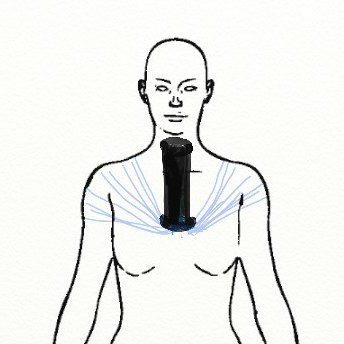
Anchor of Powerlessness
It’s incredibly frustrating. The sense that I can push and push and push and still not get closer to obtaining what I want, of not having any control over really important aspects of my life or even what direction I’m going.
In my throat, going down to my heart, like a cylinder, maybe four inches diameter. Solid, almost like a pipe, like it’s hollow on the inside. There are filaments that spread from it. (See Cables of Confinement below.)
Pipe, feels metallic and corroded, heavy and black, half-inch thick, open at top and bottom. Neutral temp. Pushing down on chest and shoulders through the filaments. No movement or sound.
It’s hard, rigid. It’s like an anchor. It’s like it’s a piece of me. It doesn’t feel bad or good, but it feels like it needs to be inside. It doesn’t go outside. It feels almost like it contains my throat and vocal cords, and when I have this feeling of being Powerless, it constricts them, reminds them not to move, just to wait. I might say something I regret because I’d be angry (hinting at Indignation below).
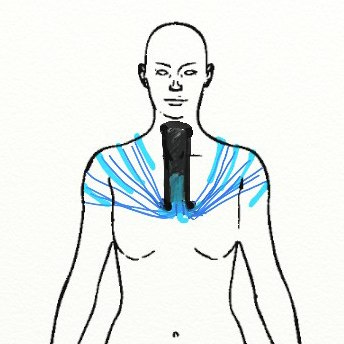
Cables of Confinement
Filaments are coming from the pipe, (Anchor of Powerlessness), but are an electric blue and glowing; seems to be some kind of electricity. Rubbery, wiry vines. Hot. Like an electric shock. Filaments are located in the hollow of the pipe, exit the bottom, and crackle as they exit. It’s like the electric current is moving through them and you can hear it popping like power lines.
Filaments initially spread out to grab my shoulders, but after they’re in place, they don’t move. Just the current moves. Feeling of being weighed down. Current moves outward through the filaments. It’s like one of those lightning balls where you put your hand on and it attracts the current.
They are clutching me, almost like they want to hold me together but they’re just holding me down. If they didn’t, the pipe might sink. These filaments are there to keep it in place.
The next pair of states emerged out of observing/mapping the first pair. They showed up as confined within the tube of the Anchor of Powerlessness, and together Hannah referred to them as Outrage. The Powerless structure above keeps the Outrage at bay.
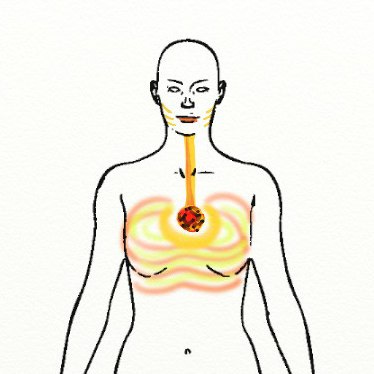
Indignation
I feel I don’t have any control over what’s happening, so I feel angry about it. I feel angry that I can’t change the circumstance. It feels like something outside is almost punishing me. There is this want for things to be better and I don’t understand why I can’t make it that way.
In the middle of my chest, above where my heart is, right where the pipe (Anchor of Powerlessness) is pushing down. About the size of a baseball. Hard, lighter than the pipe, and it’s like it’s shooting up my throat and hiding under my tongue, making my jaw really tense. Fiery red/orange and hot. It’s like the core in my chest is harder, and it’s shooting flame up from that core.
Rocky, but there seems to be this molten lava texture to it. Hard inside, and the surface is moving and bubbling. Hot. A hard center, like a core. (See The Core below.) Just the outside is molten. Two or three inches thick. As I think about it, it feels like it’s getting bigger than a baseball. Sound of the bubbles popping. Bright, fluorescent orange, with a blackish crust.
This is shooting up into my jaw. None of the black crust comes up, just this pure, hot light, more like fire. As it rises, the intensity doesn’t change, but it becomes more limber, more free to move. It’s glowing, and it’s hot, and it wants to shoot out of my throat. Because it can’t, it’s tightening my jaw instead. It can expand but it’s not the molten-ness that really expands, it’s the little jets that it sends out; can fill my entire chest cavity when it’s really aggravated. It wants to be expressed, to be let out. It wants to shriek.
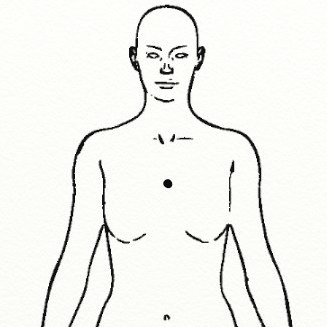
The Core
Size of a ping-pong ball, maybe smaller. Really dense like lead. Hard but heavier than just a beach rock would be. Hot but it’s hot because of the molten exterior. I don’t think the core has a temperature itself. Jet black, opaque, and matte, not shiny. No movement, feels very solid. It wants to go up. The whole mass wants to go up. Sound is like a repressed scream, like a shriek. I don’t know whether it’s a shriek of heat or human. Same all the way through, like it’s the pit in the middle of a fruit.
It’s just really angry. It’s violent. It wants to get some kind of retribution. Wants to feel like it’s powerful, like it’s making an impact, even if it’s destructive. Towards the sense of injustice, the Powerlessness. It wants to assert power and the Powerlessness wants to keep it sunken. It stays put because if it surfaces it’s not going to fix anything; it may make things worse, so it gets repressed and it just burns.
Noticing
What to make of these four observations, conducted within a single, two-hour session? We have a very specifically arranged group of four closely related components defining a dynamic interaction between powerlessness and outrage. The high resolution and fidelity of these observations, along with their strong congruence with the observer’s lived experience of this inner dynamic, require a very sophisticated functionality. Such functionality exists, as we know, in our capacity to represent our extended embodiment experience, and I suspect this same functionality is very likely to be employed for the generation of these virtual material feeling objects.
And Three More
I’d like to provide another trio of examples to make sure to illustrate the way these virtual material feeling objects often extend into the space around the body. The following trio also illustrates another common dynamic I’ll discuss below.
Trapped
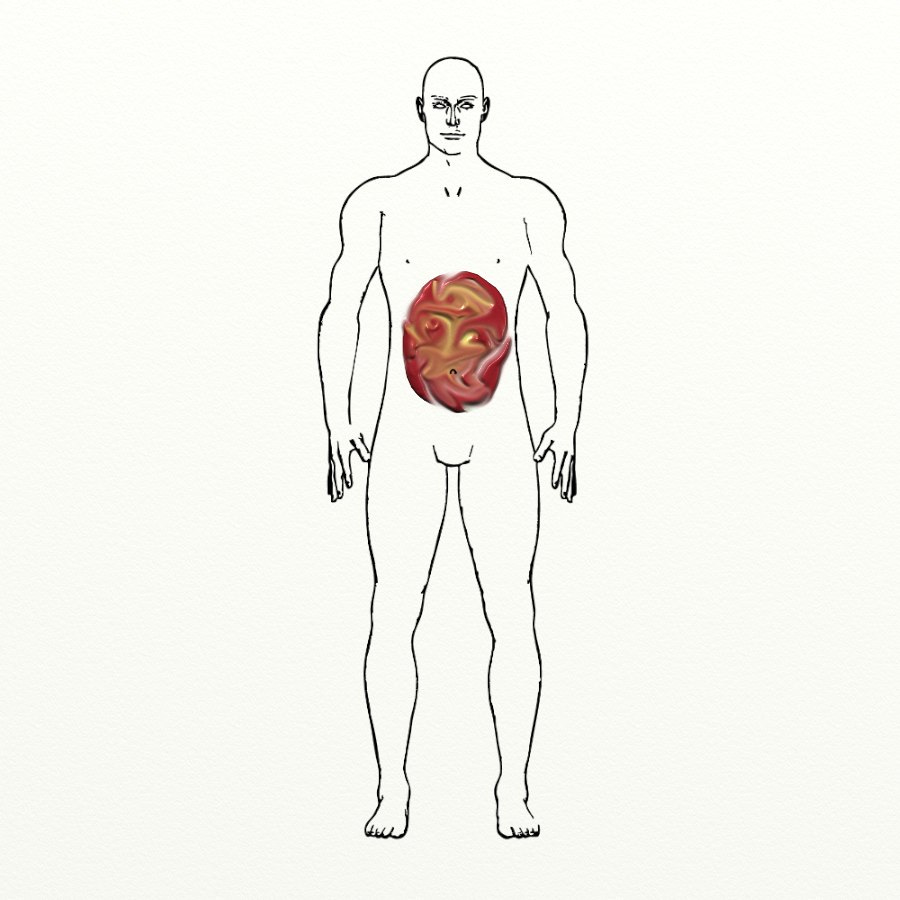
Stomach/abdomen; tight, as if resisting an imposition; twelve-inch irregular ovoid; hard/firm like an organ that is sick with some kind of cancerous growth; red, white, meat colors with some odd yellow-green; writhing, undulating, slow; bigger and more movement = more intense; feverishly hot; sound of constant tone of anxiety, vocal, not my voice, like a deranged child. “Help me.” But no point asking for help.
Trap
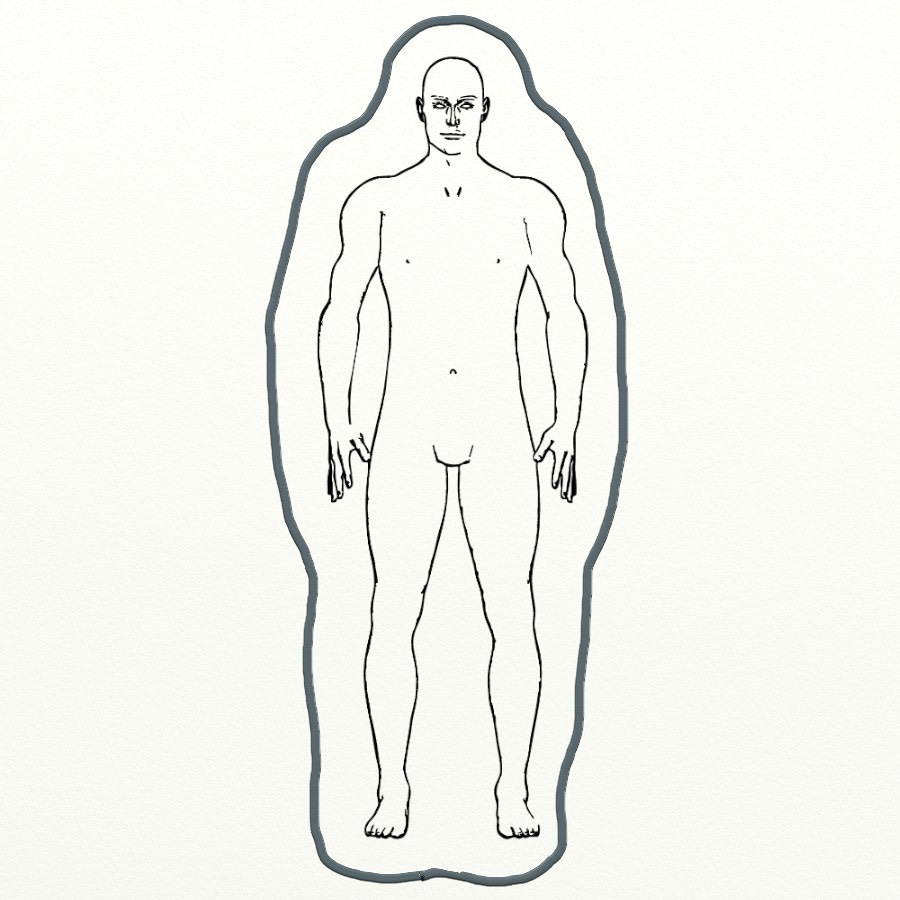
A confining container around me; sometimes very close, barely an inch away from my skin; other times farther, giving me room to move; solid, rigid, not very thick (half inch) but impenetrable; gray like a kneaded eraser; neutral temp; no movement; no sound, but I am aware that beyond it is no freedom.
The trap is controlled by what is outside it. I hate this thing. I can’t get out.
No Way Out
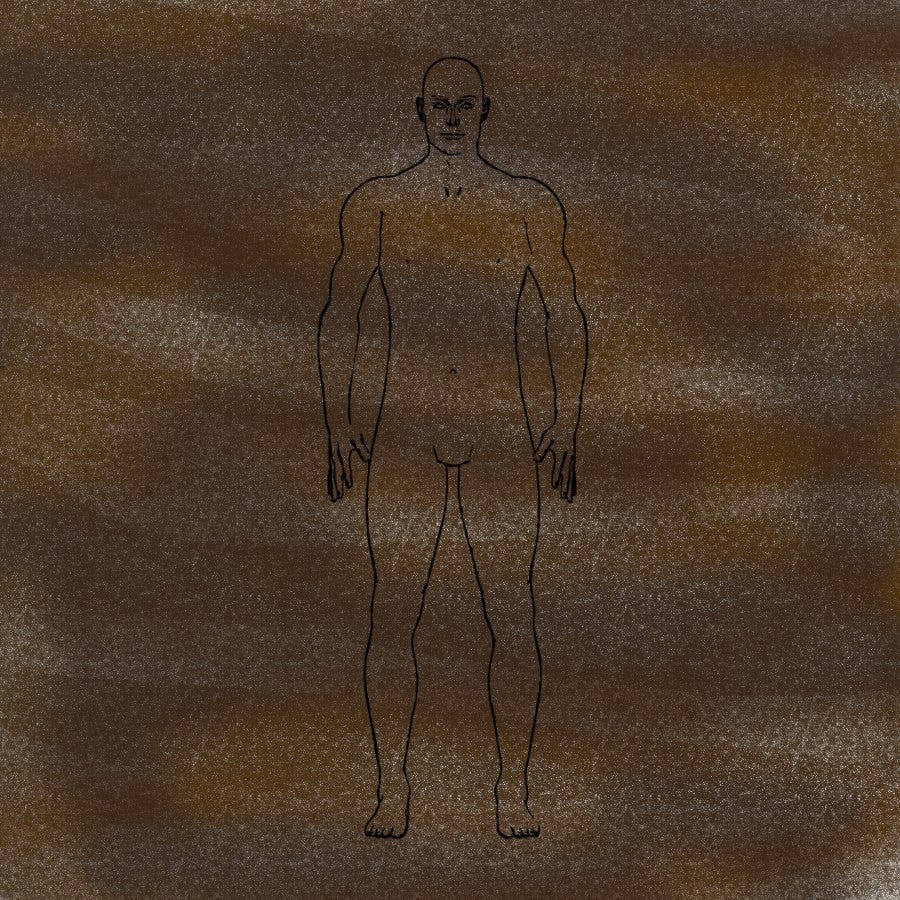
Everywhere, darkness, no light, no hope; cold; like a solid with no mass; can’t move through it, yet it appears as if nothing is there; a transparent, weightless, massless, rigid solid, immovable; dark, dark brown/black tint; no movement; no sound, at least none I can hear through Trap. This is final, permanent.
Nobody is safe (to be around). People everywhere are seriously fucked up, both stupid and dangerous. There is nowhere to go. Nothing I do will change things, even a little.
Unpacking the Relationships of This Trio and More
The first feeling state of this trio expresses the experience of being trapped. But being trapped implies there is also the experience of a trap, does it not?
In existing models of the mind, feeling and emotion, there is no clear place for the felt experience of “other” entities. We shall see more and more as we proceed that psychotopology fieldwork reveals that every significant element of our experience is represented by some sort of virtual material feeling object.
Even here, the experience of Trap carries a subtle implication that the container is not just an imposition but a protection. This is further revealed by the experience of No Way Out, which gives emphasis to the confinement experienced by Trapped, and yet is even more definitively “other” in ways that carry a distinction from the experience of self.
This unpacking of the relationship between our language entities like “trap” and the inner structure of our virtual material feeling objects opens a bigger question. What exactly is the relationship between our language and our feeling structures, especially in the domain of feeling itself?
Further: A Quiet Clue Hidden in Language
Somewhere along the line in my journey of developing this science, I began to see something that really should have stood out for all of us a long time ago. But I had never given it much thought. I realized that our everyday language had been quietly pointing to this virtual materiality all along.
Consider this. We use the word “feel” in a strikingly peculiar way. On the one hand, it refers to the sensations of our body: I feel the cold breeze on my face. I feel a hand on my back. With my fingers, I feel the texture of the rock I’ve picked up on the beach. But on the other hand, it refers to something much more subtle and abstract: I feel anxious. The vibe in this room feels juicy warm and welcoming. I feel like you’re hiding something, and I don’t quite trust what you’re telling me.
These two uses appear to span entirely different domains, one grounded in physiology, the other in emotion, intuition, or interpersonal atmosphere. And yet we use the same word.
Not just in English, either. A little internet research reveals that French, Spanish and Italian use sentir or sentire, German uses fühlen, Estonian tundma. More research shows, similarly, Mandarin, Hindi, Bengali, Swahili, Zulu, Navajo/Diné, and Quechua using the same verb applied to both tactile or somatic sensation and to mood, intuition, or inner knowing. This overlap is so common, so taken for granted, that it almost never occurs to us to question it.
But once I was working with this virtual materiality at the heart of the feeling experience, the question was impossible to ignore: Why would we use the same word for experiences that are, on the surface, so radically different? At first, the easiest assumption might be that it’s just a metaphor, that we “borrowed” the language of touch and applied it to emotion because the latter is harder to describe. OK, sure, but why did we borrow that? What if the reason these different domains share a word is because they share something more fundamental, a kind of materiality that underlies both, one physical, one virtual?
The elegance of this realization strikes deep. I hadn’t set out to answer a linguistic puzzle. I hadn’t even noticed there was one. But as soon as the observation emerges, it brings a sudden coherence to something previously unexamined. It illuminates why we might have always intuitively reached for the word “feel” to describe these disparate kinds of experience. Because on some level, below the threshold of awareness, they are not so different after all.
Moments like this serve as inner confirmation for me. As I described earlier, my approach to science is guided by a certain aesthetic — a felt sense of elegance and coherence that arises when a new insight resolves not only the question at hand but also several others that had lingered unasked. When a discovery reveals not just a piece of truth, but the beautiful structure behind it, I take that as a sign that I’m onto something real.
In this case, the realization that virtual materiality explains the linguistic dual-use of “feel” is one of those moments. A quiet clue, hidden in plain sight, has been waiting in the architecture of language. What had always seemed like a strange coincidence now feels like evidence. It’s not exactly “proof” in the conventional scientific sense, but more like a kind of resonance, an echo across domains signaling that we are seeing into something deeper than any one domain alone.
New Ground: Multiples
Before closing, I also want to call attention to how we have broken new ground here in another way. As you can see in the above examples, when we bring our new powers of observation to investigate actual feeling experience, we very quickly find ourselves in territories of multiples. In the next chapter, we will further examine this phenomenon.