In our exploration so far, we have taken the first steps toward a rigorous science of subjective experience by establishing a working map that defines feeling states as inextricably coupled with their corresponding virtual material properties. We have tested key assumptions, beginning with the idea that a given emotion — such as sadness — might present a stable and universal signature across individuals. That hypothesis was quickly overturned.
We then examined whether individuals, while experiencing emotions in ways different from one another, might at least experience their own emotions in a consistent way over time, only to find that even this was not the case. What emerged instead was an undeniable influence of life context: the same emotion, as named consistently by a single person, could appear in radically different forms depending on the situation in which it arose.
In the most recent chapter, SO-3: A New Hypothesis: The Sadness Signature?, we began to notice even more disruptive anomalies between what we might expect to find in the actual experience of sadness and the wildly diverse virtual material properties and locations of the experiences observed. The latter was most perplexing as we discovered that nearly half of our observations documented the experience of sadness extending beyond the boundary of the body. This stands in contrast with conventional thinking about these things.
The dominant theories of emotion — whether classical, constructivist, neuroscientific, or evolutionary — are grounded in a common premise: that emotions are fundamentally bodily processes. Whether treated as physiological arousal, cognitive appraisals of bodily signals, or the activation of deep brain circuits evolved for survival, each theory assumes that the fundamental substrate of emotional experience is generated by and contained within the body.
This assumption has shaped the way we attempt to understand and work with emotion in psychotherapy, psychiatry, and self-help. Therapies focus on regulating the nervous system, reframing thoughts, or increasing bodily awareness. Medications target neurochemical imbalances, aiming to adjust emotional states through pharmacological intervention. Even in the realm of self-help, people are taught to manage their emotions through breathwork, grounding exercises, or external sensory interventions. Such strategies treat feeling as something to be managed, “regulated” or manipulated rather than trusted and engaged as real in and of themselves.
However, as our fieldwork observations have already demonstrated, the actual experience of feeling frequently defies these models. We have now observed numerous cases in which the virtual material properties of a given feeling state do not confine themselves to the boundaries of the body at all. Instead, they extend outward, forming fields, forces, densities, and structures that exist beyond the skin.
Not only do they extend outside the skin, but they carry experiential properties that simply could not be generated by somatically-based processes as we understand them. Substances like “thick kiwi skin,” “oozing blood tar,” and “empty, silent blackness,” for example, have no correlates in physiological tissue. Quite simply, these findings do not align with any current scientific framework, yet they emerge repeatedly in direct observation.
If we are to take our commitment to first-person science seriously, we must confront this gap between conventional theory and lived reality. Below, I offer further examples of feeling states that challenge the notion of emotion as a strictly bodily phenomenon. As you review these, reflect on what these suggest to you. What might be the origin of such experiences? What might they mean? How are we to make sense of them?
Delightfully Divergent Examples from Louise
The following examples are drawn from a single individual, Louise, whose maps we’ve encountered in our introductory chapter, IS-1: A New Science of Being. These and the following examples are representative of what we find in mapping feeling states across all people. I’m choosing to focus on one person’s maps to highlight just how rich and diverse any one person’s inner experience is when we turn our attention inward in such a way as to actually see what is there.
Fear of Loss
Out in front of me a foot or two, spherical, about a foot or two; a black gas cloud, with a smaller red gas cloud toward the bottom radiating out, infusing the black with color until it fades out; hot at the base and fades to cold at the top and outside; oval shape; not moving; sounds like a hollow echo.
The temperature contrast is important. It’s like a burning out and a dissipating. But the core seems really strong...
This one is remarkable because of its location completely outside the body. Also, it’s like it’s own little environment, with the red/hot infusing upward into the black/cold.
Eternal Self
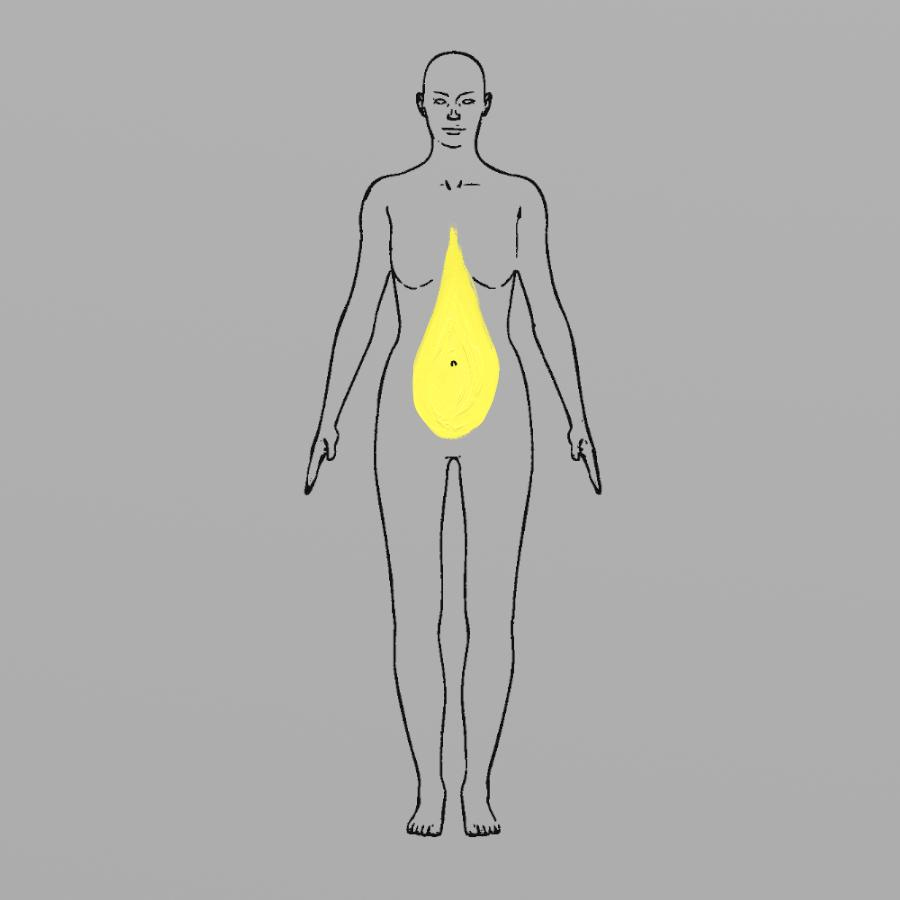
A light; white but all colors; in the base of my core, and the shape is moving up into my chest, shaped like a candle flame; a very steady, gentle pulse, a fluid pulse, moves all through it, speed of a slow heartbeat; no sound; it’s very steady.
There’s this feeling of eternity; it doesn’t diffuse, it’s always in existence, it feels very much there; it’s a consciousness that exists, a consciousness that is me but it feels removed from everything else; it’s this feeling of strength, a place to return to.
This sense of being “always in existence” is very interesting in this one, and the description of it as “a consciousness that is me but feels removed from everything else.”
Lack of Awareness
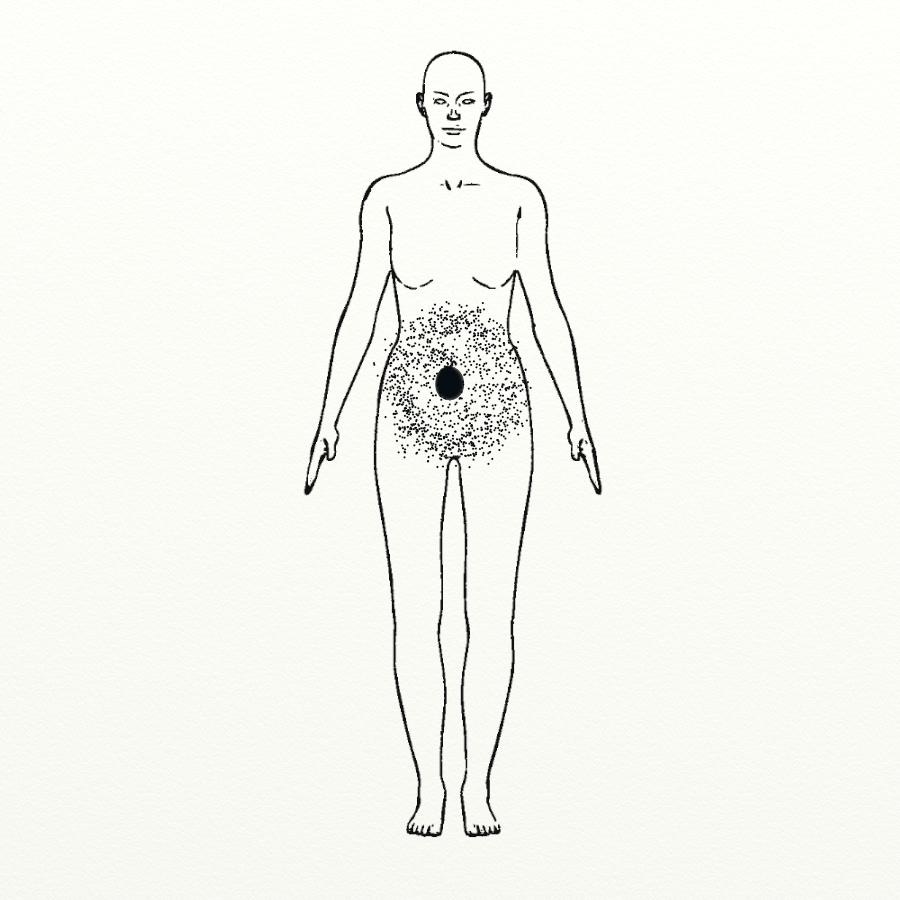
In lower abdomen; a solid sphere, hard, heavy but floating; cold; black; floating motion, very slight rotation; a real silence. Feels like it’s in my core but it also feels like it’s surrounded by this vast, empty space that’s inside of me.
It’s inevitability... there’s no way you can possibly be aware of how it’s going to happen or how you will do it, but you will do it. It can’t not happen, and there’s no way to be prepared. (It = the thing you will say or do that will change everything.)
This one is interesting in that the name seems to point to something that has no emotional content, no “affect” or “valence” of any kind. Yet it reveals itself as being no less anchored in virtual materiality. I’ll have more examples of this in chapters SO-7: The Feeling in Every Conscious Experience and SO-8: The “I” Who Observes.
Another interesting feature, the “vast, empty space that’s inside of me” — how can it be both vast and inside of her??
Point of Total Awareness
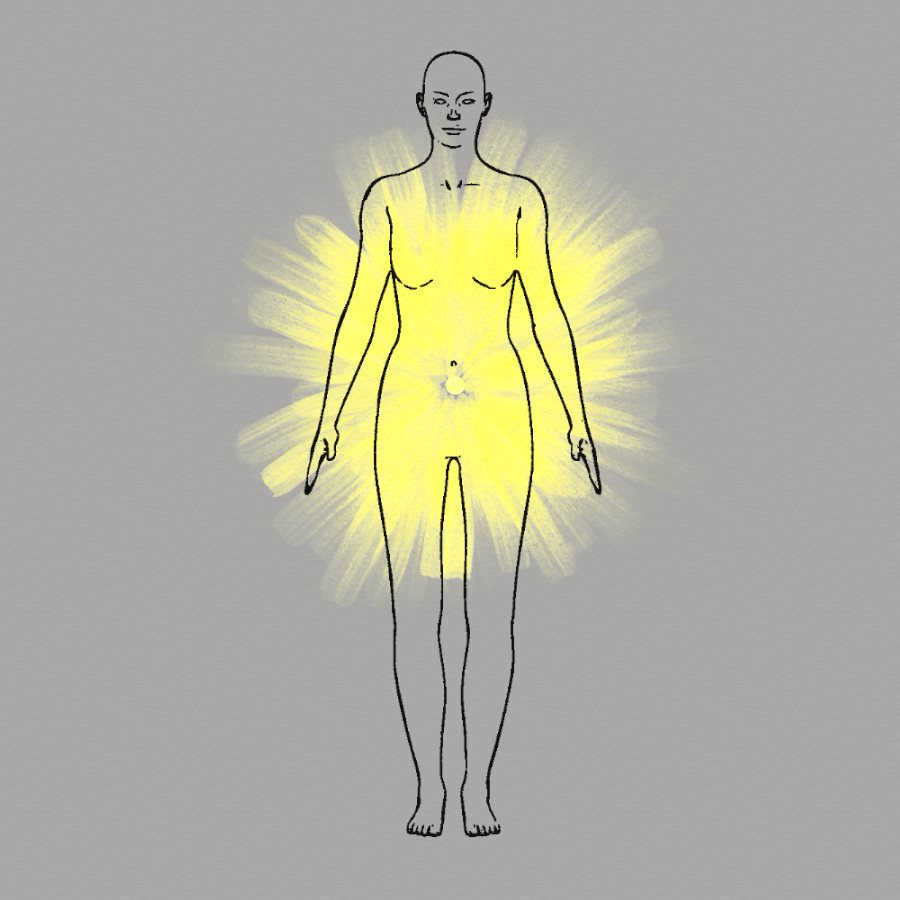
Slightly warmer than body temp; a light; a white-yellow glow; a tiny point that sends light into an area all around me, a sense of the void filled with light, and it’s inside me but so much bigger than me, this feeling of vastness filling the space; no movement; no sound; this feeling of eternity and vastness.
Luminosity comes from a tiny point of awareness, consciousness; the tiny point illuminates everything around it, and it’s just a shedding of light, absence of shadows. You don’t need complete understanding. You just need a point of comprehension to shed light on the whole thing. This feeling of complete understanding being futile, and this point of understanding radiating luminosity and awareness.
Again, so interesting the way the vastness exists in a specific space, and how there is this origin, this source, for the light that is sent “into an area all around me, a sense of the void filled with light.” Also interesting is the way her words describing her experience of this sound so much like certain kinds of enlightened states, yes? These kinds of states can be found inside all of us, and you will see more examples in SO-9: Observing Transcendent Experiences.
Longing
Deep inside, small, extends out of me, kind of elastic, way out there; soft, like many silk threads, close, not woven together; gray-blue, opaque; a gentle tug; a whisper, my voice, from another space/existence, an older me, gentle.
The whisper: “Come forward, and trust.” A very steady pull. I don’t feel forced or like I’m trying to resist. I remember feeling this when I was six or seven, knowing something was possible but not knowing what it was.
This silken elastic band stretching out who-knows-how-far into the distance, and “my voice, from another space/existence, an older me, gentle.” To me, discovering this kind of amazing inner experience in someone is utterly fascinating, and completely unexpected.
Support
Between solid and liquid, very wet, sticky mud; cold, clammy; gray, gray/brown, not real specific, dark, opaque; no movement; up to just above my ankles, past my feet but the depth doesn’t seem to matter (or it goes down infinitely), and it goes out in all directions. I’m able to move through it but very, very slowly. A feeling of real weight about it.
When you can step out of this, you can answer that call. But you can’t right now because you don’t have the strength to lift your feet out of the mud. Without the mud holding my feet, I would fall, without the tools to stand above it. It’s telling me to “Step out, when you’re ready.”
Wow, this sticky, clammy cold mud burying the feet up to the ankles and “going out in all directions.” What do you make of this? Keep in mind that this is not merely a metaphor, not a “mental image” or construct of the imagination, but a distinct, tangible perception of the actual feeling state Louise named Support. She feels the presence of this “support” at her feet and all around her.
Chaotic World
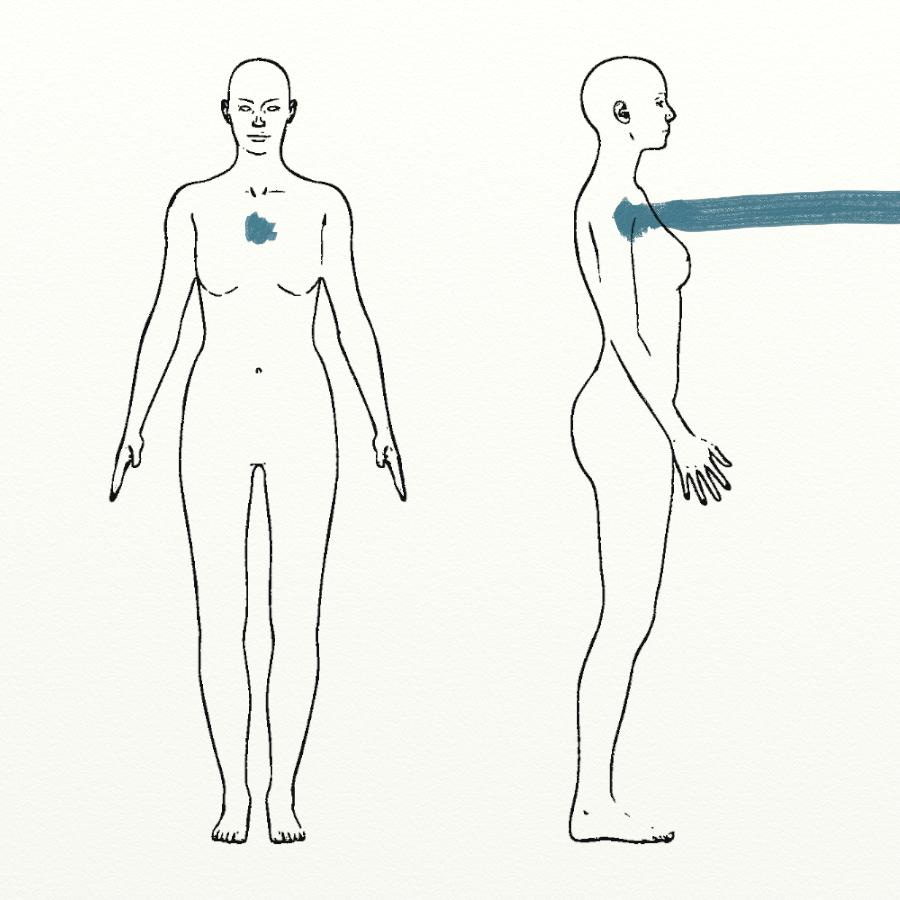
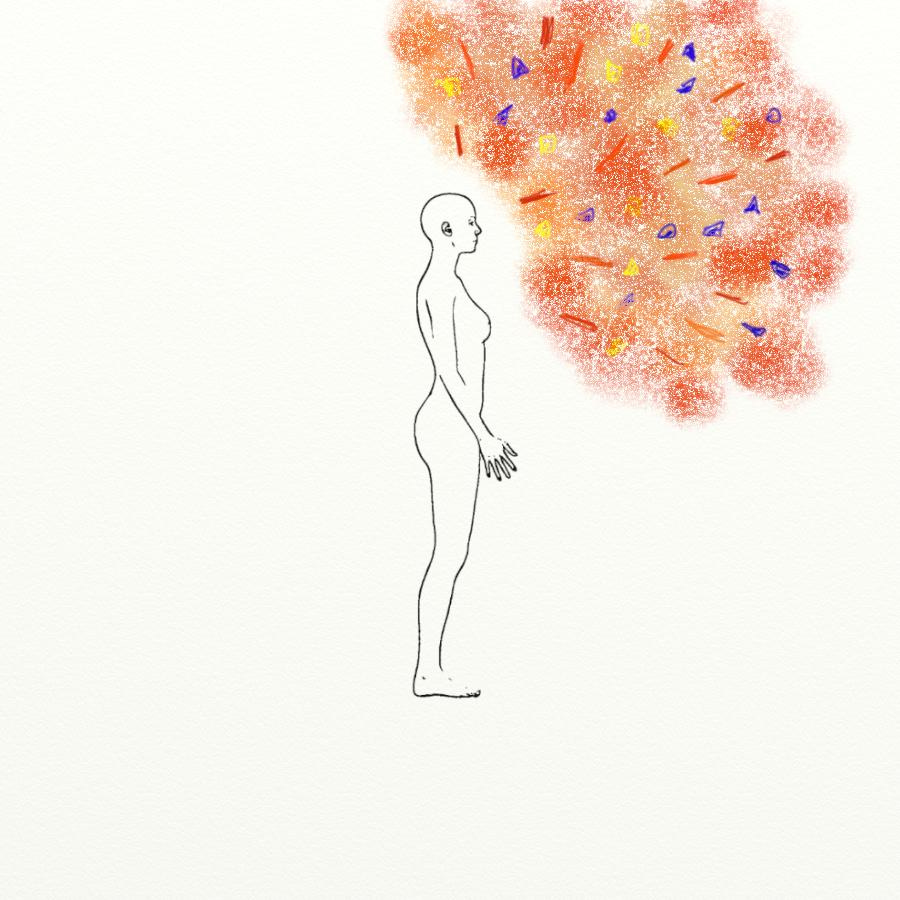
Coming down toward my head at an angle, straight at me. Sharp, jabbing, hard, all different shapes and sizes, squares, spheres, rods, all solid but metal, all different textures. And scattered energy, more like gas, pushing at me, a constant onslaught. All temperatures but more in the warm to hot range. Bright, aggressively primary colors. A faint, continuous clatter of things bumping into each other, moving, random, scattered, voices, nothing very loud but everything from chattering to faint screams and shrieks, laughter (not the good kind). Threatening. Assault. Intrusive. I’m not prepared.
This one sounds downright unpleasant, don’t you think? And it is 100% outside the body, with a chaotic presentation that is very clearly not a somatic sensation of any form.
What Are We to Make of These Observations?
The current status of our science of human experience is extremely limited. We have plenty of data about physiological markers, and we have correlated that data (crudely) to reports of emotional experience. Despite these correlations being very rough and imprecise, the effort itself has bound our current understanding into this very small box: emotion is a somatic phenomenon.
This has disruptive effects on our ongoing awareness. We develop our habits of attention in close interaction with our shared stories about what is real. This shared story results in locking our attention exclusively to the space inside our skin when we seek some information about what we are feeling.
This is like looking for your keys under the street light even though you lost them in the dark alley. You’ll only be able to see the random stones and an empty vape cartridge or candy wrapper where you’re looking. No keys. So you will take on the assumption that the keys must no longer exist.
This is the cost of not having the capacity to observe actual subjective experience, avoiding factoring that limitation honestly into the interpretation of our investigations, and surrendering to the pressure to call it real science instead of overtly acknowledging its tentative basis.
A Few Examples of the Box
I want to share a few quotes from well-known experts who have contributed to this anchoring of psychology in the sensations of the body. These are big names, and they have had a huge influence.
Bessel A. van der Kolk, M.D. (psychiatrist, trauma researcher) — “Trauma victims cannot recover until they become familiar with and befriend the sensations in their bodies. … Individuals who lack emotional awareness are able, with practice, to connect their physical sensations to psychological events. Then they can slowly reconnect with themselves.” — The Body Keeps the Score, p.103.
Peter A. Levine, Ph.D. (psychologist, creator of Somatic Experiencing) — “Trauma is not in the event, but in the nervous system.” — Widely shared by practitioners.
Pat Ogden, Ph.D. (pioneer of somatic psychology, Sensorimotor Psychotherapy founder) — “The body always leads us home… if we can simply learn to trust sensation and stay with it long enough for it to reveal appropriate action, movement, insight, or feeling.” — Widely quoted.
Candace Pert, Ph.D. (neuroscientist, Molecules of Emotion) – “The body is the subconscious mind; information just below the surface, including the skin, is an autobiography of the individual and where life experiences went well and where or how they did not.” — Widespread quote.
Eugene Gendlin, Ph.D. (philosopher and psychologist, developer of Focusing) — “A felt sense is not a mental experience but a physical one… a bodily awareness of a situation or person or event. … A felt sense doesn’t come to you in the form of thoughts or words or other separate units, but as a single (though often puzzling and very complex) bodily feeling.” — Focusing, 1981, pp. 32-33.
Antonio Damasio, Ph.D. (neuroscientist) – “We are not thinking machines that feel; rather, we are feeling machines that think.” — From Descartes’ Error.
Tara Brach, Ph.D. (clinical psychologist and mindfulness teacher) — “Mindful awareness of our bodies is a portal to full aliveness, wisdom and love.” — From Brach’s website, a Dharma talk in 2018.
Each quote above is well-known in its field and widely cited, reflecting a common theme: lasting insight and healing come from turning attention to the body’s sensations and signals, either as the primary focus or as an indispensable component of emotional awareness. Each expert calls for listening to the body to ground and inform our emotional life.
Now, I ask you: When this type of thinking and advice is so dominant, what happens to habits of attention for people seeking access to and understanding of their own inner experience? When these are the prevailing opinions, is it any wonder that our awareness of feelingmind has faded to the background? At what cost? For each of the examples I’ve provided in this chapter for feeling states that extended beyond the body, how difficult would it have been for these individuals to gain awareness of the actual presence of those states if they were immersed primarily in this somatically-dominated thinking?
At the same time, we really cannot fault these experts for this oversight. There has simply been no solid science establishing reliable maps for the terrain of the inner, subjective experience of feeling. These people are doing an honorable job of trying to connect our materialist science with the actual experience of being. But the task is simply impossible to achieve at this point if we must rely on our current sciences of consciousness and psychology. The discovery of the virtual material properties of feeling experience opens a new doorway to expand and strengthen our understanding, and it gives us much more agency in navigating this previously opaque territory.
You offer a provocative perspective Joe, and it’s one that I think is worthy of deep reflection and personal exploration!
My own sense of being is that my physical body is distinct yet completely interwoven within what I call my (subtle) emotional body…and the same is true of my mental body. It’s my sense that the physical is like the “final link” in the chain. Perceiving the “Feelingmind” as you call it offers an opportunity to deeply be with, listen to, and relate with myriad subtle energetics in our vast living system before they take up residence in the most dense aspect of that system—the physical body. It also allows us to relate with these energies at their points of origin, so to speak, after they have manifested in the physical body. Does what I’m describing here map to your own understanding/experience?




You offer a provocative perspective Joe, and it’s one that I think is worthy of deep reflection and personal exploration!
My own sense of being is that my physical body is distinct yet completely interwoven within what I call my (subtle) emotional body…and the same is true of my mental body. It’s my sense that the physical is like the “final link” in the chain. Perceiving the “Feelingmind” as you call it offers an opportunity to deeply be with, listen to, and relate with myriad subtle energetics in our vast living system before they take up residence in the most dense aspect of that system—the physical body. It also allows us to relate with these energies at their points of origin, so to speak, after they have manifested in the physical body. Does what I’m describing here map to your own understanding/experience?