

Previous chapter:

There is a lot you can do with this if you work supporting others through therapy or coaching. Fieldwork mapping addresses some of the challenges in this work in a way that is maximally honoring of the client’s inner experience. In turning toward fieldwork, you support the client in finding their own inner compass, making sense of the challenges of their life using their own wisdom, strengthening their capacity for witness awareness, and exercising more freedom of choice in how they respond to any situation. Not only that, but you can use fieldwork mapping to support yourself in maintaining your own solid base as you lean in to support others. Let’s take a look at a few of the ways this can work for you.
Adding a Stabilizing Third Point of Contact
Typically in therapy and coaching, we rely either on the cognitive dimension or on somatic sensation to navigate the tricky terrain of the inner world. Bringing fieldwork into the process sets up a third, stabilizing point of contact, neither somatic nor cognitive, through directly and intentionally accessing the virtual materiality of the feeling experience.
This can be incredibly powerful. For example, quite often a client has run through the story of why they have a particular challenge, and even why they should be able to get beyond it. But without feeling into the heart of it to notice other discrete feeling objects reinforcing the pattern, they can remain trapped, going around in circles without anything actually changing.
Similarly, someone can become very skilled at turning their attention to the micro-sensations of their body related to a particular difficulty. But the relationship between soma and mind, between body and behavior, is not two-dimensional. It also travels through the medium of feeling, and without bringing feeling into the mix, they can become stuck bouncing back and forth between the thought patterns and the body activations.
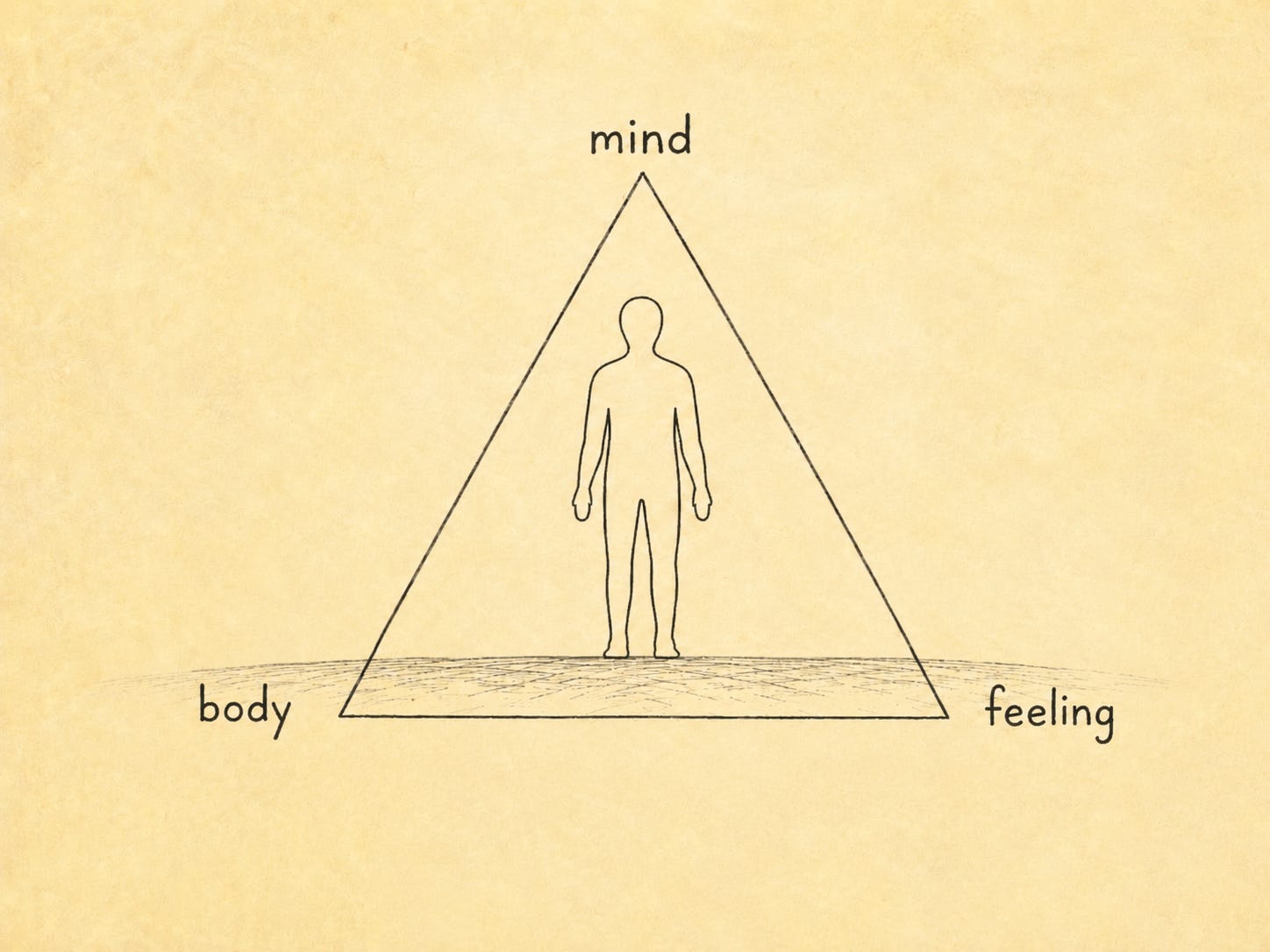
Another time the two-point focus on mind and body can get in the way is when someone becomes overwhelmed by physical reactions when they are accessing difficult memories, for example. Training this person in accessing their strong witness presence before entering this kind of territory is one way through, and simply bringing awareness to the more subtle dimension of feeling itself can relieve the overpowering effects of the body’s stored reactivity.
Finally, many times what interrupts solid progress in therapy and coaching is some form of resistance, where something is being protected that is very difficult to access through talk alone. By turning to fieldwork, we get to go in the back door, around the deflections of story, and to discover more directly what lies hidden behind those defenses.
Supporting Yourself in Supporting Others
Of course, resistance can also be challenging for the therapist or coach. How many times have you run up against your own judgment, frustration, or over-eager attempts to please when someone keeps detouring around the work that needs to be done? This can be a great opportunity for you to turn the lens of fieldwork toward your own inner terrain.
You might realize that your frustration was actually a familiar pattern fed by an underlying helplessness. Or that your desire to push them came from a place that fears failure. Giving form to your own countertransference lets you work with it compassionately. It helps you stay curious, brings you back to center.
When you’re grounded in your own feeling experience, you can hold the client’s experience without collapsing into it or floating above it. You become the third leg in their process — not just mentally present or somatically attuned, but field-aware, capable of tracking and inviting what’s actually showing up.
Next chapter:

Volume 1, Table of Contents:

Get your printed (or PDF/ebook) copy:
