The most important factor supporting a workable understanding of psychotopology is direct experience. You’ve got to map and move a few states at least, and preferably more than a few. I’m going to assume that you have some of that experience by now, because otherwise what I am about to discuss may not mean a lot to you. But I’m hoping that even if you don’t have experience yet, maybe you can kind of feel into what the following is pointing to, whether through your imagination or other related experience. Either way, let me know how it lands for you.
Where Are We, Anyway?
Through the course of Volume 1 and into this section on the steps for moving states, we have laid out a method for working with an uncommon dimension of feeling experience. To simplify, we turn our attention inward to the actual experience of feeling, inquire into its tangible, virtual material properties, and directly interact with those properties in order to bring about transformation of the feeling itself. In doing so, the related aspects of our experience including perception, belief, thought and behavior change in a way congruent with the change in feeling.
What’s up with that? I mean, think about it. Compare this method to any of the various therapies dominant in psychotherapy and/or psychiatry today. How do they work? What are they based on? The vast majority of approaches available to us look something like this:
First assumption: Feeling bad has a cause, and we know what that cause is. This could be anything from childhood trauma to wacky neurotransmitters to funky beliefs.
First action: Identify the specific cause for the specific instance of feeling bad.
Second assumption: Changing the underlying cause is necessary to change the bad feeling.
Second action: Change the cause.
In all of the dominant approaches, feeling bad is treated as a secondary characteristic, a symptom of something else that’s going on. And the approach to facilitating an outcome that includes feeling good involves interacting with that cause in a way that alters its effects.
(It’s interesting that the science of psychology, whether cognitive, neuroscience, or otherwise, is similarly structured. There is a theory hypothesizing some specific cause of the bad feeling, and research is done to demonstrate a correlation between the bad feeling and the hypothesized cause. Finding a correlation is taken as confirmation of the theory of cause.)
What are we doing here instead? Here’s where experience is important. From the outside, it might look like we’ve identified these virtual material properties as the cause of feeling bad, and we interact with those to change the feeling to good. But from the inside, something else is going on.
From the inside, the mapping experience is very tangibly that of observing — of seeing something that is actually there, that is actually real, that actually has these properties of substance and temperature and the rest. When we “observe” our feeling state through the lens of virtual materiality, we have the experience of coming home, or of seeing something for the first time. It’s like this is what the actual experience of feeling is actually made of, these properties.
And then, because the feeling is actually made of these properties, we get to interact with them in order to directly and instantly change the actual experience of the feeling. Yes, I said directly. Instantly. WTF! Seriously?
I still remember very clearly the very first time I ran my experiment back in Montana in 1994. Changing my depression to cheerfulness in half a minute by reversing the downward pull and doing absolutely nothing else just freaking blew my mind. It wasn’t supposed to work that way, and it’s not like I knew nothing about emotions and therapy and all that. I knew a lot. And again, it was not supposed to work that way.
So this was where I started. And you’re not exactly starting in the same place because I’ve added some sophistication to the method. But it’s not that different, either. The dominant approach to “healing” (I put that in quotes for a reason) involves identifying the cause for feeling bad, and intervening in the cause in order to feel good. The feeling is just a by-product, a symptom, an epiphenomenon. You’ve got to get to the underlying cause if you want things to improve.
But here we are making no effort to identify any sort of cause. We are treating the feeling experience as a thing in and of itself. As the primary “thing,” actually, more fundamental than all the other stuff that gets treated as causes. Or at least, that’s how it starts to look when you really dig in.
Let’s take a look from another angle. Science gets started with observation, but it doesn’t really get underway until you can go farther than just observing. Why? When you’re observing some phenomenon, you really have no idea what it is you’re looking at until you gain the opportunity to interact with the “it.” I mean, if we had stopped with mapping, that raises intriguing possibilities, but that’s all we have is intrigue. We can’t really experiment to find out what the heck it is we’re observing, this something that seems to be able to occupy space extending outside the body, that seems to show up in multiple coexisting instances, that sort of thing. What is it? We can speculate, but our speculations remain just that without some way to interact.
This method I’ve just laid out for you here, the ability to actually interact with those virtual material properties and have the actual feeling experience change on the spot, this is a big deal. I mean, a big deal. We get to push and pull. We get to poke and prod. We get to hypothesize and test our hypotheses.
Let me be clear, though. The methodology I’ve laid out for you so far goes farther than that first step. It does take on some of the discoveries I’ve made in pursuing a rigorous investigation of what it is we’re observing. But I felt it was important to do that so that if your motivation is not strictly science, you can actually get started using this method to good effect. What I’ve given you so far can be applied to all kinds of challenges, and I invite you to come up with your own explorations. No need to wait for the entire science presentation or the advanced skills. You have enough to provide some awesome results already with what I’ve given you. Go for it.
In the meantime, I will be taking you into the next section on the science of psychotopology. We will start with the basics, with no assumptions at all, and just start applying our bare-bones tools for mapping and moving, and see what we can discover.
As we start, we are going to encourage simple curiosity. One of the first hypotheses we will begin with involves the nature of feeling. We will assume feeling is a single, contiguous field of possible feeling states, and that using our ability to change the properties of a feeling state, we will be able to change any feeling into any other feeling at will.
That makes sense from a certain perspective about feeling, yes? For example, interoception is supposed to be a kind of summary of what’s going on in the body, and our brain comes in to interpret that signal to give us a specific feeling state, and then relates it to other aspects of our experience in order to make sense of it and decide how to respond to it. We’ll start there to see how that holds up when we’re able to actually observe and interact with something that seems to be the substrate out of which feeling is made.
And What Do We Have? Not Have?
So at this point, then, what do we have? And where are we going?
What we have is a method for bringing the nebulous experience of feeling into sharp, tangible relief. That’s the mapping phase. And we have a complementary method of interacting with that tangible experience to shift it in any direction, feeling better or feeling worse. That’s the moving phase. Putting these two together gives us the opportunity for the following:
Explore feeling experience with more rigor than was previously possible.
Work with challenging feeling states to shift them into more resourceful states.
Apply our tools to the investigation of feeling as a phenomenon, holding open the questions of what it actually is and how it actually works.
Wow. That’s a hell of an opportunity.
Now, what do we not have yet? Again, to make it very clear: we have no idea what is the “it” that we’re working with. What exactly is this experience of feeling, anyway? We know nothing about it in this new framing that brings in virtual material properties as the actual medium through which the experience of feeling shows up. And we can’t even be completely sure that’s what’s really going on, either. It seems that way, but we really, really need to test, as best we can, this first impression of what things “seem like,” to start making sense of it all.
We need to carry this humility with us moving forward.I want to advocate for one specific attitude above all as we move forward. “We do not know.” This is the most important frame for us to hold. We really don’t know what this territory is that we’ve been given access to. We don’t know what to expect, so it will be best to park all of our expectations at the door before entering into the spirit of inquiry. Science does best when curiosity drives the bus.
After going into the science, we’ll come back to the bigger picture, where we can see how the topology of our inner world that reveals itself through our investigations can provide reliable guidance about how to proceed in our mapping and moving. And we will also get into the weeds with more advanced fieldwork skills and strategies.
Are you ready? All right then. Let’s get this show on the road.
Looking Ahead
This completes the section on the basic fieldwork moving method. The next section in the book will bring us deeply into the science.
(This next section on the science is the crux of psychotopology. I may be working on that for a while, and in the meantime sharing stories and examples from the history of this work’s development. Soon, but not too soon. I want to make sure I’m delivering you the best I’ve got.)
Another Example of What You Have to Look Forward To
To support your anticipation for what is to come in this adventure, I am offering before/after examples of feeling states my client Ruby gave me permission to share.
Accessing a Safe Space from Which to Map: The Observer Self
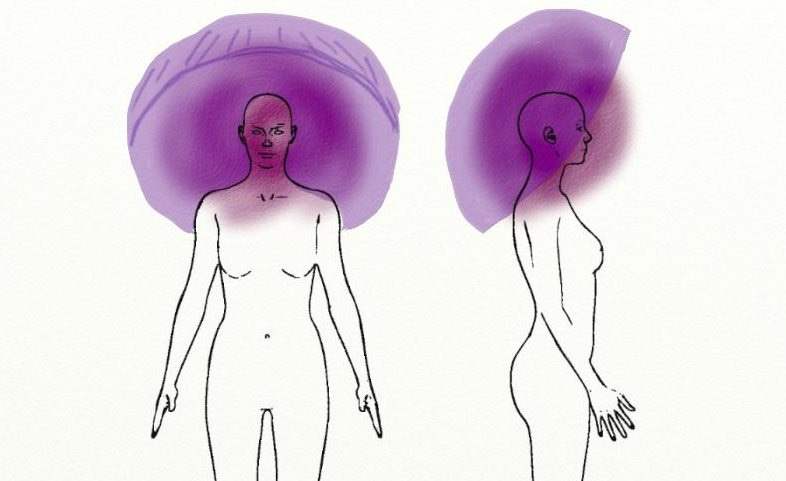
Along the way in mapping and moving a dozen states with Ruby, we chose to map the experience of the observer self from which Ruby was doing her mapping. This gave her much more explicit access to this powerfully neutral witness position, and it made it easier to go into some of the more challenging states she was working with. Here’s what that looked like.
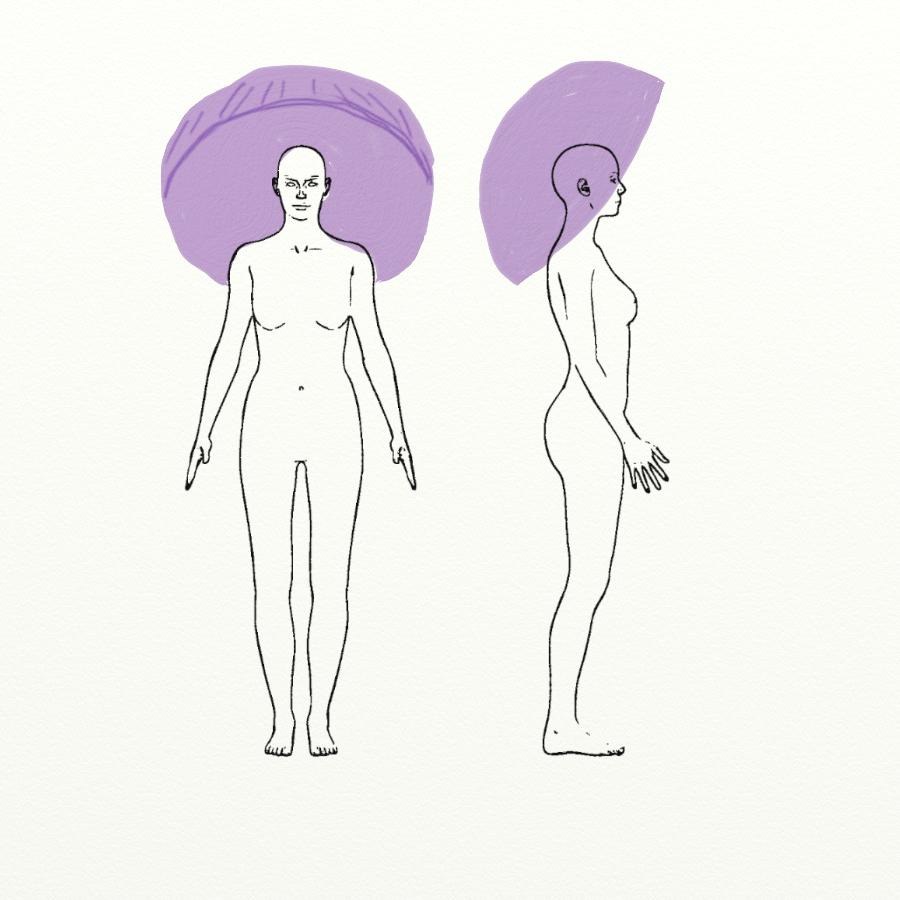
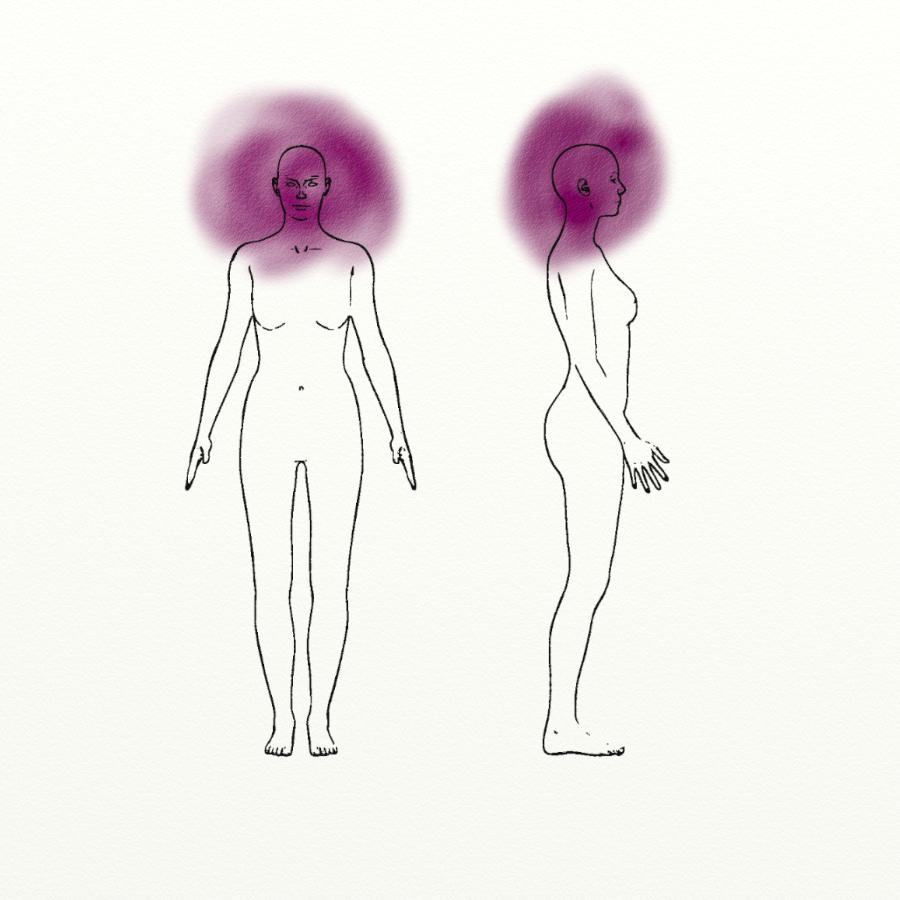
The Observer
Sort of above me, above and behind my head, all the way down to my mid- back; sort of an umbrella shape. It’s always there, but you just don’t notice that it’s there. Curve of umbrella is kind of with the curve of the body.
The gas that comes up to the surface of the umbrella, and goes all the way into my head and eyes and face. A gas, with the surface of it is more tangible, smooth, can touch it, very thin surface. Wider than me, a little bit higher. Warm. Purple. Gas is transparent. Surface is opaque, same purple. Moves with me, with the flow of the air or... No sound/voice.
Two parts: umbrella and gas. Gas because it’s barely there, have to pay attention to it to notice it. Umbrella = more of a light blue. More of a hovering presence. Gas = a little more blue.
The two feel intertwined. The gas is sort of like this energy that, if I’m aware of it I can feel it in my face. Whereas, I can’t really feel the umbrella but I know it’s there, more of an energetic feeling than something that’s in my body.
The umbrella is The Watcher. The gas is Still Presence. The Watcher is the one that is standing back and noticing everything with sort of a detached viewpoint. The Still Presence is what comes up when I step away enough to notice everything in that detached way. So it’s like The Watcher happens and it brings the Still Presence in too.
They’re each feelings of the Observer. They’re both deeper than all the rest of me.
So here we have an example of what appeared to be a single part, the Observer, but which was composed of two distinct parts, The Watcher and Still Presence, each with its own function, that operated as a whole. Here are some of Ruby’s reflection on her experience of this Observer.
My picture of this is like a zen monk, very non-judgmental. Sees all these things happening in my life, all these feelings, and it’s not negatively affected by any of it. If it could talk to me, it would say that who I really am is beyond all of that stuff.
Feels very humbling.
It’s funny, when I thought about Self Doubt, it made me so sad because it was such a terrible thing. But when I think of the Observer, it’s the opposite effect. I feel in awe that I have such an elevated part of myself.
This too shall pass. Everything’s passing, and it’s all divine, all part of the whole thing.
The key would be to be able to connect to The Observer while I’m feeling the Should and Dread...
In this last note, Ruby notices how having access to The Observer would make it easier to allow herself to feel the Should and Dread. We used this in her next session to more easily go into the Dread and move it.
We will be looking more closely at techniques like this in the section on advanced skills, to be presented after we’ve established the topology revealed by our disciplined investigation of the structure and dynamics of thousands of states such as these.
Next post/chapter in this series on fieldwork moving: (coming)
I like this piece Joe, and I’ve really been enjoying the writing here lately. This piece also helped me to clarify one of my big questions about this work: If it is true (and I think it is) that “we really don’t know what this territory is that we’ve been given access to,” then how can we “change any feeling into any other feeling at will”?
I’m not presenting this as “this is something you (Joe) have not accounted for,” but as “this is something I (Ian) struggle to wrap my head around.”
I very much feel that I don’t know the territory that this work gives access to. And so I am very wary to go about making changes to it. I’ve also found that simply mapping something often causes changes on it own. One of my own points of curiosity is: what changes, if any, should I be making, if the system has a way of changing on it own? It personally feels better to me to facilitate system change by shining my light of awareness on to the different feeing states to see what they do, rather then to come in with any intention to move them myself, though also, I remember very much wanting to move things when I first started this work.
I’m not sure I have any answers, or even any clear questions, but I am realizing my uncertainty and caution more and more clearly. I don’t want to be reckless, but I also don’t want to be over cautious.
I think maybe there is a middle way I can figure out between the two. Maybe that’s what you’ve been pointing to all along and I’m just starting to feel it out for myself…




I like this piece Joe, and I’ve really been enjoying the writing here lately. This piece also helped me to clarify one of my big questions about this work: If it is true (and I think it is) that “we really don’t know what this territory is that we’ve been given access to,” then how can we “change any feeling into any other feeling at will”?
I’m not presenting this as “this is something you (Joe) have not accounted for,” but as “this is something I (Ian) struggle to wrap my head around.”
I very much feel that I don’t know the territory that this work gives access to. And so I am very wary to go about making changes to it. I’ve also found that simply mapping something often causes changes on it own. One of my own points of curiosity is: what changes, if any, should I be making, if the system has a way of changing on it own? It personally feels better to me to facilitate system change by shining my light of awareness on to the different feeing states to see what they do, rather then to come in with any intention to move them myself, though also, I remember very much wanting to move things when I first started this work.
I’m not sure I have any answers, or even any clear questions, but I am realizing my uncertainty and caution more and more clearly. I don’t want to be reckless, but I also don’t want to be over cautious.
I think maybe there is a middle way I can figure out between the two. Maybe that’s what you’ve been pointing to all along and I’m just starting to feel it out for myself…